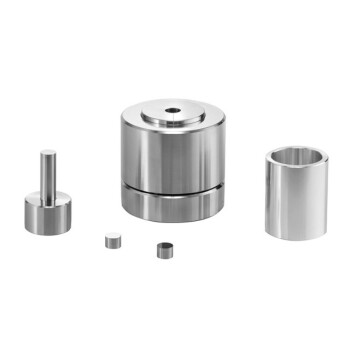
High-strength zirconia molds are the preferred apparatus for compression testing because they combine extreme mechanical hardness with chemical inertness. They allow researchers to subject solid-state electrolyte powders to compressive stresses as high as 1000 MPa without deforming the mold or contaminating sensitive samples.
Core Takeaway The selection of zirconia is driven by the requirement to apply gigapascal-level pressure to densify powders while preventing chemical reactions. This ensures that the resulting data reflects the intrinsic properties of the electrolyte, free from geometric errors or contamination.
The Necessity of Extreme Pressure Capability
Withstanding Gigapascal Stresses
To properly test the mechanical limits of solid-state electrolytes, you often need to apply immense force. High-strength zirconia molds are distinct because they can withstand compressive stresses up to 1000 MPa.
Preventing Permanent Deformation
Standard molds may warp or yield under high loads, rendering the test invalid. Zirconia retains its shape without permanent deformation, ensuring that the force applied is directed entirely into compressing the powder, rather than expanding the mold.
Ensuring Chemical Fidelity
Inertness Against Reactive Materials
Many solid-state electrolytes, particularly sulfide-based samples, are highly reactive. Metal molds can introduce impurities through chemical reactions during compression.
Eliminating Contamination Risks
Zirconia is chemically inert. Using it ensures that the sample remains pure during room-temperature compression. This is critical for maintaining the accuracy of subsequent mechanical property tests and impedance analysis.
Understanding the Trade-offs: Zirconia vs. Polymer Alternatives
The Pressure Threshold
While other materials like Polyether Ether Ketone (PEEK) offer excellent chemical stability and low friction for easy demolding, they are limited to lower pressure ranges. PEEK is generally suitable for stresses of "several hundred" megapascals.
When Zirconia is Essential
If your testing protocol requires pressures approaching or exceeding 1000 MPa to achieve full densification, polymer molds will likely fail or deform. Zirconia is the necessary choice for this high-stress regime to ensure the disc is dense and uniform.
Making the Right Choice for Your Goal
When selecting a mold material for solid-state electrolyte characterization, consider the specific requirements of your pressure protocol.
- If your primary focus is maximizing density: Choose zirconia to safely apply pressures up to 1000 MPa without risking mold failure.
- If your primary focus is chemical purity: Choose zirconia (or PEEK) to prevent contamination, specifically when working with reactive sulfide electrolytes.
- If your primary focus is ease of demolding at lower pressures: Consider PEEK for its low friction coefficient and smooth release properties, provided the pressure remains within the hundreds of MPa range.
Select the mold that withstands your required pressure while preserving the chemical integrity of your sample.
Summary Table:
| Feature | High-Strength Zirconia | PEEK (Polymer) |
|---|---|---|
| Max Pressure | Up to 1000 MPa | Several hundred MPa |
| Deformation | Negligible (Rigid) | Higher risk under stress |
| Chemical Inertness | Excellent (Inert) | High |
| Primary Use Case | High-density pelletizing | Low-pressure demolding |
| Contamination Risk | Zero metal contamination | Zero metal contamination |
Optimize Your Battery Research with KINTEK Precision Solutions
Achieving the highest density in solid-state electrolytes requires hardware that won't fail under pressure. KINTEK specializes in comprehensive laboratory pressing solutions, offering a versatile range of manual, automatic, heated, and glovebox-compatible models, as well as cold and warm isostatic presses.
Whether you are testing reactive sulfide-based powders or developing next-generation solid-state batteries, our high-strength zirconia molds and pressing equipment ensure your data is accurate and contamination-free.
Ready to elevate your lab's performance? Contact our experts today to find the perfect pressing solution for your research needs.
References
- Seung-Yong Lee, Young Whan Cho. Characterization of densification behavior and mechanical properties of solid electrolyte powders for all solid-state batteries. DOI: 10.1039/d4ta08604j
This article is also based on technical information from Kintek Solution Knowledge Base .
Related Products
- Lab Anti-Cracking Press Mold
- Lab Isostatic Pressing Molds for Isostatic Molding
- Square Lab Press Mold for Laboratory Use
- Lab Cylindrical Press Mold for Laboratory Use
- Assemble Square Lab Press Mold for Laboratory Use
People Also Ask
- What is the purpose of incorporating cartridge heaters into a lab press mold for MLCC block compression? Optimize Results
- What is the function of a pressing tool in thermoplastic panels? Master Precision Shaping & Fusion Bonding
- Why is precise cooling management of the lab press mold necessary? Protect Core Integrity in Thermoforming
- What are the requirements for pressing molds when using SSCG? Key Materials for Complex Single Crystal Production
- How do industrial-grade pressure molds affect zinc metal pouch cells? Maximize Energy Density & Performance