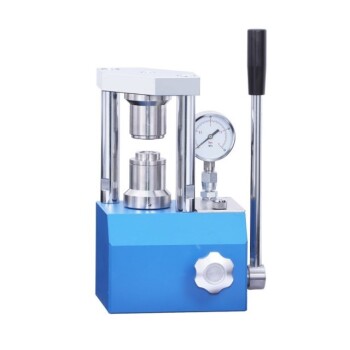
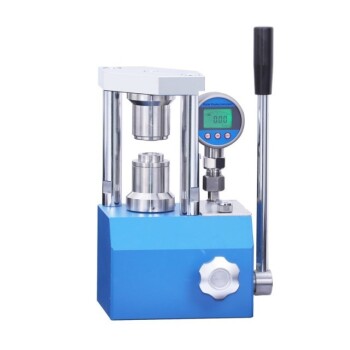
High thermal conductivity aluminum crucibles and precision sealing presses are the bedrock of accurate Differential Scanning Calorimetry (DSC) for flour. The aluminum material guarantees immediate and uniform heat transfer between the micro-sample and the sensor, ensuring the instrument captures real-time thermal events. Simultaneously, the precision press creates a hermetic seal to retain moisture, which is strictly necessary for obtaining valid gelatinization temperature and enthalpy data.
To measure flour gelatinization accurately, you must prevent moisture loss while ensuring rapid heat equilibrium. The combination of highly conductive aluminum and a mechanically sealed environment enables the capture of precise thermal transition data without interference from evaporation.
The Physics of Heat Transfer in DSC
Ensuring Immediate Response
In DSC testing, the lag between the furnace temperature and the sample temperature must be minimized. High thermal conductivity aluminum is utilized to ensure that heat flows immediately from the sensor to the micro-sample.
This rapid transfer allows the instrument to detect subtle thermal transitions the moment they occur.
Achieving Sample Uniformity
Flour samples in DSC are typically micro-samples, making them highly sensitive to temperature gradients.
The aluminum crucible distributes heat evenly across the entire sample volume. This ensures uniform heat flow, preventing parts of the sample from transitioning at different times, which would smear the resulting data peaks.
The Role of Moisture Integrity
The Necessity of Hermetic Sealing
Starch gelatinization—the primary thermal event measured in flour—is a process that relies heavily on the presence of water.
To maintain this environment, a precision laboratory press is required to cold-weld the crucible lid to the pan. This creates a hermetic seal that is capable of withstanding increasing internal pressure as the sample heats up.
Preventing Volatilization
If moisture escapes during the heating process, the fundamental chemistry of the sample changes.
The hermetic seal prevents moisture loss, ensuring that the energy measured (enthalpy) reflects the gelatinization of the starch, not the evaporation of water. This is the only way to obtain accurate gelatinization temperatures and enthalpy values.
Understanding the Risks of Improper Preparation
The Impact of Poor Sealing
If a precision press is not used, the crucible may fail to hold a tight seal.
This leads to moisture leakage, which introduces endothermic evaporation effects that can mask or distort the actual gelatinization data.
Thermal Lag Consequences
Using crucibles with lower thermal conductivity than aluminum can introduce a buffer between the sensor and the sample.
This results in a delay in data recording, causing transition temperatures to appear higher than they actually are.
Ensuring Data Validity in Flour Analysis
To generate reliable thermal transition data, you must select the correct hardware for the specific physical properties of flour.
- If your primary focus is Signal Accuracy: Utilize high thermal conductivity aluminum crucibles to eliminate thermal lag and ensure the sensor reads the true sample temperature.
- If your primary focus is Gelatinization Data: Employ a precision laboratory press to create a hermetic seal that prevents moisture loss and ensures the phase transition occurs under stable conditions.
Proper sample encapsulation is not merely a procedural step; it is the primary control for data integrity in thermal analysis.
Summary Table:
| Component | Key Feature | Impact on Flour DSC Analysis |
|---|---|---|
| Aluminum Crucible | High Thermal Conductivity | Eliminates thermal lag; ensures uniform heat distribution and real-time response. |
| Crucible Design | Micro-sample Volume | Optimized for subtle thermal transitions and uniform sample heating. |
| Precision Press | Hermetic Sealing | Prevents moisture loss; essential for accurate gelatinization enthalpy and temperature. |
| Cold-Weld Seal | Pressure Resistance | Withstands internal pressure during heating to avoid endothermic evaporation interference. |
Elevate Your Food Science Research with KINTEK Precision
Precise thermal analysis of flour and starch requires perfect sample encapsulation. KINTEK specializes in comprehensive laboratory pressing solutions, offering manual and automatic models designed for high-integrity hermetic sealing. Whether you are performing DSC for battery research or food chemistry, our laboratory presses ensure your crucibles withstand pressure and maintain moisture integrity.
Unlock superior data accuracy today:
- Comprehensive Range: Manual, automatic, heated, and multifunctional models.
- Specialized Solutions: Glovebox-compatible and isostatic presses available.
- Expert Support: Ensure your lab is equipped for consistent, repeatable results.
Contact KINTEK for Your Lab Pressing Solutions
References
- Masala Mudau, Oluwafemi Ayodeji Adebo. Effect of traditional and novel processing technologies on the thermo-pasting, microstructural, nutritional, and antioxidant properties of finger millet and Bambara groundnut flours. DOI: 10.1093/ijfood/vvae037
This article is also based on technical information from Kintek Solution Knowledge Base .
Related Products
- Lab Button Battery Tablet Press Sealing Mold
- Button Battery Sealing Press Machine for Lab
- Lab Polygon Press Mold
- Lab Anti-Cracking Press Mold
- Manual Cold Isostatic Pressing CIP Machine Pellet Press
People Also Ask
- How does a sealed battery mold facilitate the assembly and testing of asymmetric supercapacitors using VO2?
- Why use standardized CR2032 components & high-precision presses? Ensure reliability in lithium metal battery research.
- Why is a laboratory battery sealing press essential for desolvation energy testing? Ensure Reliable Kinetic Data
- What is the function of specialized battery molds and sealing consumables? Optimize Your In-situ XRD Testing Today
- What role does a laboratory sealing press play in thermal analysis of solid dispersion films? Ensure Data Integrity