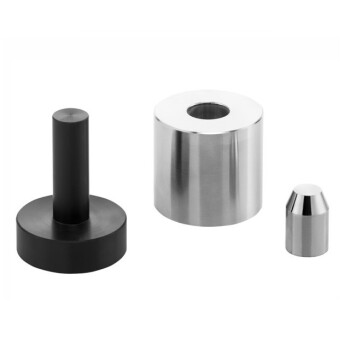
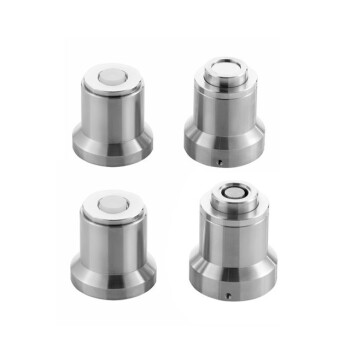
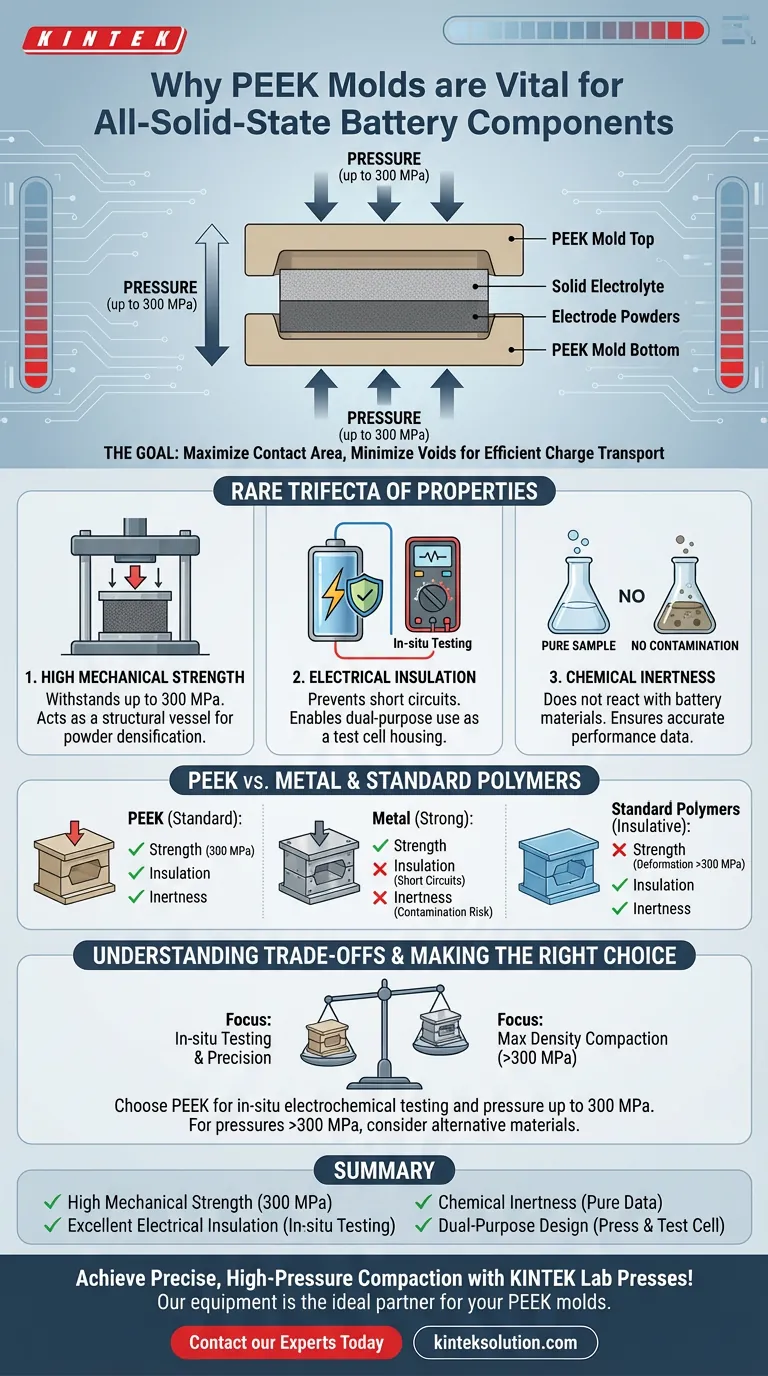
PEEK (Polyetheretherketone) is widely utilized for press-forming all-solid-state battery components because it offers a rare trifecta of properties: high mechanical strength, electrical insulation, and chemical inertness. This unique combination allows researchers to apply the immense pressure required to densify battery powders while simultaneously using the mold as an insulating housing for live electrochemical testing.
Achieving high performance in solid-state batteries requires eliminating voids between particles to minimize resistance. PEEK molds enable the application of pressures up to 300 MPa to achieve this density without contaminating the sample or causing electrical short circuits during analysis.
The Engineering Challenge: Density vs. Integrity
To understand why PEEK is chosen, you must first understand the physical requirements of solid-state battery fabrication. The goal is to maximize the contact area between solid particles.
Minimizing Voids
Solid-state electrolytes and electrodes often start as powders. To function effectively, these powders must be compacted to reduce voids.
Lowering Resistance
High-pressure compaction significantly lowers the grain boundary resistance within the electrolyte. It also reduces the interfacial resistance between the electrolyte and the electrodes.
Critical Charge Transport
By minimizing these resistances, the battery achieves efficient charge transport. Without high-pressure formation, the internal resistance would be too high for the battery to perform effectively.
Why PEEK Outperforms Metal and Standard Polymers
While metal molds offer strength and standard plastics offer insulation, PEEK is the standard because it provides both without compromising the chemistry.
High Mechanical Strength
PEEK is exceptionally rigid for a polymer. It can withstand pressures as high as 300 MPa without undergoing permanent deformation. This allows it to act as a structural vessel during the high-pressure compaction phase.
Electrical Insulation
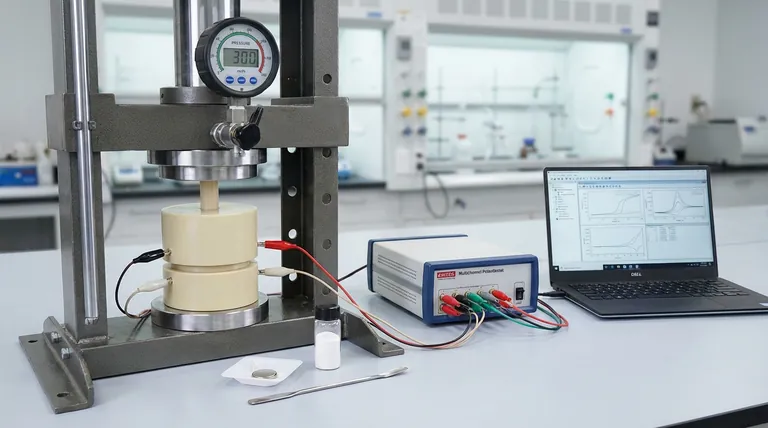
Unlike metal molds, PEEK is an excellent electrical insulator. This allows the mold to serve a dual purpose: it acts as the pressing die and the test cell. It prevents external short circuits, enabling in-situ electrochemical testing of the battery cell immediately after pressing.
Chemical Inertness
Battery chemistries are sensitive to contamination. PEEK is chemically inert, ensuring it does not react with or contaminate the electrolyte or electrode materials. This guarantees that test results reflect the true performance of the battery chemistry, not artifacts from the mold material.
Understanding the Trade-offs
While PEEK is the superior choice for many solid-state applications, it is not without limitations compared to industrial metal dies.
Pressure Limitations
While 300 MPa is impressive for a polymer, it is not infinite. If your experimental design requires pressures significantly exceeding this threshold to achieve theoretical densities, PEEK may deform or fail, necessitating a transition to ceramic or hardened steel molds with insulating liners.
Cost and Machinability
PEEK is a high-performance engineering thermoplastic. It is generally more expensive and requires more specialized machining parameters than standard plastics, which can impact the budget for consumable lab equipment.
Making the Right Choice for Your Goal
Selecting the correct mold material depends heavily on the specific phase of your research or production.
- If your primary focus is in-situ testing: Choose PEEK to prevent short circuits while maintaining enough pressure to ensure ionic conductivity.
- If your primary focus is maximum density compaction: Assess if your pressure requirements exceed 300 MPa; if so, PEEK may not provide the necessary structural rigidity.
Ultimately, PEEK acts as the essential bridge between structural integrity and electrochemical precision, ensuring your data remains pure even under extreme pressure.
Summary Table:
| Property | Benefit for Solid-State Battery R&D |
|---|---|
| High Mechanical Strength | Withstands pressures up to 300 MPa for effective powder densification. |
| Excellent Electrical Insulation | Enables in-situ electrochemical testing by preventing short circuits. |
| Chemical Inertness | Prevents sample contamination, ensuring accurate performance data. |
| Dual-Purpose Design | Serves as both the pressing die and the test cell housing. |
Ready to achieve precise, high-pressure compaction for your battery research?
KINTEK specializes in high-performance lab press machines, including automatic lab presses and heated lab presses, designed to meet the rigorous demands of all-solid-state battery development. Our equipment is the ideal partner for your PEEK molds, ensuring you can apply the necessary pressure for densification while enabling accurate in-situ analysis.
Let's enhance your R&D workflow together. Contact our experts today to discuss your specific laboratory needs!
Visual Guide
Related Products
- Carbide Lab Press Mold for Laboratory Sample Preparation
- Lab Infrared Press Mold for Laboratory Applications
- Lab Cylindrical Press Mold for Laboratory Use
- Lab Button Battery Tablet Press Sealing Mold
- Warm Isostatic Press for Solid State Battery Research Warm Isostatic Press
People Also Ask
- What is the purpose of incorporating cartridge heaters into a lab press mold for MLCC block compression? Optimize Results
- What is the function of a pressing tool in thermoplastic panels? Master Precision Shaping & Fusion Bonding
- Why is precise cooling management of the lab press mold necessary? Protect Core Integrity in Thermoforming
- How does the geometry of laboratory molds influence mycelium-based composites? Optimize Density and Strength
- What is the significance of standardized molds in lab presses? Ensure Precise Seal Material Evaluation