
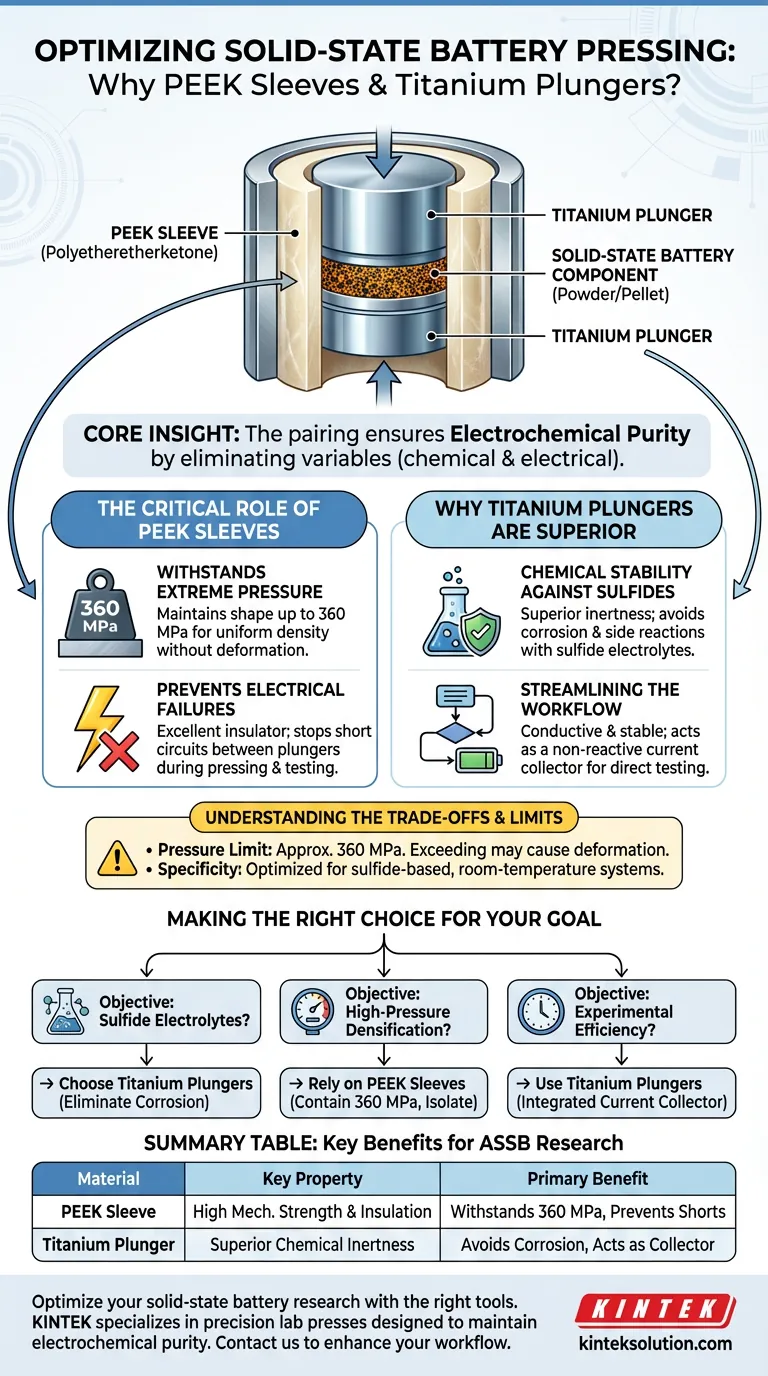
The industry preference for Polyetheretherketone (PEEK) sleeves and Titanium plungers is driven by the strict need for chemical inertness and mechanical stability. This combination specifically addresses the volatility of sulfide-based electrolytes and the high pressures required for densification. PEEK provides electrical insulation and containment up to 360 MPa, while Titanium ensures rigid pressure transmission without triggering the corrosive side reactions common with stainless steel.
Core Insight: The success of all-solid-state battery experimentation relies on eliminating variables. This specific die set material pairing is chosen not just for durability, but to preserve the electrochemical purity of the cell by preventing internal shorts and reactions between the tools and the active materials.

The Critical Role of PEEK Sleeves
Withstanding Extreme Pressure
The fabrication of solid-state batteries requires densifying powder into a solid pellet. PEEK is utilized because of its exceptional mechanical strength.
It can withstand forming pressures as high as 360 MPa without deforming. This ensures the die maintains its shape, creating a pellet with uniform density and no macroscopic defects.
Preventing Electrical Failures
A fundamental requirement of battery assembly is keeping the positive and negative electrodes electrically isolated until the circuit is closed.
PEEK serves as an excellent electrical insulator. By using a PEEK sleeve, you effectively prevent short circuits between the top and bottom plungers during the pressing process and subsequent testing.
Why Titanium Plungers are Superior
Chemical Stability Against Sulfides
Standard stainless steel plungers often fail when used with sulfide-based solid electrolytes due to corrosion or chemical side reactions.
Titanium is preferred because of its superior chemical inertness. It remains stable at the high-pressure interface, ensuring that the electrochemical data collected reflects the battery's performance, not a reaction with the testing equipment.
Streamlining the Workflow
Titanium plungers offer a dual advantage regarding experimental efficiency.
Because they are conductive and chemically stable, they can serve directly as non-reactive current collectors. This allows researchers to move the cell directly from the pressing stage to electrochemical testing without disassembling the setup.
Understanding the Trade-offs
Mechanical Limits
While PEEK is robust, it is not a ceramic or a metal. It has a defined pressure limit (approximately 360 MPa). Exceeding this limit to achieve higher densification could lead to sleeve deformation or failure, unlike harder ceramic alternatives used in other contexts.
Material Specificity
This setup is highly specialized for sulfide-based systems and room-temperature pressing.
While references note that other materials like PTFE (Teflon) offer low friction and insulation, PEEK is specifically selected here for its higher mechanical rigidity. Similarly, while stainless steel is common, it is explicitly avoided here to prevent chemical contamination.
Making the Right Choice for Your Goal
When configuring your die set for solid-state battery research, consider your primary objectives:
- If your primary focus is working with sulfide electrolytes: Choose Titanium plungers to eliminate corrosion and side reactions that corrupt electrochemical data.
- If your primary focus is high-pressure densification: Rely on PEEK sleeves to contain pressures up to 360 MPa while maintaining electrical isolation.
- If your primary focus is experimental efficiency: Use Titanium plungers to act simultaneously as pressing tools and current collectors, reducing assembly steps.
Select your materials not just for their strength, but for their chemical compatibility with your specific electrolyte chemistry.
Summary Table:
| Material | Key Property | Primary Benefit for ASSB Research |
|---|---|---|
| PEEK Sleeve | High mechanical strength & electrical insulation | Withstands pressures up to 360 MPa and prevents internal short circuits |
| Titanium Plunger | Superior chemical inertness | Avoids corrosion with sulfide electrolytes and can act as a current collector |
Optimize your solid-state battery research with the right tools. KINTEK specializes in precision lab press machines, including automatic, isostatic, and heated lab presses, designed to meet the exacting demands of laboratory R&D. Our expertise ensures your die sets and pressing processes maintain the electrochemical purity of your samples. Contact us today to discuss how our solutions can enhance your battery development workflow.
Visual Guide
References
- Yuju Jeon, Zheng Chen. Lithium diffusion-controlled Li-Al alloy negative electrode for all-solid-state battery. DOI: 10.1038/s41467-025-64386-y
This article is also based on technical information from Kintek Solution Knowledge Base .
Related Products
- Warm Isostatic Press for Solid State Battery Research Warm Isostatic Press
- Lab Button Battery Tablet Press Sealing Mold
- Laboratory Hydraulic Press Lab Pellet Press Button Battery Press
- Button Battery Sealing Press Machine for Lab
- Lab Ball Press Mold
People Also Ask
- Why must composite cathodes be sealed in vacuum lamination bags for WIP? Ensure Battery Stability and Density
- What is the function of elastic molds in warm isostatic pressing? Achieve Uniform Density in Composite Particles
- How do sacrificial volume materials (SVM) maintain microchannels in isostatic pressing? Ensure Structural Integrity
- What is the process involved in warm isostatic pressing? Mastering Uniform Density with WIP Technology
- How does Warm Isostatic Pressing differ from traditional pressing methods? Unlock Uniform Density for Complex Parts







