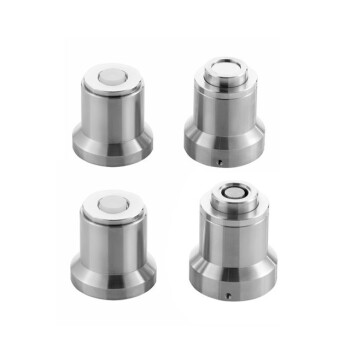
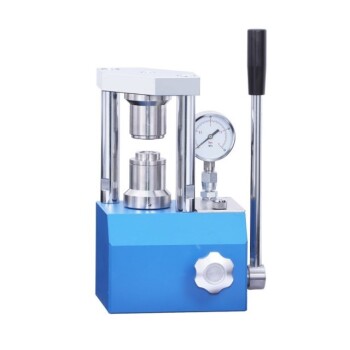
Specialized battery test molds are essential tools for ensuring the structural integrity of all-solid-state sodium batteries (ASSIBs) during operation. Because these batteries undergo drastic volume expansion and contraction during charge and discharge cycles, the molds apply a constant working pressure—often as high as 70 MPa—to counteract internal mechanical stresses and maintain component contact.
The Core Insight Solid-state batteries lack the fluid nature of liquid electrolytes, meaning they cannot naturally adapt to volume changes. The primary function of the test mold is to provide external mechanical compensation, preventing the battery's internal layers from separating or cracking, which is the leading cause of performance failure.
The Challenge of Volume Expansion
Managing Internal Stress
During the cycling process, the active materials within an ASSIB do not remain static; they breathe. As ions move, the materials undergo significant volume expansion and contraction, generating substantial internal stress within the cell stack.
Preventing Material Detachment
Without external constraint, this physical movement forces components apart. The primary reference highlights that this leads to the detachment of active materials from the current collectors or the solid electrolyte.
Avoiding Microcracks
Unchecked volume changes can cause the solid electrolyte layer to fracture. The application of constant pressure via the mold is critical to prevent the formation of microcracks, which permanently disrupt the ion transport pathways.
The Role of Constant Pressure
Ensuring Interface Connectivity
The specialized mold ensures that the solid-solid interface—where the electrode meets the electrolyte—remains in tight physical contact. By applying a constant mechanical stack pressure, the mold compensates for the breathing of the materials.
Minimizing Interfacial Impedance
Maintaining this tight contact is necessary to keep interfacial impedance low. If the layers separate even slightly (delamination), the resistance increases, and the battery's ability to move charge efficiently is compromised.
Stabilizing Long-Term Performance
Pressure regulation is directly linked to cycle life. Evidence indicates that maintaining a constant pressure environment allows for high stability, such as achieving 94.4% capacity retention after 300 cycles.
Understanding the Trade-offs
High Pressure Requirements
The pressure required to stabilize these batteries is significant. The primary reference cites 70 MPa, and supplementary data suggests 60 MPa for similar chemistries. This implies that the battery requires heavy-duty mechanical containment to function, which is a substantial engineering constraint compared to liquid-electrolyte batteries.
Dependency on Precision Hardware
The reliability of the test data is entirely dependent on the mold's ability to maintain constant pressure, not just initial pressure. If the mold cannot actively compensate for expansion (using springs or pneumatic systems), the varying internal stress will lead to inconsistent data and premature cell failure.
Making the Right Choice for Your Goal
To maximize the reliability of your solid-state battery testing, align your mechanical setup with your specific objectives:
- If your primary focus is Cycle Life: Ensure your test mold can maintain a constant pressure (e.g., 70 MPa) to prevent microcracks and achieve high capacity retention over hundreds of cycles.
- If your primary focus is Interface Quality: Prioritize molds with precision pressure compensation to minimize interfacial impedance and prevent the delamination of active materials.
By mechanically constraining the battery to counteract its natural volume changes, you bridge the gap between theoretical chemistry and practical, long-lasting energy storage.
Summary Table:
| Feature | Impact on ASSIB Performance | Benefit of Specialized Molds |
|---|---|---|
| Volume Change | Causes expansion/contraction and internal stress | Provides 60-70 MPa of mechanical compensation |
| Interface Contact | Separation leads to high interfacial impedance | Ensures tight solid-solid interface connectivity |
| Structural Integrity | Material detachment and microcracking | Prevents layer delamination and fracture |
| Cycle Stability | Premature failure and capacity loss | Achieves high retention (e.g., 94.4% over 300 cycles) |
Elevate Your Battery Research with KINTEK
Precision is non-negotiable in solid-state battery testing. KINTEK specializes in comprehensive laboratory pressing solutions designed to handle the extreme mechanical requirements of ASSIBs. Whether you need manual, automatic, heated, or glovebox-compatible models, our equipment ensures the constant stack pressure (up to 70 MPa and beyond) required to eliminate interfacial impedance and prevent material detachment.
From advanced battery research to cold and warm isostatic presses, we provide the tools necessary for high capacity retention and consistent data accuracy. Contact KINTEK today to find the perfect pressing solution for your laboratory’s needs.
References
- Meng Wu, Li‐Zhen Fan. Fluorinated amorphous halides with improved ionic conduction and stability for all-solid-state sodium-ion batteries. DOI: 10.1038/s41467-025-58113-w
This article is also based on technical information from Kintek Solution Knowledge Base .
Related Products
- Lab Button Battery Disassembly and Sealing Mold
- Carbide Lab Press Mold for Laboratory Sample Preparation
- Lab Button Battery Tablet Press Sealing Mold
- Lab Infrared Press Mold for Laboratory Applications
- Lab Cylindrical Press Mold for Laboratory Use
People Also Ask
- How does a sealed battery mold facilitate the assembly and testing of asymmetric supercapacitors using VO2?
- What is the function of specialized battery molds and sealing consumables? Optimize Your In-situ XRD Testing Today
- How does the geometry of laboratory molds influence mycelium-based composites? Optimize Density and Strength
- What role do battery testing molds play in electrolyte performance? Exploring Pressure vs. Viscoelasticity
- Why are high-precision laboratory molds and specific compaction processes required? Ensure Data Integrity in Soil Research