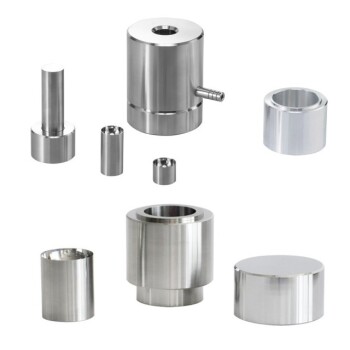
Steel molds are utilized primarily for their high thermal conductivity, which is the driving force behind rapid solidification. By extracting heat from the molten metal much faster than insulating materials, steel molds force the Zn-Al alloy to freeze quickly, fundamentally altering its internal structure.
By accelerating the cooling rate, steel molds refine the alloy's microstructure and minimize chemical segregation. This process is essential for achieving the high density and superior mechanical strength required for performance-critical alloys like Zn-15Al-3Cu-1Si.
The Physics of Chill Casting
Leveraging Thermal Conductivity
The core advantage of a steel mold is its ability to act as a heat sink. Unlike sand casting, which insulates the metal and slows heat loss, steel rapidly conducts thermal energy away from the molten alloy.
Achieving Rapid Solidification
This rapid heat extraction leads to a high cooling rate. The speed at which the metal transitions from liquid to solid is the single most important factor in determining the final properties of the material.
Microstructural Transformations
Grain Size Refinement
The rapid cooling rate prevents the formation of large, coarse crystals. Instead, it promotes the nucleation of many small crystals, resulting in a fine grain size.
Fine grains are desirable because they create more boundaries within the material, which impedes dislocation movement and increases strength.
Reducing Component Segregation
When alloys cool slowly, different chemical elements tend to separate (segregate), leading to uneven properties. Rapid solidification "freezes" the elements in place, ensuring a uniform distribution throughout the part.
Performance Outcomes
Increased Density
The combination of fine grains and reduced segregation leads to a significantly denser structure. This reduction in porosity is critical for the durability of the component.
Superior Mechanical Strength
The physical changes in the microstructure directly translate to mechanical performance. Alloys processed in steel molds exhibit higher strength compared to those cast in sand, making this method ideal for specific compositions like Zn-15Al-3Cu-1Si.
Understanding the Trade-offs: Steel vs. Sand
The Cost of Thermal Insulation
It is important to understand the inverse effect. Using a sand mold acts as an insulator, trapping heat and slowing the solidification process.
Consequences of Slow Cooling
While sand casting may be suitable for other applications, in this context, it results in a coarser microstructure. This leads to increased component segregation and lower overall mechanical strength compared to chill casting with steel.
Making the Right Choice for Your Goal
To determine if steel mold chill casting is the correct approach for your Zn-Al alloy project, consider your performance requirements.
- If your primary focus is maximum mechanical strength: Prioritize steel molds to leverage rapid solidification and grain refinement.
- If your primary focus is material uniformity: Use steel molds to minimize component segregation and ensure a dense, homogeneous structure.
Choosing the right mold material is not just about shaping the metal; it is about engineering the microstructure for peak performance.
Summary Table:
| Feature | Steel Mold (Chill Casting) | Sand Mold (Insulative Casting) |
|---|---|---|
| Cooling Rate | High (Rapid Solidification) | Low (Slow Cooling) |
| Thermal Conductivity | High (Acts as a heat sink) | Low (Acts as an insulator) |
| Microstructure | Fine grain size | Coarse grain size |
| Chemical Segregation | Minimal (Uniform distribution) | High (Element separation) |
| Density & Strength | High Density & Superior Strength | Lower Density & Reduced Strength |
Elevate Your Material Research with KINTEK Precision Solutions
Unlock the full potential of your alloy development with KINTEK’s industry-leading laboratory equipment. Whether you are conducting battery research or developing high-performance Zn-Al alloys, our comprehensive range of pressing solutions—including manual, automatic, heated, and multifunctional models—provides the precision you need.
We also offer specialized cold and warm isostatic presses and glovebox-compatible models designed to maintain the highest material integrity. Don't settle for average results; partner with KINTEK to achieve superior density and mechanical strength in every sample.
Ready to optimize your lab's performance? Contact our experts today and let us help you find the perfect pressing solution for your specific application.
References
- Ali Paşa Hekimoğlu, Temel Savaşkan. Zn-15Al-3Cu-1Si alaşımı ve SAE 660 bronzunun yağlı durumdaki aşınma karakteristikleri. DOI: 10.17341/gazimmfd.406787
This article is also based on technical information from Kintek Solution Knowledge Base .
Related Products
- XRF KBR Steel Ring Lab Powder Pellet Pressing Mold for FTIR
- Lab Double Plate Heating Mold for Laboratory Use
- Lab XRF Boric Acid Powder Pellet Pressing Mold for Laboratory Use
- Lab Polygon Press Mold
- XRF KBR Plastic Ring Lab Powder Pellet Pressing Mold for FTIR
People Also Ask
- What considerations are important regarding the die size of an XRF pellet press? Optimize for Your XRF Spectrometer and Sample
- Why are pellets used in XRF analysis, and what is their limitation? Boost Accuracy and Speed in Your Lab
- What is the general process for preparing a sample pellet for XRF? Master Consistency for Accurate Analysis
- What are the differences between manual and automatic XRF pellet presses? Choose the Right Press for Your Lab's Needs
- What are the different types of XRF pellet preparation methods available? Manual, Hydraulic, and Automated Presses Explained