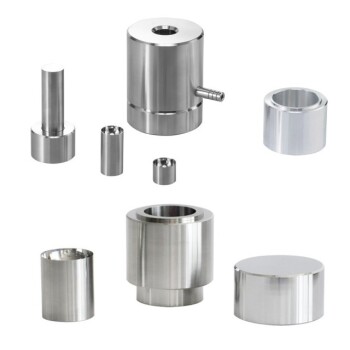
The combination of wet compaction processes and standard laboratory molds is essential for eliminating the inherent variability of natural soil. These preparation methods allow researchers to exert precise control over the sample's initial moisture content and dry density. By standardizing the preparation, you effectively minimize interference from uncontrollable natural factors—such as random voids or root systems—that inevitably skew test results.
Natural loess contains structural inconsistencies that make comparative analysis difficult. By using wet compaction within precision molds, you replace these random defects with a homogenous structure, ensuring that permeability and mechanical tests are both reliable and repeatable.
Achieving Scientific Consistency
Precision Control of Moisture and Density
The primary objective of wet compaction is to create a baseline for accurate comparison. Unlike natural samples, where density varies by location/depth, wet compaction allows you to target a specific dry density and moisture content. This creates a controlled environment where you can isolate specific variables to see how they affect the soil's behavior.
Minimizing Natural Interference
Natural loess is rarely uniform; it is often riddled with "noise" in the form of secondary defects. These include ancient root channels, animal burrows, or naturally occurring voids. Using standard preparation methods eliminates these irregularities, ensuring that test failure is caused by the soil matrix itself, not by a pre-existing structural flaw.
The Role of Precision Geometry
Ensuring Axisymmetry in Stress Fields
Standard laboratory molds—specifically high-precision cylindrical types (e.g., 38 mm diameter by 76 mm height)—are strictly designed to maintain specific aspect ratios. This geometry is critical for Unconfined Compressive Strength (UCS) tests. It ensures that the stress field distribution remains axisymmetric, meaning the pressure is applied evenly across the sample’s internal structure.
Preventing Eccentric Loading
Industrial-grade molds guarantee that the sample surfaces are perfectly flat and the dimensions are exact. If a sample has uneven surfaces, the testing machine applies force off-center, leading to "eccentric loading." This phenomenon creates artificial stress concentrations that distort the mechanical performance data, rendering the test invalid.
Understanding the Trade-offs
Loss of Natural Structure
While wet compaction ensures repeatability, it comes at the cost of the soil's natural structure. Geologists must recognize that this process destroys the naturally occurring cementation and structural bonds found in undisturbed loess. Therefore, while the data is highly consistent, it represents "remolded" behavior rather than exact "in-situ" behavior.
Interpretation Limits
Data derived from these samples is best used for parametric studies and understanding fundamental soil mechanics. Because the natural macro-structure (like vertical joints) is removed, engineers should be cautious when directly extrapolating these specific lab results to large-scale slope stability predictions without applying correction factors.
Optimizing Your Testing Strategy
To ensure your data is both valid and useful, align your preparation method with your specific testing goals:
- If your primary focus is comparative analysis: Use wet compaction to strictly homogenize samples, ensuring that differences in results are due to your test variables, not sample defects.
- If your primary focus is mechanical precision: Utilize industrial-grade molds to guarantee surface flatness, preventing eccentric loading artifacts in your stress-strain data.
By controlling the material input and the geometric boundaries, you transform a variable natural material into a predictable engineering medium.
Summary Table:
| Feature | Wet Compaction & Standard Molds | Natural Loess Samples |
|---|---|---|
| Structural Integrity | Homogenous and uniform matrix | Contains random voids and root channels |
| Density Control | Precise target dry density | Highly variable based on depth/location |
| Stress Distribution | Axisymmetric (even distribution) | Prone to eccentric loading distortions |
| Repeatability | High; ideal for comparative studies | Low; significant structural 'noise' |
| Geometry | Precision cylindrical dimensions | Irregular and often non-standard |
Elevate Your Geotechnical Research with KINTEK Precision
Precise sample preparation is the foundation of reliable soil mechanics data. KINTEK specializes in comprehensive laboratory pressing solutions, offering the high-precision molds and compaction tools needed to eliminate structural inconsistencies in loess and other materials. Whether your research requires manual, automatic, or specialized isostatic presses, our equipment ensures your samples meet strict geometric and density standards for repeatable, peer-review-quality results.
Ready to eliminate 'noise' from your mechanical testing?
Contact KINTEK Today to Find Your Pressing Solution
References
- Pengli He, Shixu Zhang. Feasibility of Microbially Induced Carbonate Precipitation to Enhance the Internal Stability of Loess under Zn-Contaminated Seepage Conditions. DOI: 10.3390/buildings14051230
This article is also based on technical information from Kintek Solution Knowledge Base .
Related Products
- Lab Polygon Press Mold
- Lab Round Bidirectional Press Mold
- Lab Anti-Cracking Press Mold
- Carbide Lab Press Mold for Laboratory Sample Preparation
- Lab XRF Boric Acid Powder Pellet Pressing Mold for Laboratory Use
People Also Ask
- What is the purpose of incorporating cartridge heaters into a lab press mold for MLCC block compression? Optimize Results
- How do the design and geometric precision of pressing molds and mandrels affect the quality of PTFE composite samples?
- What role do precision positioning and pressure molds play in single-lap joints? Ensure 100% Data Integrity
- What are the requirements for pressing molds when using SSCG? Key Materials for Complex Single Crystal Production
- How do industrial-grade pressure molds affect zinc metal pouch cells? Maximize Energy Density & Performance