
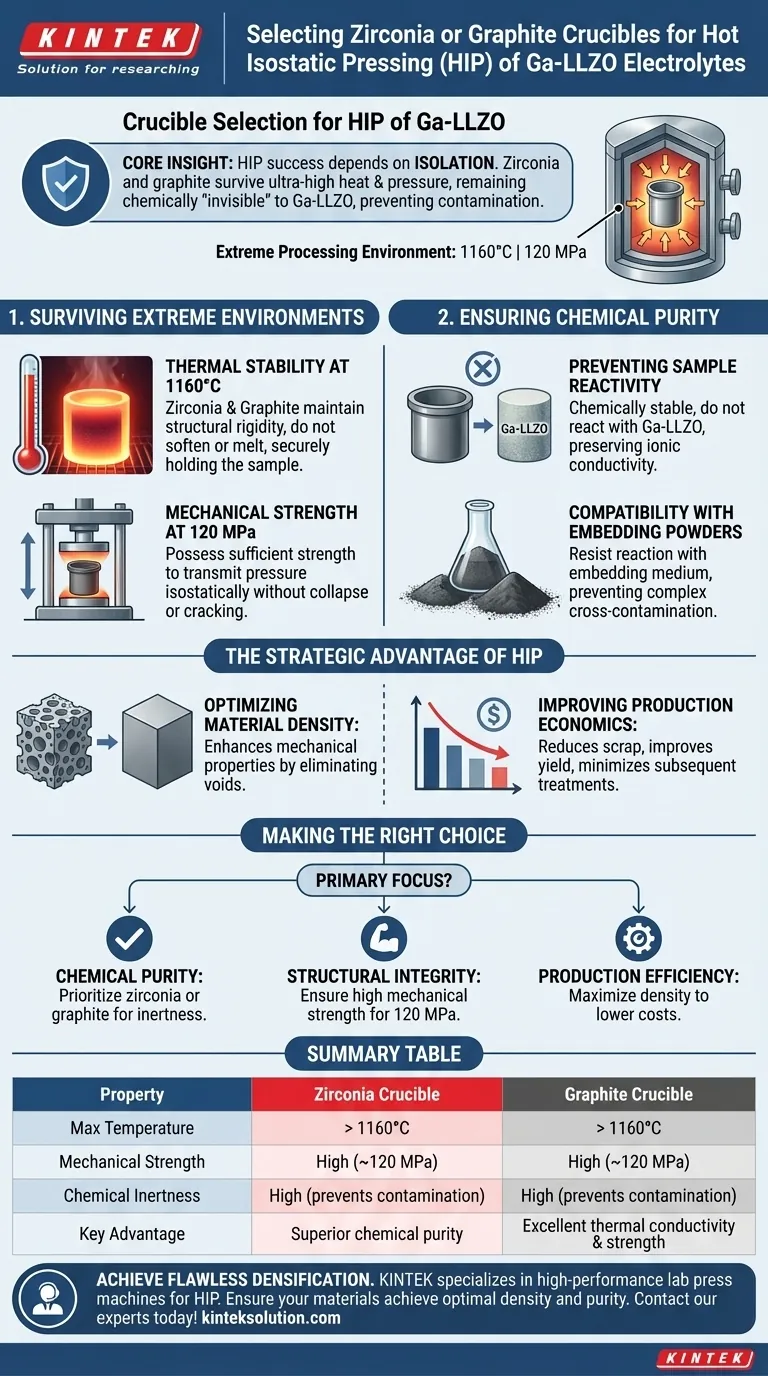
The selection of zirconia or graphite crucibles is dictated by the need for materials that act as an unyielding barrier against extreme processing environments. During the Hot Isostatic Pressing (HIP) of Ga-LLZO electrolytes, these crucibles must withstand temperatures of 1160°C and pressures of 120 MPa without structural failure. Crucially, their chemical inertness prevents reactions with the sample, ensuring the final electrolyte retains the high purity required for optimal battery performance.
Core Insight: The success of the HIP process depends entirely on isolation. Zirconia and graphite are utilized not just for their ability to survive ultra-high heat and pressure, but because they remain chemically "invisible" to the Ga-LLZO sample, preventing contamination that would compromise the electrolyte's conductivity.
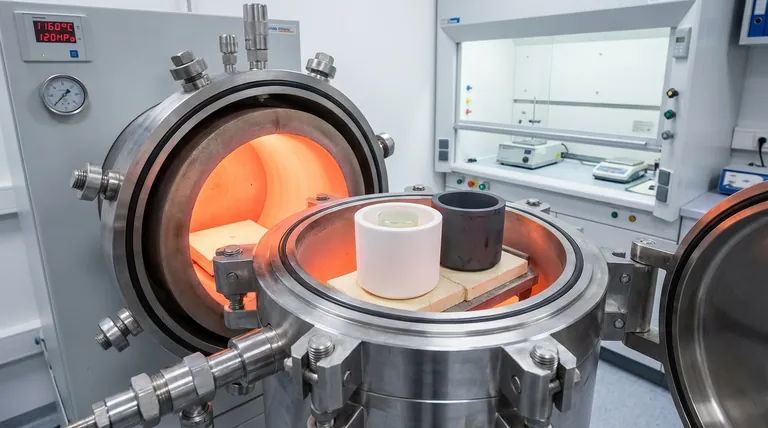
Surviving Extreme Environments
To densify Ga-LLZO electrolytes effectively, the processing environment must push materials to their physical limits. The crucible serves as the primary shield during this operation.
Thermal Stability at 1160°C
The HIP process subjects the sample to ultra-high temperatures, specifically around 1160°C.
At these temperatures, many standard containment materials would soften, melt, or deform. Zirconia and graphite are selected because they maintain their structural rigidity and do not degrade thermally, ensuring the sample remains securely held throughout the heating cycle.
Mechanical Strength at 120 MPa
Simultaneous with high heat, the process applies a crushing pressure of roughly 120 MPa.
The crucible must possess sufficient mechanical strength to transmit this pressure isostatically without collapsing or cracking. Zirconia and graphite provide the necessary durability to endure these compressive forces, protecting the physical integrity of the sample setup.
Ensuring Chemical Purity
Beyond physical survival, the primary role of the crucible is to prevent chemical interference. Ga-LLZO electrolytes are sensitive materials where purity dictates performance.
Preventing Sample Reactivity
Both zirconia and graphite are chemically stable relative to Ga-LLZO.
They do not react with the electrolyte material even under high-energy conditions. This inertness is critical; if the crucible were to react with the sample, it would alter the chemical composition of the electrolyte, likely degrading its ionic conductivity.
Compatibility with Embedding Powders
The process often involves a graphite embedding powder surrounding the sample.
The crucible material must be compatible not only with the sample but also with this embedding medium. Zirconia and graphite resist reaction with the embedding powder, preventing complex cross-contamination scenarios that could introduce impurities into the final product.
The Strategic Advantage of HIP
While the conditions are harsh, the selection of the right crucible enables the broader benefits of the Hot Isostatic Pressing process. Understanding these benefits clarifies why such rigorous material selection is necessary.
Optimizing Material Density
The primary goal of subjecting the sample to this pressure is to create highly dense materials.
By eliminating voids and pores, the process enhances the mechanical properties and overall performance of the electrolyte. This density is impossible to achieve without the containment stability provided by high-grade crucibles.
Improving Production Economics
Effective HIP processing can significantly reduce scrap rates and improve yield.
By densifying the material uniformly, the process minimizes the need for subsequent heat treatments. This streamlines the manufacturing pipeline, ultimately lowering the total production costs of the final product.
Making the Right Choice for Your Goal
Selecting the correct containment strategy is about matching the material properties to the specific threats present in your processing environment.
- If your primary focus is Chemical Purity: Prioritize materials like zirconia or graphite that are chemically inert to prevent secondary contamination of the Ga-LLZO.
- If your primary focus is Structural Integrity: Ensure your crucible choice offers high mechanical strength to withstand pressures up to 120 MPa without deformation.
- If your primary focus is Production Efficiency: Utilize this setup to maximize material density, which reduces scrap and lowers total manufacturing costs.
The correct crucible material transforms the extreme conditions of HIP from a destructive force into a precise tool for material densification.
Summary Table:
| Property | Zirconia Crucible | Graphite Crucible |
|---|---|---|
| Max Temperature | > 1160°C | > 1160°C |
| Mechanical Strength | High (withstands ~120 MPa) | High (withstands ~120 MPa) |
| Chemical Inertness | High (prevents Ga-LLZO contamination) | High (prevents Ga-LLZO contamination) |
| Key Advantage | Superior chemical purity | Excellent thermal conductivity & strength |
Achieve flawless densification of your sensitive materials with the right crucible solution. KINTEK specializes in high-performance lab press machines, including isostatic presses, designed for demanding processes like HIP. Our expertise ensures your materials, like Ga-LLZO electrolytes, achieve optimal density and purity. Let us help you optimize your production efficiency and yield. Contact our experts today to discuss your specific application needs!
Visual Guide
Related Products
- Warm Isostatic Press for Solid State Battery Research Warm Isostatic Press
- Automatic High Temperature Heated Hydraulic Press Machine with Heated Plates for Lab
- Automatic Heated Hydraulic Press Machine with Hot Plates for Laboratory
- Automatic Heated Hydraulic Press Machine with Heated Plates for Laboratory
- Manual Heated Hydraulic Lab Press with Integrated Hot Plates Hydraulic Press Machine
People Also Ask
- Why must composite cathodes be sealed in vacuum lamination bags for WIP? Ensure Battery Stability and Density
- How do sacrificial volume materials (SVM) maintain microchannels in isostatic pressing? Ensure Structural Integrity
- What is the function of elastic molds in warm isostatic pressing? Achieve Uniform Density in Composite Particles
- What is the role of the flexible material in warm isostatic pressing? Key to Uniform Density & Precision
- What is the process involved in warm isostatic pressing? Mastering Uniform Density with WIP Technology



















