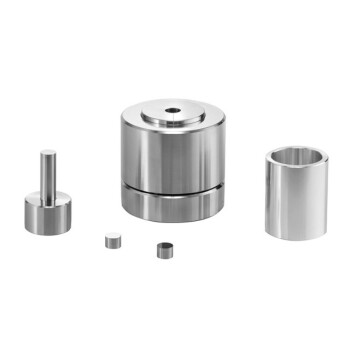
Unlike traditional liquid batteries that rely on permeation, all-solid-state batteries (ASSBs) depend entirely on physical solid-to-solid contact for ion conduction. While liquid electrolytes naturally fill microscopic voids between electrodes, solid electrolytes remain rigid, requiring the application of specific, high sealing pressure via a laboratory press to force components together.
This pressure serves two immediate functions: ensuring the battery casing is tightly engaged to create an airtight seal (typically around 4.9 MPa) and applying initial "pre-tensioning" to the internal components. This pre-tensioning is the critical variable that guarantees the consistency and repeatability of testing data across different samples.
The Core Takeaway In solid-state battery assembly, pressure is a functional component of the electrochemical system, not just a packaging step. Without precise mechanical compression to eliminate voids and establish "pre-tensioning," ions cannot traverse the rigid interfaces, rendering the battery inoperable or ensuring the resulting data is unreliable.
The Fundamental Barrier: Solid-to-Solid Contact
The transition from liquid to solid electrolytes introduces a massive physical challenge: contact resistance.
The Limitation of Solids
Liquids possess "wettability"—they flow into porous electrodes and establish contact automatically. Solid electrolytes are rigid.
When a solid electrolyte meets a solid electrode, they touch only at rough, microscopic peaks. Without intervention, this results in significant gaps (voids) where no ion transfer can occur.
The Necessity of Pre-Tensioning
To bridge these gaps, a laboratory press applies a specific sealing pressure. As noted in your primary context, a pressure of roughly 4.9 MPa acts as a "pre-tensioning" force.
This force ensures that the internal stack is compressed enough to function as a cohesive unit before the battery ever cycles.
Reproducibility of Data
For research and development, consistency is paramount. Variations in assembly pressure lead to variations in internal resistance.
Using a precision laboratory press ensures that every coin cell or stack starts with the exact same mechanical baseline, allowing for valid comparisons between different material samples.
Mechanics of the Interface
Beyond simply closing the case, the pressure applied during assembly drives the physical mechanisms required for electrochemistry.
Densification of Materials
High mechanical pressure (often higher during pellet formation, around 80 MPa) compresses cathode powders and electrolyte materials into dense structures.
This minimizes the porosity between particles, establishing continuous "highways" for ion transport.
Plastic Deformation for "Wetting"
For batteries utilizing lithium metal anodes, the pressure serves a unique purpose. Lithium metal is relatively soft.
Under high pressure from the press, the lithium undergoes plastic deformation. It physically flows into the microscopic surface irregularities of the electrolyte, effectively "wetting" the surface without a liquid.
Reducing Interfacial Impedance
The primary result of eliminating voids and improving contact is a drastic reduction in interfacial impedance (resistance).
Low impedance is the fundamental physical requirement for efficient operation; without it, the battery suffers from high voltage drop and poor efficiency.
Common Pitfalls and Trade-offs
While pressure is essential, it introduces complexity that does not exist in liquid battery manufacturing.
The Risk of Delamination
Batteries "breathe" during operation; electrode materials expand and contract as they charge and discharge.
If the assembly pressure is not maintained (using specialized fixtures or clamps), these volume changes can cause the layers to separate (delaminate), leading to sudden contact failure.
Bipolar Stack Sensitivity
In bipolar configurations (cells in series), pressure control is even more stringent.
Because the current must pass through every layer sequentially, a single poor interface caused by uneven pressure causes a surge in internal resistance for the entire module.
Dendrite Formation
Ironically, while pressure helps, uneven pressure can hurt.
If contact is poor in specific spots, current concentrates there. This uneven distribution promotes the growth of lithium dendrites (metal needles) which can penetrate the electrolyte and short-circuit the cell.
Making the Right Choice for Your Goal
When selecting a laboratory press or defining your assembly protocol, consider your specific objective:
- If your primary focus is Data Consistency: Prioritize a press with highly repeatable force control (e.g., capable of exactly 4.9 MPa every time) to ensure your pre-tensioning is identical across all samples.
- If your primary focus is Cycle Life: Ensure your assembly process transitions into a fixture that maintains stable external pressure (e.g., 1 MPa) during operation to counteract volume expansion and prevent delamination.
- If your primary focus is Interface Optimization: You may require a press capable of higher pressures (up to 80 MPa) to densify pellets and force plastic deformation of the lithium anode before final sealing.
Ultimately, the laboratory press in solid-state assembly acts as a surrogate for the wettability of liquid electrolytes, forcing rigid materials to behave as a unified electrochemical system.
Summary Table:
| Feature | Liquid Li-ion Batteries | All-Solid-State Batteries (ASSBs) |
|---|---|---|
| Electrolyte Form | Liquid (flows into pores) | Rigid Solid (requires compression) |
| Interface Mechanism | Natural wetting/permeation | Mechanical solid-to-solid contact |
| Assembly Pressure | Minimal (casing seal only) | High (sealing + pre-tensioning) |
| Critical Goal | Leak prevention | Interfacial impedance reduction |
| Key Component | Electrolyte filler | Laboratory Press & Fixtures |
Elevate Your Battery Research with KINTEK
Precise pressure control is the difference between a functional battery and a failed experiment. KINTEK specializes in comprehensive laboratory pressing solutions tailored for the rigorous demands of all-solid-state battery (ASSB) research.
Our extensive range includes manual, automatic, heated, multifunctional, and glovebox-compatible models, alongside high-performance cold and warm isostatic presses. Whether you are densifying electrolytes at 80 MPa or establishing delicate pre-tensioning for coin cells, our equipment ensures the consistency and repeatability your data deserves.
Ready to optimize your solid-to-solid interfaces? Contact our experts today to find the perfect press for your lab's specific needs.
References
- Alexander Beutl, Artur Tron. Round‐robin test of all‐solid‐state battery with sulfide electrolyte assembly in coin‐type cell configuration. DOI: 10.1002/elsa.202400004
This article is also based on technical information from Kintek Solution Knowledge Base .
Related Products
- Warm Isostatic Press for Solid State Battery Research Warm Isostatic Press
- Laboratory Hydraulic Press Lab Pellet Press Button Battery Press
- Lab Button Battery Tablet Press Sealing Mold
- Lab Infrared Press Mold for Laboratory Applications
- Carbide Lab Press Mold for Laboratory Sample Preparation
People Also Ask
- Why must composite cathodes be sealed in vacuum lamination bags for WIP? Ensure Battery Stability and Density
- How do sacrificial volume materials (SVM) maintain microchannels in isostatic pressing? Ensure Structural Integrity
- What is the function of elastic molds in warm isostatic pressing? Achieve Uniform Density in Composite Particles
- What is the process involved in warm isostatic pressing? Mastering Uniform Density with WIP Technology
- How does Warm Isostatic Pressing differ from traditional pressing methods? Unlock Uniform Density for Complex Parts