
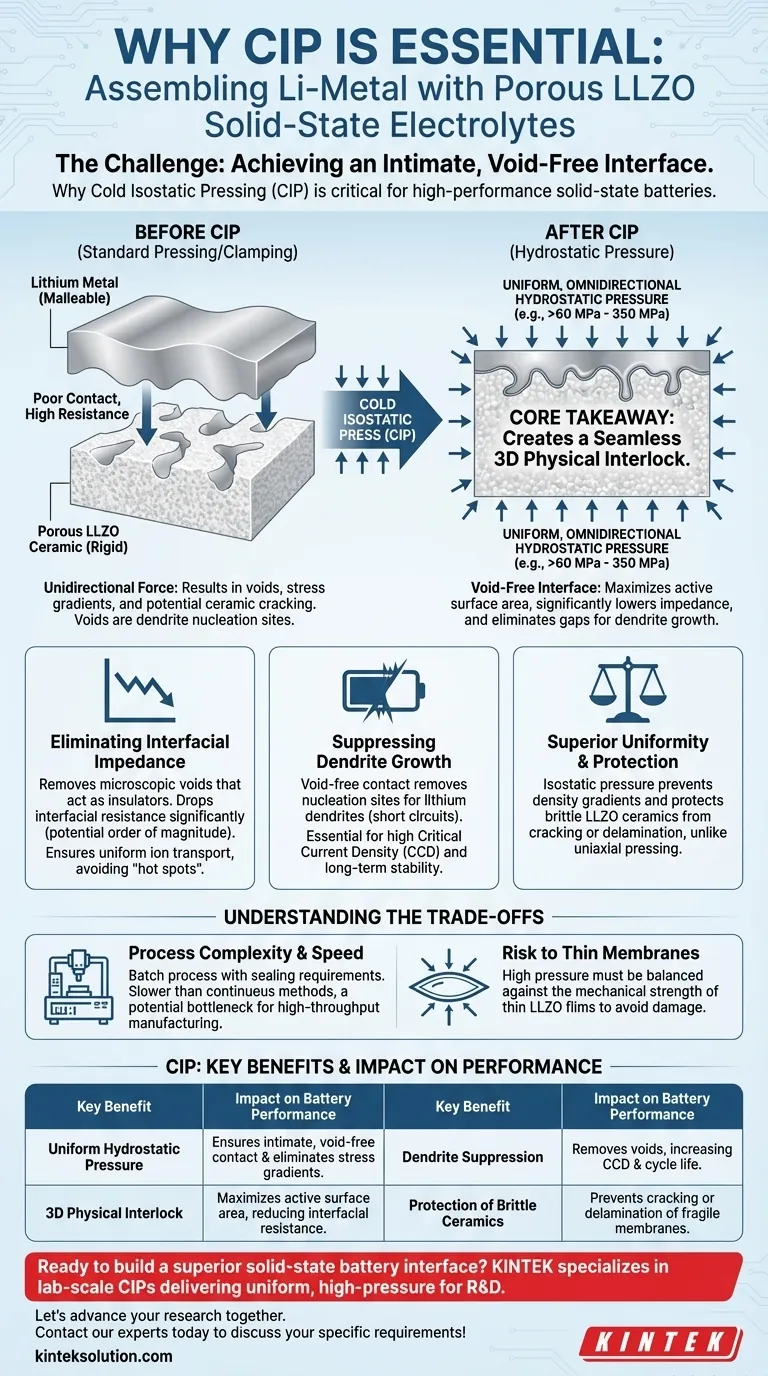
The primary function of a Cold Isostatic Press (CIP) in this context is to apply uniform, omnidirectional hydrostatic pressure to the battery assembly. This forces the malleable lithium metal to flow into the microscopic pores of the rigid LLZO ceramic scaffold, creating a physical interlock that creates an intimate, void-free interface impossible to achieve with standard unidirectional pressing.
The Core Takeaway Simply placing lithium against a ceramic electrolyte results in poor contact and high resistance. CIP solves this by driving the lithium into the ceramic structure, maximizing the active surface area to lower impedance and eliminate the gaps where battery-killing dendrites typically form.
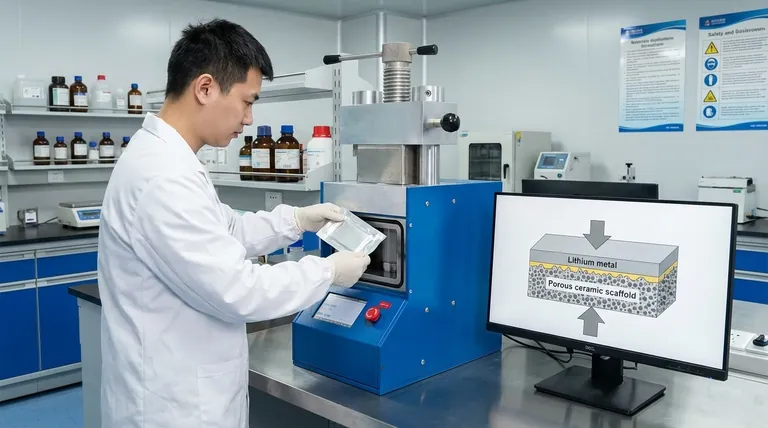
Creating a Seamless Interface
The interface between the lithium anode and the solid-state electrolyte is the most critical failure point in solid-state batteries. CIP technology addresses the fundamental mismatch between the soft metal and the hard ceramic.
The Mechanics of Infiltration
Lithium metal is relatively soft, while the LLZO membrane is hard and porous. Under the high hydrostatic pressure of a CIP (often exceeding 60 MPa or even up to 350 MPa depending on the application), the lithium behaves plastically.
It effectively "flows" into the surface irregularities and deep into the porous scaffold of the LLZO. This transforms a planar contact into a three-dimensional, interlocked boundary.
Eliminating Interfacial Impedance
Standard assembly methods often leave microscopic voids between layers. These voids act as insulators, forcing current through fewer contact points and spiking local resistance.
By eliminating these voids, CIP ensures the interfacial resistance drops significantly—potentially by an order of magnitude. This allows for uniform ion transport across the entire surface rather than through concentrated "hot spots."
Why Hydrostatic Pressure is Superior
While simple hydraulic presses (uniaxial pressing) are common in labs, they are often insufficient for high-performance solid-state assemblies.
Uniformity vs. Stress Gradients
Uniaxial pressing applies force from only one direction (top-down). This often creates density gradients and stress concentrations that can crack the brittle LLZO ceramic or cause the layers to delaminate.
CIP applies pressure equally from every direction (isostatic). This uniformity protects the structural integrity of the ceramic membrane while ensuring the lithium is pressed evenly into every available pore, regardless of surface geometry.
Suppressing Dendrite Growth
Lithium dendrites (needle-like structures that cause short circuits) tend to nucleate in voids or areas of low pressure at the interface.
By creating a void-free physical contact, CIP removes the space required for dendrites to initiate. This is a prerequisite for achieving a high Critical Current Density (CCD) and ensuring the battery remains stable over long-term cycling.
Understanding the Trade-offs
While CIP is technically superior for interface formation, it introduces specific challenges that must be managed.
Process Complexity and Speed
CIP is inherently a batch process, requiring samples to be sealed in flexible molds or bags to transmit the hydrostatic pressure. This is significantly slower and more labor-intensive than continuous roll-pressing or uniaxial stacking, making it a bottleneck for high-throughput manufacturing.
Risk to Thin Membranes
Although isostatic pressure is uniform, the sheer magnitude of pressure required to flow lithium can still damage extremely thin or fragile electrolyte films if not supported correctly. Operators must balance the pressure needed for infiltration against the mechanical bending strength of the specific LLZO formulation.
Making the Right Choice for Your Goal
The decision to utilize CIP depends on the specific stage of your development and your performance targets.
- If your primary focus is reducing interfacial resistance: Use CIP to maximize the active contact area, as simple clamping pressure will not overcome the surface roughness of the ceramic.
- If your primary focus is preventing short circuits (dendrites): Rely on CIP to eliminate the interfacial voids that serve as nucleation sites for lithium filament growth.
- If your primary focus is scalable manufacturing: Acknowledge that while CIP provides the best performance baseline, you may eventually need to validate alternative methods (like warm isostatic pressing or soft interlayers) for mass production.
Ultimately, using a Cold Isostatic Press is not just about squashing layers together; it is the most reliable method for merging two distinct materials into a single, cohesive electrochemical unit.
Summary Table:
| Key Benefit of CIP | Impact on Battery Performance |
|---|---|
| Uniform Hydrostatic Pressure | Ensures intimate, void-free contact between lithium and LLZO, eliminating stress gradients. |
| 3D Physical Interlock | Maximizes active surface area, significantly reducing interfacial resistance. |
| Dendrite Suppression | Removes voids where dendrites nucleate, increasing critical current density (CCD) and cycle life. |
| Protection of Brittle Ceramics | Isostatic pressure prevents cracking or delamination of fragile LLZO membranes. |
Ready to build a superior solid-state battery interface?
KINTEK specializes in lab-scale Cold Isostatic Presses (CIP) that deliver the uniform, high-pressure conditions essential for R&D into next-generation lithium metal and LLZO assemblies. Our presses help you achieve the low-impedance, dendrite-free interfaces required for high-performance and safe solid-state batteries.
Let's advance your research together. Contact our experts today to discuss your specific application requirements!
Visual Guide
References
- Faruk Okur, Maksym V. Kovalenko. Intermediate‐Stage Sintered LLZO Scaffolds for Li‐Garnet Solid‐State Batteries. DOI: 10.1002/aenm.202203509
This article is also based on technical information from Kintek Solution Knowledge Base .
Related Products
- Electric Lab Cold Isostatic Press CIP Machine
- Electric Split Lab Cold Isostatic Pressing CIP Machine
- Automatic Lab Cold Isostatic Pressing CIP Machine
- Manual Cold Isostatic Pressing CIP Machine Pellet Press
- Lab Isostatic Pressing Molds for Isostatic Molding
People Also Ask
- What are the applications of electric lab cold isostatic presses in research settings? Advance Material R&D with High-Pressure CIPs
- What role do electric lab cold isostatic presses play in industrial contexts? Bridge R&D and Manufacturing with Precision
- How does electrical Cold Isostatic Pressing (CIP) contribute to cost savings? Unlock Efficiency and Reduce Expenses
- What are some research applications of electric lab CIPs? Unlock Uniform Powder Densification for Advanced Materials
- What are the characteristics of standard off-the-shelf electric lab CIP solutions? Achieve Immediate, Cost-Effective Processing






