
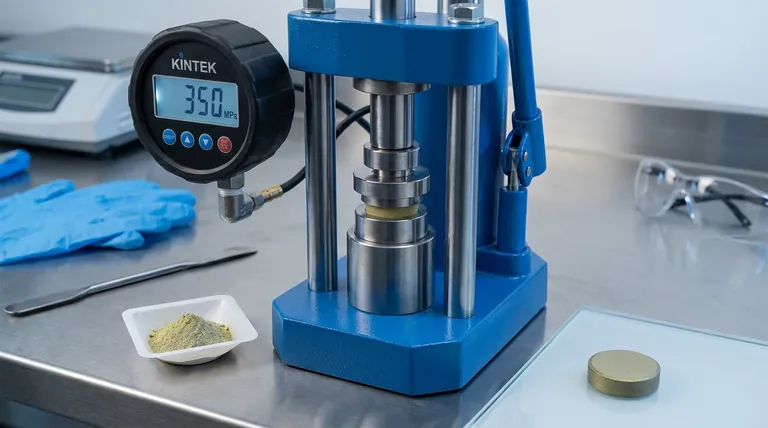
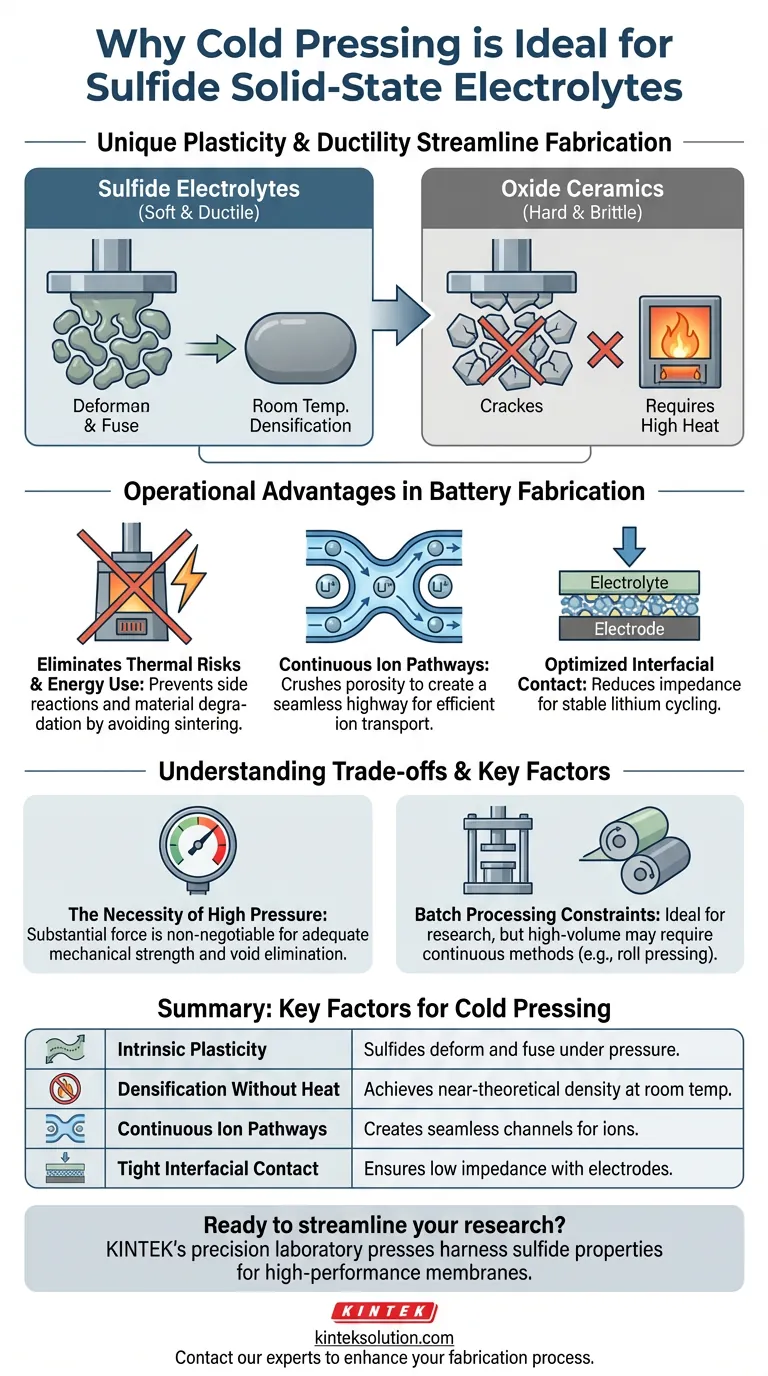
The suitability of cold pressing for sulfide solid-state electrolytes is primarily dictated by their exceptional intrinsic plasticity and ductility. Unlike oxide ceramics, which are brittle and require heat to bond, sulfide particles are soft enough to deform and fuse under simple mechanical pressure at room temperature, allowing a laboratory press to create high-density membranes without thermal processing.
Core Takeaway Sulfide electrolytes exhibit a unique mechanical "softness" that allows them to be cold-pressed into dense, cohesive pellets. This capability streamlines fabrication by eliminating the need for high-temperature sintering, directly facilitating tight interfacial contact and efficient ion transport pathways with significantly reduced energy input.
The Material Science: Why Softness Matters
Intrinsic Plasticity vs. Brittleness
The fundamental advantage of sulfide electrolytes lies in their mechanical properties. While traditional oxide ceramics are hard and brittle, sulfides possess excellent ductility and plasticity.
When force is applied, sulfide particles deform to fill gaps rather than fracturing or resisting compression. This allows them to behave somewhat like a malleable metal during processing.
Densification Without Heat
Because of this plasticity, a laboratory hydraulic press can achieve near-theoretical density at room temperature. The mechanical force alone is sufficient to eliminate the voids between particles.
This contrasts sharply with other ceramic materials, which often require high-temperature sintering (heating near the melting point) to fuse particles together.
Operational Advantages in Battery Fabrication
Eliminating Thermal Risks
By removing the sintering step, cold pressing avoids the high energy consumption associated with industrial furnaces.
More importantly, it prevents potential side reactions or material degradation that can occur when complex chemical compounds are exposed to extreme heat.
Creating Continuous Ion Pathways
The performance of a solid-state battery relies on the movement of lithium ions. Cold pressing effectively crushes porosity, transforming loose powder into a continuous, solid channel.
This creates a seamless highway for ion transport, which is the foundational requirement for high ionic conductivity.
Optimizing Interfacial Contact
A laboratory press applies precise, uniform pressure to ensure the electrolyte forms a tight physical interface with the current collector or electrode.
This "intimate contact" significantly reduces interfacial impedance (resistance), which is critical for stabilizing lithium deposition and stripping cycles in anode-free designs.
Understanding the Trade-offs
The Necessity of High Pressure
While heat is not required, the magnitude of pressure is non-negotiable. To achieve a self-supporting membrane with adequate mechanical strength, the laboratory press must deliver substantial force (often hundreds of MPa).
If the pressure is insufficient, voids will remain, severing ion pathways and severely compromising battery performance.
Batch Processing Constraints
A laboratory hydraulic press is inherently designed for batch processing—making one pellet or cell at a time.
While this is ideal for research and ensuring uniformity in experimental data, translating this "static" cold pressing to high-volume manufacturing often requires adapting the principle to continuous methods, such as roll pressing.
Making the Right Choice for Your Goal
Whether you are optimizing for pure conductivity or manufacturing efficiency, understanding the role of pressure is key.
- If your primary focus is Maximizing Ionic Conductivity: Prioritize higher pressure settings to completely eliminate inter-particle voids and establish dense transport pathways.
- If your primary focus is Process Efficiency: Leverage the cold-pressing capability to remove sintering steps, thereby reducing cycle times and preventing thermal degradation of unstable materials.
By exploiting the natural ductility of sulfides through cold pressing, you achieve a balance of high performance and simplified processing that is difficult to replicate with other solid-state chemistries.
Summary Table:
| Key Factor | Why It Matters for Cold Pressing |
|---|---|
| Intrinsic Plasticity | Sulfide particles deform and fuse under pressure, unlike brittle oxides. |
| Densification Without Heat | Achieves near-theoretical density at room temperature, avoiding thermal degradation. |
| Continuous Ion Pathways | Crushes porosity to create seamless channels for efficient ion transport. |
| Tight Interfacial Contact | Ensures low impedance with electrodes, critical for stable battery cycling. |
Ready to streamline your solid-state battery research?
KINTEK's precision laboratory presses—including automatic, isostatic, and heated models—are engineered to harness the unique properties of materials like sulfide solid-state electrolytes. By applying controlled, high pressure, our presses help you achieve dense, high-performance electrolyte membranes without the complexity and risk of thermal sintering, accelerating your development cycle.
Contact us today to discuss how our lab press solutions can enhance your fabrication process and bring you closer to your energy storage goals.
Visual Guide
Related Products
- Electric Lab Cold Isostatic Press CIP Machine
- Electric Split Lab Cold Isostatic Pressing CIP Machine
- Manual Cold Isostatic Pressing CIP Machine Pellet Press
- Lab Cylindrical Press Mold for Laboratory Use
- Assemble Square Lab Press Mold for Laboratory Use
People Also Ask
- What role do electric lab cold isostatic presses play in industrial contexts? Bridge R&D and Manufacturing with Precision
- What are the applications of electric lab cold isostatic presses in research settings? Advance Material R&D with High-Pressure CIPs
- How does electrical Cold Isostatic Pressing (CIP) contribute to cost savings? Unlock Efficiency and Reduce Expenses
- What are some research applications of electric lab CIPs? Unlock Uniform Powder Densification for Advanced Materials
- What are the characteristics of standard off-the-shelf electric lab CIP solutions? Achieve Immediate, Cost-Effective Processing



















