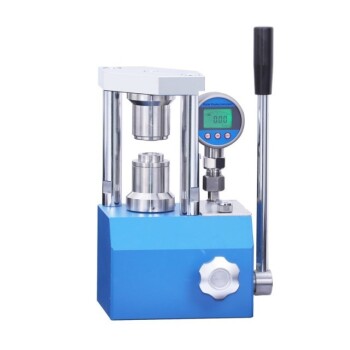
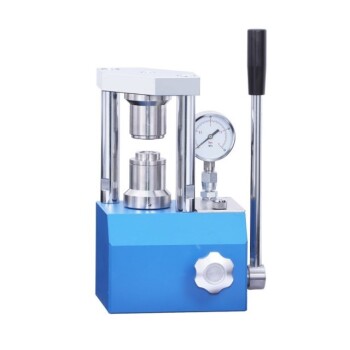
A digital pressure-controlled electric sealing machine or laboratory press is indispensable for assembling all-solid-state button cells because it provides the constant, quantifiable, and repeatable tightening pressure required to fuse solid components into a functional unit. Unlike liquid electrolytes that naturally flow into gaps, solid-state materials require precise mechanical force to establish the tight interfacial contact necessary for ion transport and electrochemical performance.
Core Insight: The fundamental challenge in all-solid-state batteries is the "solid-solid" interface. Without the precise, high-pressure application provided by these machines, active materials cannot establish the physical continuity required for efficient ion movement, leading to immediate performance failure.
The Critical Role of Interfacial Contact
Overcoming the Solid-Solid Barrier
In traditional batteries, liquid electrolytes wet the electrode surfaces, filling every microscopic gap. In all-solid-state batteries, you are pressing two solids together. A laboratory press applies force—often several hundred megapascals—to create tight physical contact between the cathode, solid electrolyte, and anode.
Eliminating Internal Voids
Without sufficient pressure, microscopic air gaps (voids) remain between particles. These voids act as insulators, blocking the flow of ions. High-pressure compaction forces the materials to merge, effectively eliminating internal porosity and creating continuous pathways for lithium ions and electrons.
Inducing Plastic Deformation
To achieve high densification, the pressure must be significant enough to cause plastic deformation in the particles. This means the solid electrolyte powder and electrode materials physically deform to mold against one another, minimizing physical interfacial impedance.
Ensuring Long-Term Structural Integrity
Preventing Delamination
During charge and discharge cycles, active materials in the battery expand and contract. Without a maintained constant pressure, these volume changes can cause the layers to separate (delaminate). The electric sealing machine ensures the stack remains compressed, preventing interlayer separation that would otherwise sever the ionic pathway.
Stabilizing the Solid Electrolyte Interphase (SEI)
Uniform pressure is required to bond the electrolyte to the lithium metal anode. This close contact facilitates specific chemical reactions (such as with In-MOF) during initial cycles to generate a dense, inorganic-rich SEI layer. This layer is vital for reducing interfacial impedance and ensuring stable operation.
Maintaining Sealing Integrity
Precise pressure control prevents micro-displacements during the sealing process itself. This ensures the battery remains hermetically sealed against external impurities while maintaining the internal alignment necessary for long-term cycling and high-rate testing.
Common Pitfalls and Trade-offs
The Risk of Inconsistent Pressure
Manual or uncontrolled sealing methods lead to variable results. If the pressure is too low, interface resistance remains high; if it varies between cells, your data becomes unreliable. Digital control ensures repeatability, allowing you to isolate material performance from assembly errors.
Balancing Pressure and Integrity
While high pressure is necessary for contact, it must be applied uniformly. A laboratory press ensures the load is distributed evenly across the cell. This guarantees a uniform thickness of the electrolyte layer, establishing a consistent baseline for advanced diagnostics like Electrochemical Impedance Spectroscopy (EIS).
Making the Right Choice for Your Goal
To maximize the success of your all-solid-state battery assembly, consider your specific testing objectives:
- If your primary focus is reducing internal resistance: Prioritize equipment capable of delivering high pressures (e.g., 360–530 MPa) to induce plastic deformation and maximize particle-to-particle contact.
- If your primary focus is long-term cycle life: Ensure your equipment can maintain a constant holding pressure (e.g., 100 MPa) to counteract the stress of volume expansion during charging.
- If your primary focus is reproducible research: Rely on digital pressure controls to standardize the density and thickness of your electrolyte layers for consistent EIS analysis.
Success in all-solid-state battery research is defined by your ability to turn loose powder into a dense, unified solid through precise mechanical control.
Summary Table:
| Feature | Importance in Solid-State Assembly | Impact on Battery Performance |
|---|---|---|
| Interfacial Contact | Fuses solid layers (cathode/electrolyte/anode) | Minimizes ionic resistance and impedance |
| Void Elimination | Removes microscopic air gaps through compaction | Creates continuous pathways for ion transport |
| Plastic Deformation | Forces materials to mold against each other | Increases densification and material unity |
| Pressure Stability | Prevents delamination during volume changes | Ensures long-term cycling and structural integrity |
| Digital Control | Provides quantifiable and repeatable force | Standardizes research data and cell reliability |
Elevate Your Battery Research with KINTEK Precision
Achieving the perfect solid-solid interface requires more than just force—it requires precision. KINTEK specializes in comprehensive laboratory pressing solutions tailored for advanced energy research. Whether you need manual, automatic, heated, or glovebox-compatible models, or advanced cold and warm isostatic presses, our equipment is designed to deliver the exact megapascal pressure needed to eliminate voids and induce plastic deformation in your battery cells.
Ready to standardize your assembly process and reduce interfacial impedance? Contact KINTEK Today to Find Your Ideal Pressing Solution
References
- David Orisekeh, Xinyi Xiao. Solid-to-Solid Manufacturing Processes for High-Performance Li-Ion Solid-State Batteries. DOI: 10.3390/polym17131788
This article is also based on technical information from Kintek Solution Knowledge Base .
Related Products
- Button Battery Sealing Press Machine for Lab
- Button Battery Sealing Machine for Button Batteries
- Manual Button Battery Sealing Machine for Battery Sealing
- Electric Split Lab Cold Isostatic Pressing CIP Machine
- Electric Lab Cold Isostatic Press CIP Machine
People Also Ask
- Why use standardized CR2032 components & high-precision presses? Ensure reliability in lithium metal battery research.
- Why is a laboratory battery sealing press essential for desolvation energy testing? Ensure Reliable Kinetic Data
- Why is a laboratory hydraulic press or battery sealing machine essential? Ensure Coin Cell Data Integrity
- How do laboratory battery sealing machines ensure performance consistency? Master Your Lithium and LFP Battery Assembly
- What role does a laboratory sealing press play in thermal analysis of solid dispersion films? Ensure Data Integrity