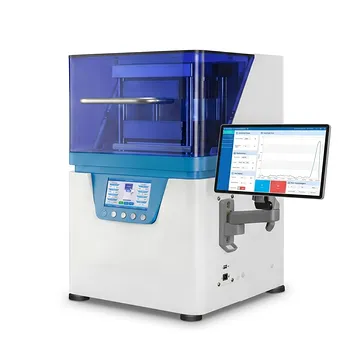
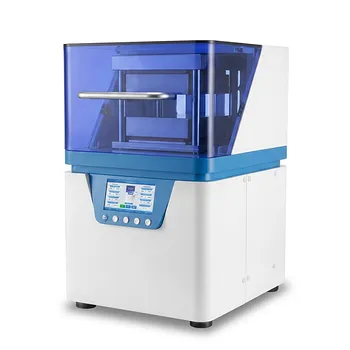
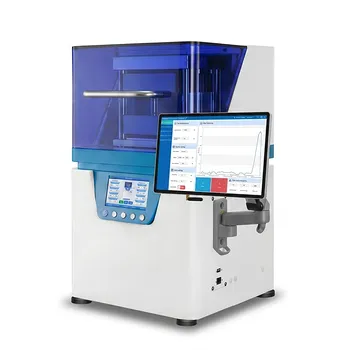
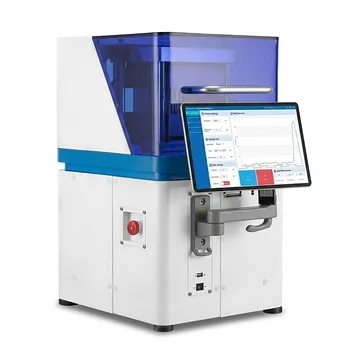
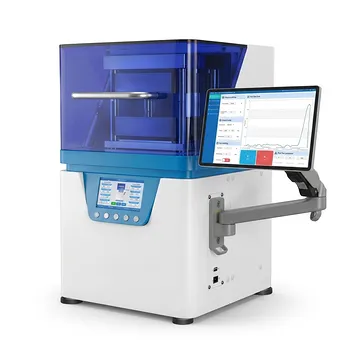
The precision required for polymer testing demands a specimen free of internal flaws. A heated hydraulic press is used to prepare HDPE/LLDPE film specimens because it provides the simultaneous control of high temperature and high pressure necessary to fully melt the resin and eliminate internal air bubbles. This process ensures the resulting films have a uniform thickness, high density, and smooth surface finish required for standardized physical property testing.
The core utility of the heated hydraulic press lies in its ability to transform raw polymer pellets into standardized, high-density test specimens by eliminating voids and ensuring structural uniformity. This controlled environment is the only way to guarantee that subsequent test data reflects the material's true properties rather than manufacturing defects.
The Synergy of Thermal and Mechanical Control
Achieving Full Polymer Fusion
For semi-crystalline polymers like HDPE and LLDPE, reaching a precise melt temperature (often between 135°C and 190°C) is critical. The heated press ensures the resin particles transition into a homogenous melt, allowing the molecular chains to flow and interlock completely.
High-Pressure Consolidation
The application of high pressure, typically around 10 MPa, forces the polymer melt to occupy every corner of the mold. This mechanical force is essential for achieving the high density and structural integrity required for accurate mechanical analysis.
Elimination of Internal Voids
Air bubbles and gas pockets act as stress concentrators that can cause premature failure during testing. The combination of heat and pressure effectively expels air gaps and volatiles, producing a solid, void-free specimen.
Ensuring Specimen Standardization and Reliability
Precision Thickness and Surface Quality
Standardized tests require specimens with minimal thickness deviation to ensure stress is distributed evenly. The hydraulic press utilizes precision-ground platens to produce films with a smooth surface and uniform cross-section.
Controlled Cooling and Internal Stress
Modern presses allow for programmable cooling stages, which are vital for managing how the polymer crystallizes. Controlled cooling reduces internal residual stresses, which could otherwise skew the results of creep or fatigue testing.
Reproducibility in Laboratory Settings
By utilizing stepped pressure control (e.g., increasing from 5 MT to 15 MT), technicians can ensure every specimen is created under identical conditions. This repeatability is the foundation of reliable spectroscopic, mechanical, and barrier property evaluations.
Understanding the Trade-offs and Limitations
Risk of Thermal Degradation
Exposure to high temperatures for extended periods can lead to polymer degradation or chain scission. It is critical to balance the "soak time" required for melting with the thermal stability of the specific HDPE or LLDPE grade being tested.
Complexity of Pressure Calibration
If the hydraulic system is not perfectly calibrated, it can produce density gradients across the specimen. These gradients create "weak spots" that result in inconsistent data across a single batch of test plates.
Material Flash and Waste
High-pressure molding often results in "flash," where excess material escapes the mold boundaries. While this ensures the mold is completely full, it requires manual trimming and can lead to material waste in high-volume testing environments.
How to Apply This to Your Project
Recommendations Based on Testing Goals
To get the best results from your heated hydraulic press, align your process parameters with your primary analytical objective.
- If your primary focus is mechanical tensile testing: Prioritize the elimination of internal voids and surface scratches, as these are the leading causes of premature specimen failure.
- If your primary focus is optical or spectroscopic analysis (FTIR/XRF): Focus on achieving the thinnest possible uniform film to ensure maximum light transmission and accurate chemical signatures.
- If your primary focus is barrier property evaluation: Emphasize precise temperature control during the cooling phase to ensure a consistent crystalline structure throughout the film.
By mastering the balance of heat and pressure, you ensure that your laboratory data is a definitive reflection of the material's inherent performance.
Summary Table:
| Parameter | Function / Benefit | Importance to Testing |
|---|---|---|
| High Temperature | Achieves full polymer fusion (135°C - 190°C) | Ensures molecular chains flow and interlock completely |
| High Pressure | Mechanical consolidation (approx. 10 MPa) | Forces melt into every mold corner and increases density |
| Vacuum Effect | Elimination of internal voids and bubbles | Prevents premature failure caused by stress concentrators |
| Precision Platens | Uniform thickness and smooth surface | Guarantees even stress distribution during mechanical analysis |
| Controlled Cooling | Management of polymer crystallization | Reduces internal residual stresses for reliable creep/fatigue data |
Elevate Your Material Testing with KINTEK Precision
Ready to achieve unmatched consistency in your laboratory results? KINTEK specializes in comprehensive laboratory pressing solutions, offering manual, automatic, heated, multifunctional, and glovebox-compatible models, as well as cold and warm isostatic presses widely applied in polymer analysis and battery research.
From preparing standardized HDPE/LLDPE films to developing advanced battery materials, our high-precision equipment ensures every specimen is free of internal flaws and ready for rigorous analysis. Don't let manufacturing defects skew your data—partner with the experts in laboratory consolidation.
Contact KINTEK today to find the perfect press for your research!
References
- Najat J. Saleh, Weam A. Abed. Studing Of Some Phisical Properties And Morphology Of Blends Of Hdpe /Lldpe After And Before Exposure To Uv Light. DOI: 10.30684/etj.27.4.18
This article is also based on technical information from Kintek Solution Knowledge Base .
Related Products
- Heated Hydraulic Press Machine with Heated Plates for Vacuum Box Laboratory Hot Press
- Automatic High Temperature Heated Hydraulic Press Machine with Heated Plates for Lab
- Automatic Heated Hydraulic Lab Press with Programmable Touch Screen Controls and Precision Temperature Regulation
- Automatic Hydraulic Heat Press Machine with Multi Stage Programmable Control and Integrated Water Cooling Plate Size 180x180mm
- Automatic Hydraulic Hot Press with Large Plate and Precision Temperature Control for Advanced Material Sample Preparation and Industrial Research
People Also Ask
- What are the requirements for electrode pressing with high-viscosity ionic liquids like EMIM TFSI? Optimize Performance
- How does a laboratory heated hydraulic press facilitate PBN sample prep for WAXS? Achieve Precise X-Ray Scattering
- What are the industrial applications of heated hydraulic presses? Master Heat & Force for Precision Manufacturing
- Function of a Laboratory Hydraulic Press with Heated Platens in SSE? Enhance Battery Density & Conductivity
- How are heated hydraulic presses utilized in the preparation of thin films? Key Mechanisms and Applications