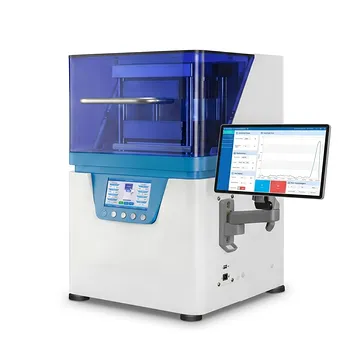
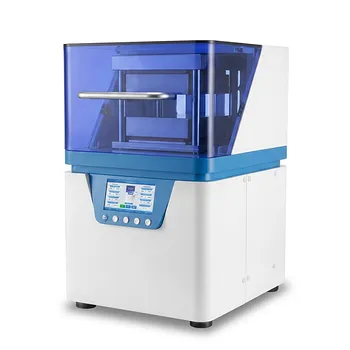
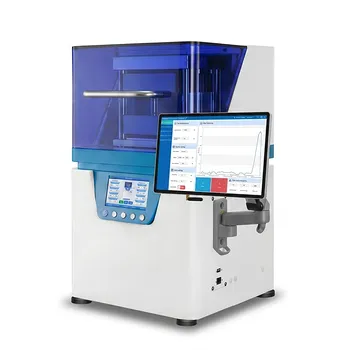
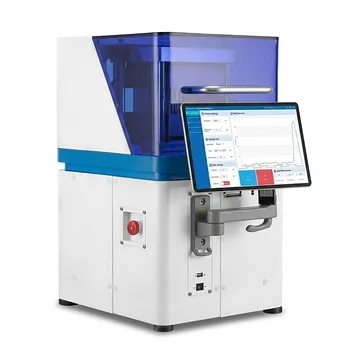
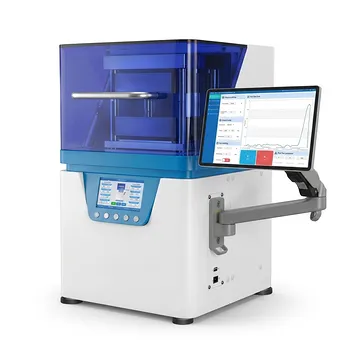
Heated hydraulic presses facilitate the preparation of thin films by subjecting raw materials—typically powders or polymers—to the simultaneous application of thermal energy and mechanical force. This dual-action process consolidates the material, inducing thermoplastic deformation to create a product with uniform thickness, consistent density, and high structural integrity.
The Core Insight While pressure alone can compact a material, the addition of controlled heat is what allows for diffusion bonding and flow. This ensures the final thin film is free of internal voids and density gradients, which is critical for accurate analysis in spectroscopy and advanced materials research.
The Principles of Film Formation
Simultaneous Heat and Pressure
The primary mechanism at work is the combination of hydraulic force with precise temperature control.
By applying heat, the press softens the material, promoting thermoplastic deformation. Simultaneously, the hydraulic pressure forces the particles or polymer chains to flow and bond together, a process often referred to as diffusion bonding.
Eliminating Density Gradients
A major challenge in creating thin films from loose powders is achieving homogeneity.
The heated press eliminates density gradients within the "green body" (the compacted but unfired material). This ensures a uniform distribution of lattice sites throughout the film’s three-dimensional space.
Preventing Microstructural Defects
Without heat, pressure might leave localized regions of high or low density.
Heated pressing prevents the formation of loose regions that could block ion hopping paths. This ensures that the internal structure—such as the site mapping of an electrolyte—is representative across the entire sample.
Applications Across Material Types
Polymer Films for Spectroscopy
In the analysis of polymers, heated presses are essential for creating samples for transmission IR spectroscopy and mechanical testing.
The press consolidates the polymer into a film with specific properties regarding crystallinity and density. This allows researchers to study the material's structure without artifacts introduced by uneven preparation.
Advanced Powder Compaction
For materials like sulfide powders used in solid-state batteries, the press plays a critical role in reducing interfacial impedance.
The constant high pressure causes plastic deformation in the powder particles, ensuring tight contact between them. When heat is added, it enhances adhesion between different components (e.g., polymers and sulfides), significantly improving the ionic conductivity of the resulting membrane.
Understanding the Trade-offs
Process Sensitivity
While effective, the process requires rigorous control over process parameters.
If the temperature is too high, the material may degrade or alter its chemical composition before the film is formed. Conversely, insufficient pressure may result in a film that lacks structural integrity or contains voids.
Equipment Limitations
Heated hydraulic presses are excellent for batch processing and laboratory-scale sample preparation.
However, for large-scale continuous manufacturing, other methods (like roll-to-roll processing) may be more efficient, though they often lack the extreme pressure capabilities of a hydraulic system.
Making the Right Choice for Your Goal
To maximize the utility of a heated hydraulic press for your specific application, consider the following:
- If your primary focus is Optical/Spectroscopic Analysis: Ensure your press can deliver precise, low-variance thickness to prevent path-length errors in IR or XRF readings.
- If your primary focus is Battery or Electrolyte Research: Prioritize high-pressure capabilities to minimize interfacial impedance and maximize density for ion transport.
- If your primary focus is Polymer Testing: Focus on temperature control accuracy to manage crystallinity without inducing thermal degradation.
By leveraging the dual power of heat and pressure, you transform loose, variable materials into uniform, high-performance films ready for rigorous analysis.
Summary Table:
| Feature | Mechanism/Benefit | Impact on Thin Film Quality |
|---|---|---|
| Thermal Energy | Promotes thermoplastic deformation and diffusion bonding | Eliminates internal voids and structural defects |
| Mechanical Force | High hydraulic pressure for particle flow | Ensures uniform thickness and consistent density |
| Structural Control | Minimizes density gradients and lattice site variation | Improves ion conductivity and spectroscopic accuracy |
| Versatility | Adjustable temperature and pressure parameters | Suitable for polymers, sulfides, and battery materials |
Elevate Your Material Research with KINTEK Precision
Ready to achieve flawless thin film preparation? KINTEK specializes in comprehensive laboratory pressing solutions designed for the most demanding applications. Whether you are conducting advanced battery research or spectroscopic analysis, our range of manual, automatic, heated, and multifunctional models—including glovebox-compatible and isostatic presses—delivers the uniform thickness and high density your research requires.
Why choose KINTEK?
- Precision Control: Master thermoplastic deformation with industry-leading temperature and pressure accuracy.
- Versatile Solutions: From sulfide powder compaction to polymer film creation, we have the right press for your workflow.
- Expert Support: Benefit from our deep expertise in laboratory material processing.
Contact KINTEK Today to Find Your Perfect Pressing Solution!
Related Products
- Heated Hydraulic Press Machine with Heated Plates for Vacuum Box Laboratory Hot Press
- Automatic High Temperature Heated Hydraulic Press Machine with Heated Plates for Lab
- Automatic Heated Hydraulic Lab Press with Programmable Touch Screen Controls and Precision Temperature Regulation
- Automatic Hydraulic Heat Press Machine with Multi Stage Programmable Control and Integrated Water Cooling Plate Size 180x180mm
- Automatic Hydraulic Hot Press with Large Plate and Precision Temperature Control for Advanced Material Sample Preparation and Industrial Research
People Also Ask
- What are the requirements for electrode pressing with high-viscosity ionic liquids like EMIM TFSI? Optimize Performance
- How does a laboratory heated hydraulic press facilitate PBN sample prep for WAXS? Achieve Precise X-Ray Scattering
- What are the industrial applications of heated hydraulic presses? Master Heat & Force for Precision Manufacturing
- Function of a Laboratory Hydraulic Press with Heated Platens in SSE? Enhance Battery Density & Conductivity
- What industrial applications does a heated hydraulic press have beyond laboratories? Powering Manufacturing from Aerospace to Consumer Goods