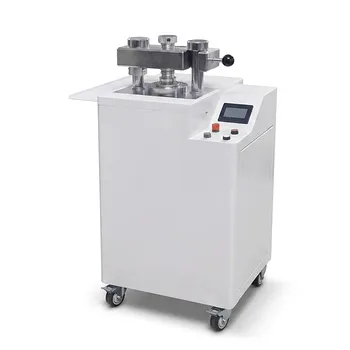
Precision laboratory hot presses are the linchpin of flame retardant polypropylene (PP) research because they provide the exact thermal and mechanical conditions required to eliminate internal defects and ensure material uniformity. By utilizing multi-stage pressure cycles and precise temperature management, these machines produce sample plates with the consistent thickness and high structural density necessary for valid fire safety certification.
A high-precision hot press transforms raw composites into standardized test specimens by eliminating air bubbles and internal stresses. This process ensures that the physical properties of the sample plate accurately represent the material's true performance during rigorous flame-retardant testing.
Eliminating Internal Defects and Porosity
The Role of Multi-Stage Pressure Cycles
The molding process often requires a delicate transition from low-pressure preheating to high-pressure compaction. For example, applying 20 kN during preheating followed by 50 kN for compaction allows the polypropylene to melt fully before the final shape is set.
Removing Air Bubbles and Micro-Voids
High-pressure molding is critical for forcing micro-bubbles out of the polymer melt. If these air pockets remain, they can act as "fuel" or pathways for heat during testing, leading to inconsistent results in the Limiting Oxygen Index (LOI) or UL94 vertical burning tests.
Achieving Theoretical Density
A precision press ensures that the experimental density of the sample plate matches its theoretical density. This homogeneity is a vital prerequisite for any quantitative research, ensuring that there are no density gradients that could skew mechanical or thermal data.
Achieving Structural and Thermal Uniformity
Precise Temperature Control and Thermal Fields
Maintaining a uniform thermal field (such as 210°C) across the entire platen surface is essential for consistent melting. This prevents localized "cold spots" that could lead to incomplete fusion of polypropylene granules or uneven distribution of flame-retardant additives.
Managing Crystallization and Internal Stress
The ability to control the cooling rate after pressing is just as important as the heating phase. Controlled cooling dictates the polymer crystallization process and spherulite size, which directly affects the mechanical integrity and internal stress levels of the final plate.
Ensuring Consistent Specimen Thickness
Standardized fire tests require specimens of a predetermined, uniform thickness. High-precision presses utilize upper and lower platens that maintain perfect parallelism, ensuring the resulting sheets are flat and meet the strict dimensional requirements of global testing standards.
Understanding the Trade-offs
The Risk of Material Degradation
While high temperatures are necessary for melting, excessive heat or prolonged dwell times can cause thermal degradation of the polypropylene matrix or the flame-retardant additives. A high-precision press mitigates this by allowing for tight control over the heating duration.
Balancing Pressure and Flow
If the pressure is applied too rapidly, it can cause internal stresses or uneven fiber arrangement in reinforced composites. Conversely, insufficient pressure fails to eliminate voids; finding the "sweet spot" requires equipment capable of fine, incremental adjustments.
How to Apply This to Your Project
Making the Right Choice for Your Goal
- If your primary focus is regulatory compliance (UL94/LOI): Prioritize a press with multi-stage pressure switching to ensure zero-void density and exact thickness consistency.
- If your primary focus is material science and morphology: Look for a system with programmable cooling rates to precisely control the crystallization and spherulite growth of the PP matrix.
- If your primary focus is composite fabrication (e.g., fiber-reinforced): Ensure the press provides a stable, high-pressure environment to facilitate the total impregnation of fibers within the polymer.
By mastering the variables of temperature and pressure, researchers can ensure that their flame-retardant samples are defined by their chemistry rather than their manufacturing flaws.
Summary Table:
| Key Feature | Impact on PP Molding | Research Advantage |
|---|---|---|
| Multi-Stage Pressure | Eliminates micro-bubbles and voids | Achieves theoretical material density |
| Thermal Uniformity | Prevents localized cold spots | Ensures consistent additive distribution |
| Platen Parallelism | Guarantees uniform specimen thickness | Meets strict UL94/LOI testing standards |
| Cooling Control | Manages polymer crystallization | Minimizes internal stress and defects |
Optimize Your Sample Preparation with KINTEK
Ensure the integrity of your flame-retardant research with KINTEK’s comprehensive laboratory pressing solutions. Whether you require manual, automatic, heated, or multifunctional models, our equipment is designed to provide the precision needed for battery research and advanced polymer science. Our range includes glovebox-compatible models and isostatic presses tailored for high-density requirements.
Ready to eliminate manufacturing flaws from your test specimens? Contact our experts today to find the perfect solution for your lab!
References
- Thuy Tien Nguyen Thanh, Beáta Szolnoki. Development of Intumescent Flame Retardant for Polypropylene: Bio-epoxy Resin Microencapsulated Ammonium-polyphosphate. DOI: 10.3311/ppch.19468
This article is also based on technical information from Kintek Solution Knowledge Base .
Related Products
- Automatic High Temperature Heated Hydraulic Press Machine with Heated Plates for Lab
- Automatic Hydraulic Hot Press with Large Plate and Precision Temperature Control for Advanced Material Sample Preparation and Industrial Research
- 24T 30T 60T Heated Hydraulic Lab Press Machine with Hot Plates for Laboratory
- Automatic Heated Hydraulic Press Machine with Heated Plates for Laboratory
- Automatic Heated Hydraulic Press Machine with Hot Plates for Laboratory
People Also Ask
- Function of a Laboratory Hydraulic Press with Heated Platens in SSE? Enhance Battery Density & Conductivity
- What are the requirements for electrode pressing with high-viscosity ionic liquids like EMIM TFSI? Optimize Performance
- How does a laboratory heated hydraulic press facilitate PBN sample prep for WAXS? Achieve Precise X-Ray Scattering
- What are the industrial applications of heated hydraulic presses? Master Heat & Force for Precision Manufacturing
- Why is a laboratory hydraulic press with heating plates required for PLA/TEC films? Achieve Precise Sample Integrity