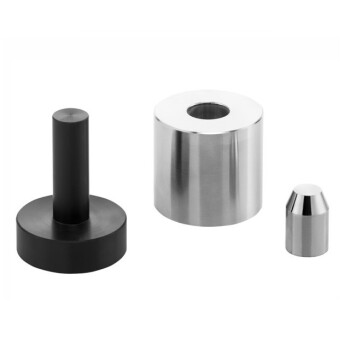
High-precision equipment is the fundamental baseline for valid electrochemical data. A high-precision laboratory press or punching press is necessary to produce electrode discs with exact diameters and clean, burr-free edges. This mechanical accuracy is the only way to prevent physical defects that cause internal short circuits and to ensure that the active material loading remains consistent across every test cell you assemble.
Without precision preparation, you introduce mechanical variables that disguise the true electrochemical performance of your material. Precision ensures that data variations result from the chemistry, not the fabrication method.
Eliminating Physical Failure Modes
Prevention of Internal Short Circuits
The most immediate risk in coin cell preparation is the formation of burrs—small, sharp projections of metal on the edge of the current collector.
Manual or low-quality cutting shears the metal poorly, leaving jagged edges. In the tightly compressed environment of a coin cell, these burrs can puncture the separator, causing a hard internal short circuit. A precision press uses tight-tolerance dies to shear the material cleanly, eliminating this risk entirely.
Protecting Coating Integrity
Electrode films are often brittle or prone to delamination. Dull or unstable cutting tools can cause the active material coating to crack or detach from the current collector (copper or aluminum foil) at the rim of the disc.
Precision machines utilize stable pressure control and alignment. This ensures the electrode structure remains intact right up to the edge, preserving the electronic transmission paths necessary for the battery to function.
Ensuring Data Reliability and Repeatability
Consistency of Active Material Loading
To calculate specific capacity or current density accurately, you must know the exact mass and area of your electrode.
If your cutting method yields discs with slight variations in diameter or ragged edges, the effective contact area becomes a variable rather than a constant. Precision punches guarantee that every disc has the exact same surface area (e.g., exactly 13 mm). This geometric uniformity ensures that mass loading is consistent, allowing for valid comparisons between different cells.
Reducing Interfacial Contact Resistance
While the primary function of a punching press is shaping, laboratory presses are also used to apply vertical pressure to the formed disc.
This process compresses the active powder, conductive agents, and binder, eliminating internal voids. This densification optimizes the pore structure for electrolyte wetting and ensures robust physical contact between particles. The result is minimized interfacial contact resistance and improved mechanical strength.
Understanding the Trade-offs
The "Sharpness" Fallacy
Owning a high-precision press does not guarantee results if the tooling is neglected. The precision lies in the die, not just the hydraulic force.
If the punching die becomes dull or misaligned, even a high-end press will produce burrs. Regular maintenance and inspection of the cutting die are just as critical as the machine itself.
Cutting vs. Calendering
It is important to distinguish between shaping (cutting the disc) and densifying (pressing the disc).
While one machine can sometimes perform both tasks (with different tooling), they serve different purposes. Punching focuses on geometry and edge quality; pressing focuses on porosity and density. Confusing these steps or assuming one covers the other can lead to electrodes that are the right shape but possess poor electronic conductivity due to a lack of density.
Making the Right Choice for Your Goal
To select the right preparation workflow, consider your specific experimental needs:
- If your primary focus is Cycle Life and Safety: Prioritize a press with high-quality, sharp dies to ensure absolutely burr-free edges, preventing separator puncture during long-term testing.
- If your primary focus is Specific Capacity Calculations: Prioritize a machine with rigid stability to guarantee exact geometric consistency, ensuring your area-based math is flawless.
Precision in sample preparation is the invisible prerequisite for accuracy in electrochemical analysis.
Summary Table:
| Feature | Precision Press Benefit | Impact on Battery Testing |
|---|---|---|
| Edge Quality | Burr-free, clean shearing | Prevents separator puncture & internal shorts |
| Geometric Tolerance | Exact diameter consistency | Ensures accurate mass loading & capacity math |
| Coating Integrity | Stable alignment, no delamination | Maintains electronic transmission & active area |
| Densification | Optimized porosity & contact | Lowers interfacial resistance & improves wetting |
Elevate Your Battery Research with KINTEK Precision
Unreliable electrode fabrication can ruin months of research. KINTEK specializes in comprehensive laboratory pressing solutions designed to eliminate mechanical variables. Whether you need manual, automatic, heated, or glovebox-compatible models, our equipment ensures your data reflects your chemistry, not fabrication flaws.
Our value to you:
- Versatile Solutions: From cold and warm isostatic presses to specialized coin cell punches.
- Precision Engineering: High-tolerance dies for burr-free, consistent electrode discs.
- Expert Support: Equipment tailored for the rigorous demands of modern battery R&D.
Contact KINTEK Today to Optimize Your Lab Workflow
References
- Behnoosh Bornamehr, Volker Presser. High-Performance Lithium-Ion Batteries with High Stability Derived from Titanium-Oxide- and Sulfur-Loaded Carbon Spherogels. DOI: 10.1021/acsami.3c16851
This article is also based on technical information from Kintek Solution Knowledge Base .
Related Products
- Automatic Laboratory Hydraulic Press for XRF and KBR Pellet Pressing
- Lab Polygon Press Mold
- Special Shape Lab Press Mold for Laboratory Applications
- Assemble Lab Cylindrical Press Mold for Laboratory Use
- Lab Cylindrical Press Mold for Laboratory Use
People Also Ask
- Why is pressing powder into a pellet critical before sintering? Ensure Dense, Conductive Solid-State Electrolytes
- What is the role of a laboratory pressure machine and KBr in FTIR? Master Sample Preparation for Flame Retardants
- What are the advantages of using a laboratory automatic hydraulic press for HEA green compact forming?
- What are the advantages of using a lab automatic hydraulic press for HEA green body molding? Ensure Material Integrity
- What are the technical advantages of an automatic laboratory hydraulic press for biomimetic surfaces?