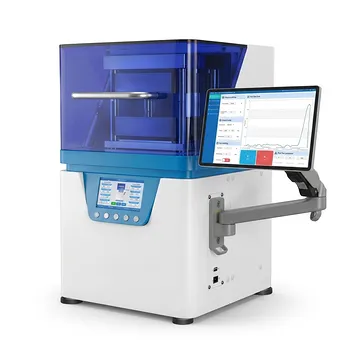
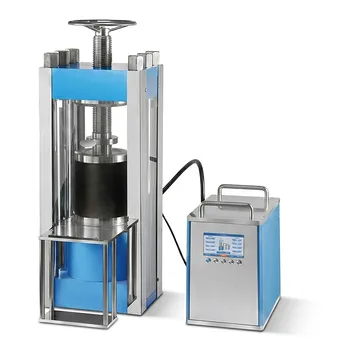
Achieving structural integrity in brominated polystyrene films requires crossing a specific thermal threshold. Heating capability exceeding 300°C is critical because brominated polystyrene powders pressed at lower temperatures only achieve superficial physical fusion, resulting in brittle and non-uniform blanks. Reaching this high temperature ensures complete melt flow, which is necessary to eliminate internal 50-micron particulate structures and produce high-quality experimental films with consistent density and thickness.
Central Takeaway: A high-temperature press exceeding 300°C is the only way to transition from a brittle, particulate-based "fused" powder to a truly homogenous, high-density film suitable for precise experimental targets.
Overcoming the Limitations of Low-Temperature Fusion
The Failure of Physical Fusion
At temperatures below 300°C, brominated polystyrene powder particles may stick together, but they do not fully merge at a molecular level. This state, known as physical fusion, creates a structurally weak "blank" that remains highly brittle. These blanks lack the mechanical robustness required for handling or subsequent physical testing.
Eliminating Internal Particulate Structures
Brominated polystyrene powder typically contains internal particulate structures of approximately 50 microns. If the heating capability is insufficient, these structures persist within the pressed film, creating points of failure and non-uniformity. Only temperatures exceeding 300°C provide the thermal energy required to force a complete melt flow, dissolving these particulate boundaries entirely.
Engineering High-Quality Experimental Targets
Achieving Precise Thickness and Density
For high-quality physical experiments, films must reach a uniform thickness of approximately 25 microns. A high-performance heated press allows the material to flow into a perfectly flat, thin layer while maintaining a consistent density throughout the sheet. This precision is impossible if the material is not fully molten, as unmelted particles create localized thickness variations.
Eliminating Micropores and Internal Stresses
The transition to a full melt state, when combined with applied pressure, effectively eliminates micropores that may be left behind by previous processing steps like solution casting. Precise thermal management during this phase ensures that the final film is free of internal stresses. This results in standardized specimens that provide accurate data during thermal and mechanical property testing.
Understanding the Trade-offs and Risks
The Risk of Thermal Degradation
While 300°C is the necessary floor for melt flow, excessive heat beyond the material's stability point can lead to polymer degradation. If the temperature is not precisely controlled, the recycled or brominated plastic can break down chemically, compromising the structural strength of the final product.
The Interplay of Temperature and Viscosity
Maintaining a constant, precise temperature is critical because heat directly dictates the melt viscosity of the polymer. If the temperature fluctuates or is too low, the polymer cannot flow sufficiently to create a smooth surface or achieve proper interfacial bonding. Conversely, maintaining high pressure without the correct temperature will fail to eliminate the 50-micron particulate structures.
How to Apply This to Your Material Preparation
To ensure your brominated polystyrene films meet the required experimental standards, align your pressing strategy with your specific quality goals:
- If your primary focus is structural uniformity: Ensure your press maintains a stable temperature above 300°C to fully eliminate 50-micron particulate boundaries.
- If your primary focus is thin-film accuracy (e.g., 25 microns): Use a high-performance press that combines 300°C+ heat with precise pressure maintenance to ensure even flow across the die.
- If your primary focus is material longevity and testing accuracy: Monitor for signs of degradation and ensure the press provides rapid, uniform heating to minimize the time the polymer spends at peak temperature.
By mastering the transition from physical fusion to a complete melt, you transform brittle powders into the precise, high-density films required for sophisticated technical analysis.
Summary Table:
| Feature | Below 300°C (Physical Fusion) | Above 300°C (Melt Flow) |
|---|---|---|
| Structural Integrity | Brittle, particulate-based blanks | Homogenous, high-density films |
| Internal Structure | Persistent 50-micron particles | Complete molecular merger |
| Film Uniformity | Localized thickness variations | Consistent ~25 micron thickness |
| Material Quality | High micropores & internal stress | Minimized pores & stress-free |
| Application | Unsuitable for precise testing | Ideal for high-quality experiments |
Elevate Your Material Research with KINTEK
Unlock precision in your lab with KINTEK’s specialized laboratory pressing solutions. Achieving the critical 300°C+ threshold for brominated polystyrene requires equipment that delivers both high-temperature stability and precise pressure control.
From manual and automatic heated models to multifunctional and isostatic presses, our technology is designed to eliminate internal stresses and micropores, ensuring your battery research and material samples meet the highest experimental standards.
Ready to optimize your thin-film production? Contact KINTEK today for expert guidance and equipment tailored to your needs!
References
- C. Spindloe, G. Gregori. Target fabrication for the POLAR experiment on the Orion laser facility. DOI: 10.1017/hpl.2015.2
This article is also based on technical information from Kintek Solution Knowledge Base .
Related Products
- Automatic High Temperature Heated Hydraulic Press Machine with Heated Plates for Lab
- Automatic Hydraulic Hot Press with Large Plate and Precision Temperature Control for Advanced Material Sample Preparation and Industrial Research
- Lab Heat Press Special Mold
- Lab Polygon Press Mold
- 24T 30T 60T Heated Hydraulic Lab Press Machine with Hot Plates for Laboratory
People Also Ask
- Function of a Laboratory Hydraulic Press with Heated Platens in SSE? Enhance Battery Density & Conductivity
- What are the requirements for electrode pressing with high-viscosity ionic liquids like EMIM TFSI? Optimize Performance
- How does a laboratory heated hydraulic press facilitate PBN sample prep for WAXS? Achieve Precise X-Ray Scattering
- What are the industrial applications of heated hydraulic presses? Master Heat & Force for Precision Manufacturing
- Why is a laboratory hydraulic press with heating plates required for PLA/TEC films? Achieve Precise Sample Integrity