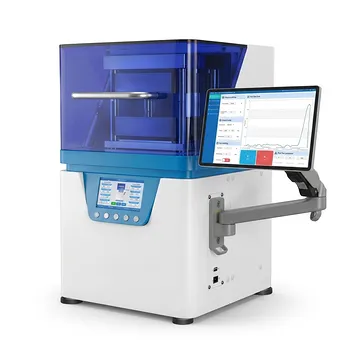
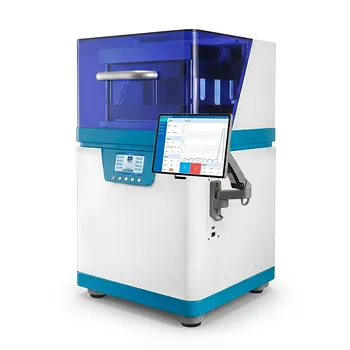
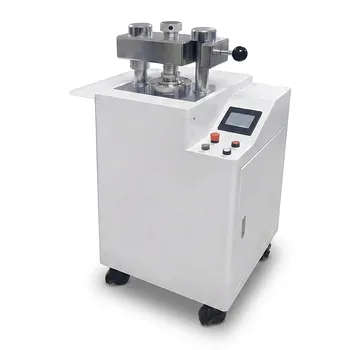
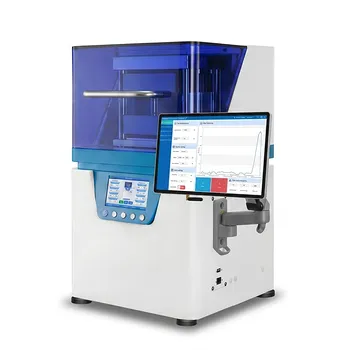
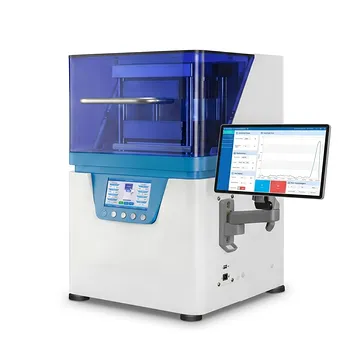
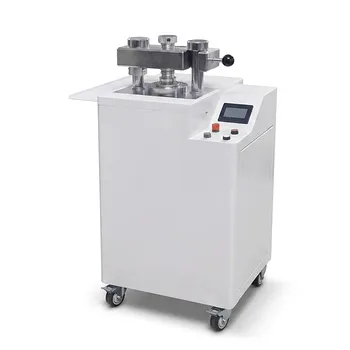
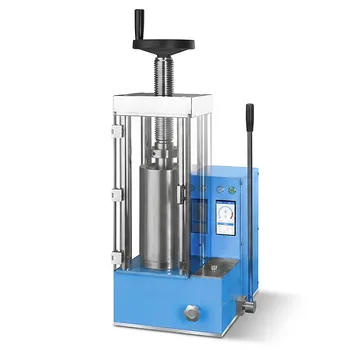
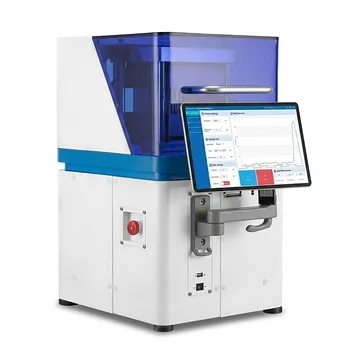
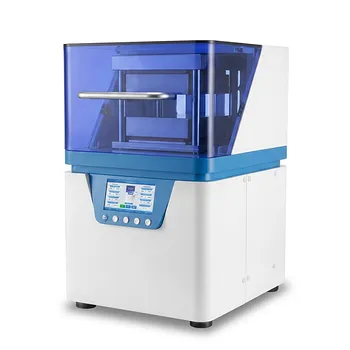
High-tonnage automatic hydraulic presses are essential for ceramic target fabrication because they provide the extreme pressure uniformity required to achieve near-theoretical density. This mechanical consistency ensures the target can withstand high-energy bombardment during deposition processes like sputtering or pulsed laser deposition (PLD). Without this level of precision, targets develop micro-cracks and density gradients that directly degrade the epitaxial quality and electrical performance of the resulting ferroelectric thin films.
Core Takeaway: The high-tonnage press acts as the critical foundation for thin-film quality by eliminating structural voids and ensuring a stable, consistent flow of particles during the deposition process, which is mandatory for advanced ferroelectric applications.
Achieving Structural Integrity and Maximum Density
Eliminating Internal Voids and Micro-cracks
High-tonnage presses apply a precise, uniform load to high-purity oxide powders, forcing particles to rearrange and bond tightly. This level of compaction creates a "green body" that is virtually free of the internal micro-cracks that typically expand during high-temperature sintering.
Maintaining Stability Under High-Energy Bombardment
Ceramic targets in thin-film production are subjected to intense energy beams that can cause uneven peeling or catastrophic cracking if the target is not perfectly dense. A high-tonnage press ensures the internal structure is robust enough to provide a stable particle flow, which is vital for maintaining the compositional consistency of the deposited film.
Securing Epitaxial Growth and Lattice Matching
For ferroelectric materials like PbZrO3, the film's performance depends on its ability to grow epitaxially on a substrate. By producing a high-density target with minimal impurities, the press ensures the lattice matching required for strain engineering is accurately achieved during film growth.
Regulating Material Dynamics During Synthesis
Managing Grain Growth and Phase Transformations
Advanced hydraulic presses often integrate heating elements to enable hot-press sintering, which regulates grain growth kinetics. This synergy of temperature and pressure is crucial for stabilizing high-symmetry phases that are difficult to maintain at atmospheric pressure but are necessary for ferroelectric performance.
Reducing Porosity and Impurity Oxidation
Vacuum-integrated hydraulic presses remove air and trace volatiles from the mold cavity during the compression cycle. This significantly reduces the porosity of the finished target, preventing the oxidation of raw materials and ensuring high electrical and thermal conductivity.
Driving Atomic Rearrangement
In complex materials such as high-entropy ceramics, high-pressure environments drive the atomic rearrangement necessary for the formation of stable, high-purity samples. This results in targets with superior thermodynamic properties, which translates to more reliable and higher-performing thin-film devices.
Understanding the Trade-offs and Pitfalls
The Risk of Over-Pressing
While high tonnage is necessary, exceeding the material's structural limits during the "pressing" phase can lead to lamination defects. If pressure is released too quickly or applied unevenly, the elastic recovery of the powder can cause the green body to split into layers.
Equipment Complexity and Cost
Automatic high-tonnage systems represent a significantly higher capital investment than manual laboratory presses. They require precise maintenance of the hydraulic seals and calibration of the pressure transducers to ensure the repeatability required for scientific research.
Material Specificity
Not all ceramic materials respond identically to high pressure; some may undergo unwanted phase changes if the tonnage is too high. Selecting the correct pressure requires a deep understanding of the specific material's deformation mechanics and sintering profile.
How to Apply This to Your Thin-Film Project
Choosing the right pressing strategy is a prerequisite for achieving high-performance ferroelectric devices.
- If your primary focus is epitaxial film quality: Prioritize a high-tonnage press with vacuum capabilities to minimize porosity and ensure the chemical purity required for precise lattice matching.
- If your primary focus is high-throughput sputtering: Select an automatic system with high dwelling precision to ensure target density is uniform across the entire surface, preventing uneven target wear.
- If your primary focus is experimental phase stability: Invest in a heated hydraulic press (hot-press) to control grain growth and stabilize the specific crystalline phases required for ferroelectric switching.
The physical integrity of the ceramic target is the silent guardian of the thin film's ultimate electrical and structural success.
Summary Table:
| Key Feature | Impact on Ceramic Target | Benefit to Thin-Film Production |
|---|---|---|
| Extreme Uniform Pressure | Eliminates micro-cracks & internal voids | Ensures stable particle flow during bombardment |
| High-Tonnage Compaction | Achieves near-theoretical density | Prevents target peeling & catastrophic cracking |
| Vacuum/Heating Integration | Reduces porosity & impurity oxidation | Secures epitaxial growth & lattice matching |
| Automatic Precision | Consistent composition & grain size | Enhances electrical & thermodynamic properties |
Elevate Your Thin-Film Research with KINTEK
High-performance ferroelectric devices start with high-density ceramic targets. KINTEK specializes in comprehensive laboratory pressing solutions designed to meet the rigorous demands of material science. From manual and automatic hydraulic presses to heated, multifunctional, and glovebox-compatible models, our equipment provides the extreme precision required for battery research and advanced ceramic synthesis.
Whether you need cold or warm isostatic presses for maximum density or a high-tonnage automatic system for consistent output, we have the expertise to enhance your lab's efficiency.
Ready to optimize your material density?
Contact KINTEK experts today to find the perfect press for your research goals.
References
- D. M. Hoyle, Tom McLeish. Large amplitude oscillatory shear and Fourier transform rheology analysis of branched polymer melts. DOI: 10.1122/1.4881467
This article is also based on technical information from Kintek Solution Knowledge Base .
Related Products
- Automatic Large Format Laboratory Heated Hydraulic Press 400x400mm Plate Capacity
- Automatic Hydraulic Hot Press with Large Plate and Precision Temperature Control for Advanced Material Sample Preparation and Industrial Research
- Automatic High Temperature Heated Hydraulic Press Machine with Heated Plates for Lab
- Automatic Fluorescence Sample Preparation Press 40 Ton Lab Pellet Press for XRF Analysis
- Automatic Laboratory Hydraulic Press for XRF and KBR Pellet Pressing
People Also Ask
- Why is a laboratory heated hydraulic press required? Ensure Precise Vulcanization for NBR/EPDM Nanocomposites
- What role does a Laboratory Heated Hydraulic Press play in rubber vulcanization? Master Precision Specimen Molding
- How does a laboratory heated hydraulic press improve the performance of dried composite solid-state membranes? Guide
- What role does a laboratory heated hydraulic press play in PLA/MCC molding? Achieve superior composite density.
- Role of Laboratory Heated Hydraulic Presses in Solid Electrolyte Fabrication: Enhance Density & Ionic Conductivity