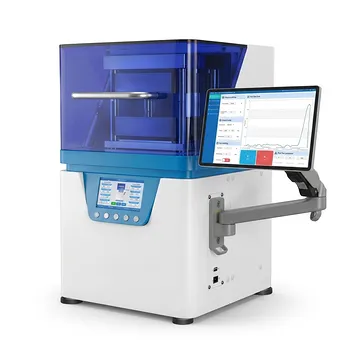
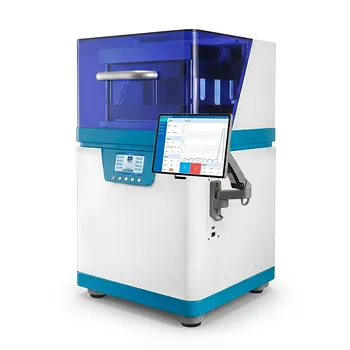
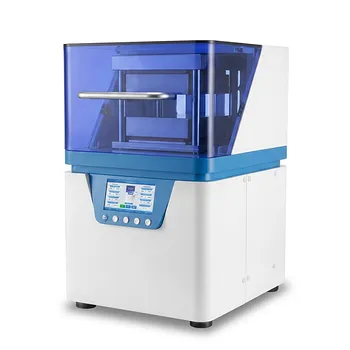
The primary role of a laboratory heated hydraulic press is to ensure high ionic conductivity and accurate impedance measurements by densifying solid electrolyte materials and creating seamless interfaces. By applying synchronized high pressure and controlled heat, the press eliminates internal voids and bonds electrodes to the electrolyte, ensuring that subsequent Electrochemical Impedance Spectroscopy (EIS) results reflect the material's intrinsic properties rather than contact resistance.
A laboratory heated hydraulic press acts as the critical bridge between loose powders and functional electrochemical cells. Its dual action of thermal and mechanical energy minimizes interfacial impedance and optimizes the ion conduction paths necessary for reliable solid-state battery testing.
Achieving Material Densification and Geometric Consistency
Eliminating Voids and Porosity
Solid-state electrolyte (SSE) powders, including sulfides and oxides, naturally contain significant air gaps that impede ion movement. The hydraulic press applies massive axial pressure—often ranging from 200 MPa to 370 MPa—to force particles into a high-density configuration. This consolidation reduces internal porosity, which is the most critical step in lowering the resistance to ion transport.
Standardizing Pellet Dimensions
To obtain reproducible data, samples must have consistent thickness and diameter. The press utilizes specialized molds to compress materials into dense, thin pellets, typically around 200 μm in thickness. This geometric consistency ensures that calculations for ionic conductivity remain uniform across different batches and experimental setups.
Improving Mechanical Strength
A densified pellet is not just electrochemically superior but also mechanically robust. High-pressure compression ensures the solid electrolyte achieves sufficient structural integrity for subsequent battery cycling tests. Without this mechanical pressing, the electrolyte layer would be too fragile to handle or sustain the stresses of interlayer lamination.
Enhancing Interfacial Contact and Ion Transport
Creating Effective Conduction Paths
In the fabrication of impedance cells, the press is used to hot-press catalyzed electrodes directly onto the surface of a membrane. By applying precise pressure (e.g., 111.2 kN) and temperature (e.g., 130°C), the press establishes tight physical contact between the catalyst layer and the electrolyte. This ensures that ions can move freely across the interface without being blocked by microscopic gaps.
Reducing Grain Boundary Resistance
For ceramic and sulfide electrolytes, the resistance at the boundaries between individual grains often dominates the total impedance. The hydraulic press reduces this grain boundary resistance by forcing the particles into atomic-level or micron-level contact. This physical extrusion process is essential for achieving efficient charge and discharge performance in the final cell.
Minimizing Interfacial Impedance
Poor contact between solid materials is a primary obstacle to charge transfer. The hydraulic press overcomes this by utilizing a pressure-holding process that "beds in" the active material particles against the solid electrolyte. This results in a stable structural foundation that accurately represents the bulk transport properties of the material during EIS testing.
The Synergistic Role of Temperature and Pressure
Inducing Viscous Flow in Glassy Materials
When using heated platens, the press can raise the temperature of the electrolyte powder above its glass transition temperature (Tg). At this point, glassy or polymer-based materials soften and exhibit viscous flow. This allows the material to fill voids more effectively than cold-pressing alone, often achieving higher density at lower mechanical pressures.
Thermal Bonding of Components
The heat provided by the press facilitates a semi-permanent bond between the electrolyte and the electrode assembly. In proton exchange membrane (PEM) setups, this thermal synchronization ensures the membrane and the electrode layers behave as a single, integrated unit. This integration is vital for reducing contact resistance to negligible levels.
Understanding the Trade-offs
Pressure Limits and Material Deformation
While higher pressure generally improves density, excessive force can lead to "over-pressing." This can cause micro-cracks in brittle ceramic electrolytes or excessive thinning of polymer membranes. Finding the balance between maximum densification and structural integrity is a common challenge for researchers.
Thermal Degradation Risks
Applying heat improves contact but carries the risk of thermal degradation. If the temperature exceeds the stability window of the organic ionic plastic crystals (OIPC) or the polymer membrane, the material may decompose. Precise control of the heated platens is required to avoid altering the chemical structure of the electrolyte.
Internal Short Circuits
High pressure can sometimes force conductive particles from the electrode through a thin solid electrolyte layer. This creates a vertical "bridge" that causes an internal short circuit. Users must carefully calibrate the pressure based on the thickness of the electrolyte to prevent cell failure during assembly.
How to Apply This to Your Fabrication Process
If you are setting up a laboratory workflow for solid electrolyte testing, consider these recommendations based on your material type:
- If your primary focus is Sulfide or Oxide Powders: Utilize high-pressure cold-pressing (200-370 MPa) to minimize porosity and reduce grain boundary resistance before cell assembly.
- If your primary focus is Polymer or Glassy Electrolytes: Employ the heated platens to reach the glass transition temperature, allowing for better densification at lower pressures through viscous flow.
- If your primary focus is Impedance Accuracy (EIS): Ensure a hot-pressing step is included to bond electrodes to the membrane, as this is the only way to effectively eliminate contact resistance artifacts.
A laboratory heated hydraulic press is the indispensable tool for transforming raw materials into high-performance, measurable electrochemical cells.
Summary Table:
| Key Function | Impact on Fabrication & Testing |
|---|---|
| High-Pressure Densification | Eliminates voids (200-370 MPa) to maximize ion transport paths. |
| Thermal Bonding | Synchronizes heat and pressure to minimize interfacial resistance. |
| Geometric Consistency | Ensures uniform pellet thickness (~200 μm) for reproducible data. |
| Viscous Flow Induction | Softens glassy/polymer electrolytes for superior fill at lower pressures. |
| Mechanical Integrity | Improves structural strength for handling and subsequent battery cycling. |
Elevate Your Battery Research with KINTEK Precision
Achieving the perfect interface and maximum density is critical for reliable solid-state electrolyte data. KINTEK specializes in comprehensive laboratory pressing solutions designed specifically for advanced battery research.
Our versatile range includes:
- Manual & Automatic Models for consistent pressure application.
- Heated & Multifunctional Platens for optimized thermal bonding.
- Glovebox-Compatible Designs for air-sensitive material processing.
- Cold & Warm Isostatic Presses for uniform 3D densification.
Don't let contact resistance compromise your results. Contact KINTEK today to discover the ideal pressing solution for your laboratory’s unique requirements.
References
- Anthony J. Schrauth, Jung‐Hoon Chun. Design of High-Ionic Conductivity Electrodes for Direct Methanol Fuel Cells. DOI: 10.1149/1.3635665
This article is also based on technical information from Kintek Solution Knowledge Base .
Related Products
- 24T 30T 60T Heated Hydraulic Lab Press Machine with Hot Plates for Laboratory
- Automatic Large Format Laboratory Heated Hydraulic Press 400x400mm Plate Capacity
- Automatic Heated Hydraulic Lab Press with Programmable Touch Screen Controls and Precision Temperature Regulation
- Automatic Heated Hydraulic Lab Press 120x120mm Plate Fully Automated Material Research Press
- Automatic Heated Hydraulic Press Machine with Hot Plates for Laboratory
People Also Ask
- Function of a Laboratory Hydraulic Press with Heated Platens in SSE? Enhance Battery Density & Conductivity
- What is the primary function of a laboratory heated hydraulic press? Mastering Thermoplastic Carbon Fiber Composites
- Why Use a Laboratory Heated Hydraulic Press for SSAB CCM? Optimize Solid-State Battery Interfacial Bonding
- Why is a laboratory hydraulic press with heating plates required for PLA/TEC films? Achieve Precise Sample Integrity
- What role does a laboratory heated hydraulic press play in LTCC? Essential for High-Density Ceramic Lamination