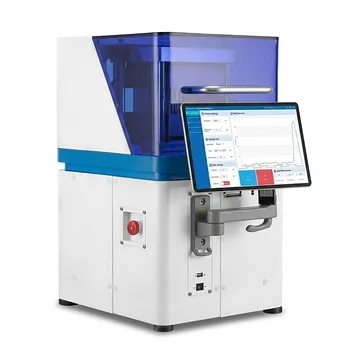
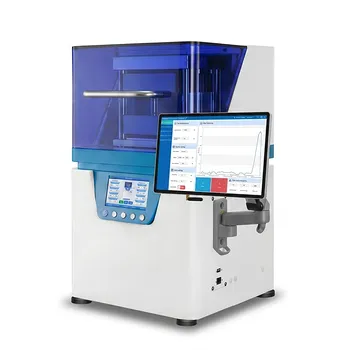
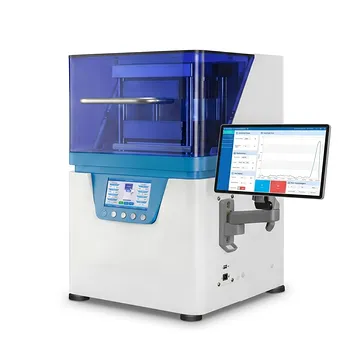
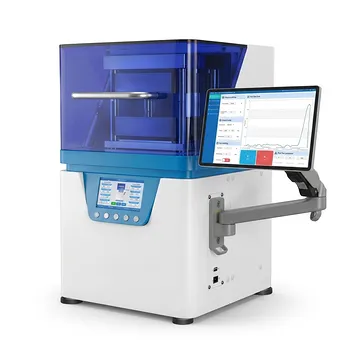
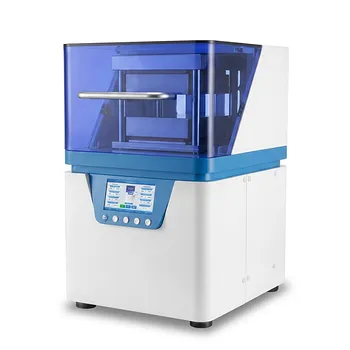
The laboratory hydraulic press with heated platens is a critical tool for densifying solid-state electrolytes. It functions by simultaneously applying high axial pressure and controlled thermal energy to transition electrolyte powders into a softened, viscous state. This dual action facilitates the removal of internal voids and the creation of highly dense, thin films or pellets that are essential for efficient ion transport.
Core Takeaway: By combining heat and pressure, a laboratory hydraulic press lowers the mechanical resistance of electrolyte materials, allowing them to flow and consolidate into dense structures. This process is vital for minimizing porosity and reducing interfacial resistance in solid-state battery components.
Transforming Electrolyte Powder through Viscous Flow
The Role of the Glass Transition Temperature
The primary function of the heated platens is to raise the electrolyte material's temperature above its glass transition temperature ($T_g$). At this point, glassy or semi-crystalline materials soften and begin to exhibit viscous flow.
Facilitating Material Redistribution
Once the material is softened, the hydraulic press applies uniform pressure to force the viscous electrolyte into remaining gaps. This synchronized environment of heat and pressure effectively eliminates voids between particles that cold-pressing alone might not reach.
Achieving High Density at Lower Pressures
Because heat reduces the material's yield strength, the press can achieve highly dense thin films at relatively lower pressures compared to cold-pressing methods. This efficiency protects the material's structural integrity while ensuring maximum compaction.
Enhancing Electrochemical Performance
Reducing Interfacial and Contact Resistance
Hot-pressing establishes tight physical contact between the electrolyte and other components, such as catalyzed carbon paper or electrodes. By creating "intimate contact" at the molecular level, the press significantly reduces contact resistance, which is vital for accurate electrochemical testing.
Creating Efficient Ion Conduction Paths
The elimination of internal porosity creates a continuous medium for lithium-ion transport. By maximizing the contact area between particles, the press establishes the stable structural foundation necessary for superior ionic conductivity.
Ensuring Uniform Sample Geometry
The press allows for the fabrication of pellets with geometric consistency, often producing samples as thin as 200 μm. This standardization is critical for providing uniform samples required for repeatable ionic conductivity measurements and battery cycling tests.
Versatility in Processing Techniques
Supporting Solvent-Free Fabrication
In solvent-free preparation, a heated press is used for pre-pressing and molding bulk materials after kneading. It softens polymer components (often at temperatures like 60 °C), allowing them to spread into pre-pressed sheets with defined strength and thickness suitable for rolling.
Application in Diverse Electrolyte Chemistries
While critical for polymers near their $T_g$, the press is also used for sulfide and OIPC powders. Even when heat is not the primary driver, the high-pressure capabilities (often up to 200–370 MPa) ensure that even brittle materials achieve the necessary packing density.
Understanding the Trade-offs
Thermal Degradation Risks
Applying excessive heat during the pressing process can lead to the thermal decomposition of sensitive organic components. It is vital to precisely control the platen temperature to avoid altering the material's intrinsic chemical properties while attempting to improve its density.
Stress-Induced Structural Damage
While high pressure is necessary for densification, excessive axial force can cause micro-cracks or phase transformations in certain solid-state electrolytes. Balancing the temperature to soften the material can mitigate this, but finding the "sweet spot" between pressure and heat is a complex optimization task.
How to Apply This to Your Project
Making the Right Choice for Your Goal
- If your primary focus is maximizing ionic conductivity: Use the heated platens to reach the material's $T_g$, ensuring that internal voids are eliminated through viscous flow rather than just mechanical force.
- If your primary focus is accurate EIS characterization: Prioritize hot-pressing to establish tight physical contact between the membrane and electrodes, which minimizes parasitic contact resistance.
- If your primary focus is working with heat-sensitive sulfides: Focus on the high-pressure capabilities of the press (up to 370 MPa) while keeping temperatures well below the material's degradation threshold.
- If your primary focus is scale-up via rolling: Use the heated press as a pre-molding step to create a uniform, softened sheet that can withstand the mechanical stresses of precision rolling.
Properly calibrated heat and pressure are the fundamental requirements for transforming loose electrolyte powders into the high-performance solid-state components required for next-generation energy storage.
Summary Table:
| Key Function | Mechanism | Benefit to Battery Research |
|---|---|---|
| Densification | Simultaneous heat and axial pressure above $T_g$. | Eliminates internal voids for high-density pellets/films. |
| Resistance Reduction | Creating intimate contact through viscous flow. | Minimizes interfacial and contact resistance in tests. |
| Structural Integrity | Softening material to reduce yield strength. | Achieves high compaction at lower hydraulic pressures. |
| Sample Consistency | Precision molding and uniform heat distribution. | Ensures repeatable samples as thin as 200 μm for testing. |
| Pre-molding | Softening polymers for solvent-free fabrication. | Creates uniform sheets ready for high-precision rolling. |
Elevate Your Solid-State Battery Research with KINTEK
Achieving the perfect densification of solid-state electrolytes requires precision, control, and the right equipment. KINTEK specializes in comprehensive laboratory pressing solutions tailored for advanced battery research. Whether you need manual, automatic, heated, multifunctional, or glovebox-compatible models, our range is designed to meet the rigorous demands of material science.
From achieving uniform sample geometry to exploring cold and warm isostatic presses, our experts are ready to help you optimize your hot-pressing workflow.
Ready to enhance your lab's efficiency and material performance?
Contact KINTEK Today to find the ideal pressing solution for your project!
References
- Hernando J. Gonzalez Malabet, Thomas A. Yersak. Improved Thermal Stability of Oxysulfide Glassy Solid-State Electrolytes. DOI: 10.1149/1945-7111/ad07ff
This article is also based on technical information from Kintek Solution Knowledge Base .
Related Products
- 24T 30T 60T Heated Hydraulic Lab Press Machine with Hot Plates for Laboratory
- Automatic Heated Hydraulic Press Machine with Hot Plates for Laboratory
- Automatic Heated Hydraulic Press Machine with Heated Plates for Laboratory
- Automatic High Temperature Heated Hydraulic Press Machine with Heated Plates for Lab
- Heated Hydraulic Press Machine With Heated Plates For Vacuum Box Laboratory Hot Press
People Also Ask
- Why is a laboratory hydraulic press with heating plates required for PLA/TEC films? Achieve Precise Sample Integrity
- What role does a laboratory heated hydraulic press play in LTCC? Essential for High-Density Ceramic Lamination
- Why reduce load when applying composite strengthening tabs? Protect Specimen Integrity and Data Accuracy
- Why is a laboratory heated hydraulic press required? Ensure Precise Vulcanization for NBR/EPDM Nanocomposites
- Why Use a Laboratory Heated Hydraulic Press for SSAB CCM? Optimize Solid-State Battery Interfacial Bonding