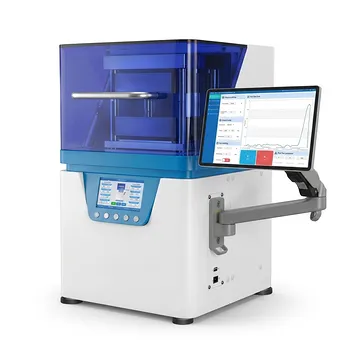
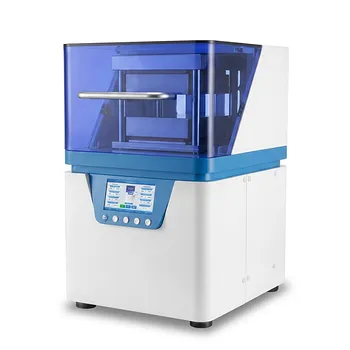
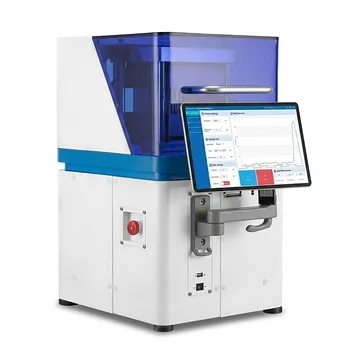
The laboratory heated hydraulic press is the critical hardware required to transform raw LDPE and fish scale powder into a functional bio-composite. It provides the simultaneous, precise application of high temperature (approximately 420 K or 190 °C) and high pressure (10 MPa to 15 MPa) necessary to melt the polymer matrix and fuse it with the organic filler. This dual-action process ensures the material is dense, free of air traps, and standardized for rigorous scientific testing.
The heated hydraulic press acts as a controlled environment that overcomes the physical resistance of polymer melts, ensuring that fish scale particles are perfectly encapsulated within a uniform, pore-free LDPE matrix. Without this precise control, the resulting material would lack the structural integrity and uniformity required for valid analytical data.
Achieving Material Homogeneity through Thermal Control
Facilitating the Phase Transition of LDPE
Low-density polyethylene (LDPE) is a semi-crystalline polymer that requires specific thermal energy to reach its melting point. The heated press provides a stable temperature, typically around 420 K (190 °C), which allows the LDPE pellets or powder to transition into a molten state. This fluidity is the prerequisite for any meaningful integration with the fish scale bio-fillers.
Enabling Molecular Interfacial Bonding
Once the LDPE is molten, the heat facilitates physical flow and cross-linking between the polymer chains and the fish scale particles. This thermal energy ensures that the matrix doesn't just sit alongside the filler but actually bonds with it. This creates a cohesive bio-composite rather than a loose mixture of two disparate materials.
The Role of High Pressure in Structural Density
Eliminating Internal Pores and Air Traps
During the mixing of solid powders and molten plastic, air is naturally reaching the interior of the mixture. The hydraulic press applies high pressure, ranging from 10 MPa to 15 MPa, to forcibly evacuate these air bubbles. This "degassing" effect is vital to prevent internal voids that would otherwise act as failure points during mechanical stress.
Ensuring Dense Packing of Bio-Fillers
The mechanical force of the press ensures that the fish scale powder is densely packed within the LDPE matrix. By eliminating gaps between particles, the press creates a dense internal structure that optimizes the load-bearing capabilities of the composite. This density is a primary factor in the material’s final physical and chemical stability.
Standardization for Scientific Characterization
Precise Control of Sample Thickness
For characterization techniques like tensile testing or optical analysis, samples must have a uniform thickness—often targeted at approximately 170 μm. The press uses calibrated molds and programmable pressure stages to produce films with minimal thickness deviation. This uniformity is essential to ensure that test results are a reflection of the material properties, not variations in sample geometry.
Erasing Thermal History for Data Accuracy
Polymers "remember" how they were previously processed, which can skew results in rheological or X-ray scattering analysis (SAXS/WAXS). The controlled heating and cooling cycles of a hydraulic press eliminate this thermal history. This provides a "blank slate" for the material, ensuring that all subsequent data is accurate, repeatable, and standardized.
Understanding the Trade-offs and Pitfalls
The Risk of Thermal Degradation
While high heat is necessary to melt the LDPE, excessive temperatures can degrade the organic fish scale components. If the temperature exceeds the stability threshold of the bio-filler, the material may discolor or lose mechanical strength. Precision in the press's temperature compensation system is the only way to balance melting with preservation.
Pressure-Induced Residual Stress
Applying too much pressure too quickly—or cooling the material too rapidly while under pressure—can lock residual stresses into the composite sheet. These internal stresses can lead to warping, dimensional instability, or premature cracking once the sample is removed from the mold.
How to Apply This to Your Synthesis Goals
Optimizing Your Press Parameters
- If your primary focus is mechanical strength: Prioritize the maximum pressure (15 MPa) and longer pressure-holding cycles to ensure the highest possible density and void elimination.
- If your primary focus is optical or barrier properties: Focus on the precision of the cooling cycle and mold cleanliness to ensure a smooth surface finish and uniform thickness of 170 μm.
- If your primary focus is bio-filler integrity: Use the minimum effective melting temperature (approx. 420 K) and minimize the time the material spends at peak heat to prevent the degradation of the fish scale powder.
The heated hydraulic press is ultimately the bridge between raw material components and a standardized, high-performance bio-composite suitable for advanced research.
Summary Table:
| Parameter | Optimized Setting | Scientific Purpose |
|---|---|---|
| Temperature | ~420 K (190 °C) | Facilitates LDPE melting and interfacial bonding |
| Pressure | 10 MPa – 15 MPa | Eliminates air traps and ensures dense packing |
| Thickness | ~170 μm Target | Standardizes samples for tensile and optical tests |
| Processing | Controlled Cooling | Erases thermal history and prevents residual stress |
Elevate Your Bio-Composite Research with KINTEK
Achieving material homogeneity and precise interfacial bonding requires professional-grade equipment. KINTEK specializes in comprehensive laboratory pressing solutions, offering manual, automatic, heated, multifunctional, and glovebox-compatible models, as well as cold and warm isostatic presses. Whether you are synthesizing bio-composites or conducting advanced battery research, our tools ensure the high-density and pore-free results your data demands.
Ready to standardize your synthesis process? Contact us today to find the perfect laboratory press for your research needs!
References
- Gojayev EM, V. V. Salimova. Dielectric properties of bionano-composites modified by fish scales. DOI: 10.5281/zenodo.5766314
This article is also based on technical information from Kintek Solution Knowledge Base .
Related Products
- Automatic High Temperature Heated Hydraulic Press Machine with Heated Plates for Lab
- Automatic Heated Hydraulic Press Machine with Heated Plates for Laboratory
- Automatic Hydraulic Hot Press with Large Plate and Precision Temperature Control for Advanced Material Sample Preparation and Industrial Research
- Automatic Heated Hydraulic Press Machine with Hot Plates for Laboratory
- Automatic Large Format Laboratory Heated Hydraulic Press 400x400mm Plate Capacity
People Also Ask
- Function of a Laboratory Hydraulic Press with Heated Platens in SSE? Enhance Battery Density & Conductivity
- What are the requirements for electrode pressing with high-viscosity ionic liquids like EMIM TFSI? Optimize Performance
- How does a laboratory heated hydraulic press facilitate PBN sample prep for WAXS? Achieve Precise X-Ray Scattering
- What are the industrial applications of heated hydraulic presses? Master Heat & Force for Precision Manufacturing
- Why is a laboratory hydraulic press with heating plates required for PLA/TEC films? Achieve Precise Sample Integrity