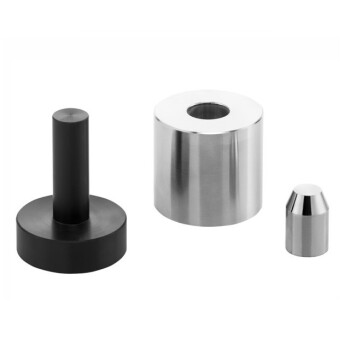
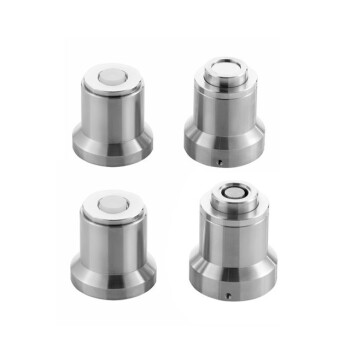
A laboratory high-pressure combination mold is the defining mechanism that transforms separate solid layers into a functional, unified electrochemical system. When paired with hydraulic equipment, it applies extreme tightening pressures—often reaching several hundred megapascals (MPa)—during the final stages of assembly. This immense force is required to push the cathode, solid-state electrolyte, and anode into atomic-level contact, which eliminates contact resistance and ensures the structural integrity required for efficient charge transfer.
The Core Challenge
In liquid batteries, the electrolyte naturally flows into pores to create contact; in solid-state batteries, this "wetting" capability is absent. The high-pressure mold acts as the mechanical substitute for chemical wetting, compressing materials to eliminate voids and create the low-impedance interfaces necessary for ion transport.
Overcoming the Solid-Solid Interface Challenge
The primary function of the mold is to solve the inherent physical incompatibility of stacking rigid materials. Without significant intervention, solid layers merely touch at high points, leaving microscopic gaps that block performance.
Achieving Atomic-Level Contact
Solid-state electrolytes and electrodes have rough microscopic surfaces. The mold utilizes hydraulic pressure to deform these materials, forcing them together to establish continuous physical connectivity.
Eliminating Interfacial Impedance
Gaps between layers act as electrical insulators, creating high resistance that impedes battery function. By applying pressures as high as 360 MPa to 410 MPa, the mold closes these gaps, drastically lowering the impedance at the solid-solid interface.
Enabling Ion Transport
For a battery to function, ions must move freely between the anode and cathode. The tight, seamless contact created by the mold establishes the fundamental pathways required for smooth ion migration.
Enhancing Material Density and Conductivity
Beyond simple surface contact, the high-pressure mold modifies the internal structure of the electrolyte materials themselves, particularly when working with powders or pellets.
Compacting Electrolyte Powders
When using sulfide or oxide (e.g., LLZO) electrolyte powders, the mold functions as a compaction tool. It applies cold-pressing pressure to densify loose powders into solid ceramic pellets.
Reducing Internal Porosity
High pressure eliminates internal pores within the electrolyte layer. This is critical because ionic conductivity relies on particle-to-particle contact; reducing porosity creates a denser material with faster transport channels.
Improving Kinetics
By increasing the density of the electrolyte layer, the mold ensures better interaction with active materials. This improves the overall kinetics of lithium-ion transport, allowing the battery to operate efficiently even under high current densities.
Ensuring Long-Term Structural Integrity
The assembly process is not just about initial performance; it is about ensuring the battery survives the physical stresses of operation.
Mitigating Volume Expansion
During charge and discharge cycles, battery materials naturally expand and contract. The continuous, stable mechanical pressure applied by the mold setup helps inhibit this volume expansion, preventing layers from delaminating over time.
Inhibiting Dendrite Formation
Lithium dendrites are metallic growths that can penetrate electrolytes and cause short circuits. The high-density compaction achieved by the mold creates a physical barrier that helps inhibit the penetration of these dendrites.
Establishing a Stable Testing Baseline
For research applications, the mold maintains a constant internal stress baseline. This eliminates variables caused by assembly errors, ensuring that data gathered during in-situ strain monitoring reflects the chemistry of the battery, not mechanical looseness.
Understanding the Trade-offs
While pressure is essential, the application of force requires precision and understanding of material limits.
Precision vs. Brute Force
Applying pressure is not simply about maximizing force; it is about uniformity. If the mold does not apply pressure evenly, it can create localized stress points that may fracture brittle ceramic electrolytes like LLZO.
Pressure Maintenance
The benefits of high pressure are often lost if the pressure is released after assembly. In many advanced setups, the mold or casing must maintain this pressure continuously during operation to prevent contact failure during the stripping and plating processes.
Making the Right Choice for Your Goal
The specific utility of the high-pressure mold depends on the stage of your development and the materials involved.
- If your primary focus is fabrication of sulfide electrolytes: You need a mold capable of reaching 410 MPa to maximize pellet density and establish continuous ion transport channels.
- If your primary focus is decreasing internal resistance: Prioritize a mold that ensures uniform atomic-level contact to eliminate gaps between the solid electrolyte and the lithium metal anode.
- If your primary focus is long-term cycle testing: Ensure your assembly setup allows for continuous pressure maintenance to inhibit volume expansion and prevent layer separation during cycling.
High-pressure assembly is not an optional step; it is the fundamental prerequisite that allows solid-state chemistry to function as a viable energy storage device.
Summary Table:
| Key Feature | Impact on Solid-State Battery Performance |
|---|---|
| Pressure Range | 360 MPa to 410 MPa for extreme material compaction |
| Interface Goal | Achieves atomic-level contact to eliminate interfacial impedance |
| Material Density | Reduces internal porosity to optimize ion transport kinetics |
| Structural Integrity | Inhibits lithium dendrite formation and mitigates volume expansion |
| Research Utility | Establishes a stable mechanical baseline for in-situ testing |
Elevate Your Battery Research with KINTEK Precision
Ready to overcome the challenges of solid-solid interface resistance? KINTEK specializes in comprehensive laboratory pressing solutions tailored for the next generation of energy storage. From manual and automatic models to heated, multifunctional, and glovebox-compatible presses—including advanced cold and warm isostatic systems—we provide the tools necessary to achieve superior material density and seamless ion transport.
Empower your lab with the precision required for groundbreaking battery innovation.
Contact KINTEK Today for a Solution Quote
References
- Tongtai Ji, Hongli Zhu. Operando neutron imaging-guided gradient design of Li-ion solid conductor for high-mass-loading cathodes. DOI: 10.1038/s41467-025-62518-y
This article is also based on technical information from Kintek Solution Knowledge Base .
Related Products
- Carbide Lab Press Mold for Laboratory Sample Preparation
- Lab Cylindrical Press Mold for Laboratory Use
- Lab Infrared Press Mold for Laboratory Applications
- Lab Polygon Press Mold
- Special Shape Lab Press Mold for Laboratory Applications
People Also Ask
- What is the purpose of incorporating cartridge heaters into a lab press mold for MLCC block compression? Optimize Results
- What is the function of a pressing tool in thermoplastic panels? Master Precision Shaping & Fusion Bonding
- Why is precise cooling management of the lab press mold necessary? Protect Core Integrity in Thermoforming
- How does the geometry of laboratory molds influence mycelium-based composites? Optimize Density and Strength
- What is the significance of standardized molds in lab presses? Ensure Precise Seal Material Evaluation