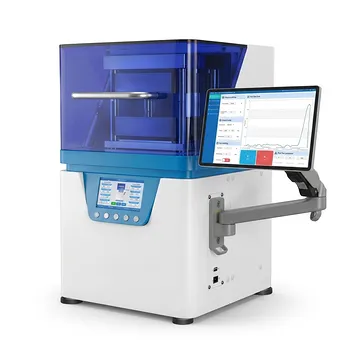
A laboratory hydraulic press is essential for NiO-doped polymer composites because it applies the precise, uniform pressure necessary to eliminate internal air micropores. This compaction transforms loose composite blends into high-density bulk materials by inducing particle rearrangement and ensuring the polymer matrix fully infiltrates the NiO dopants. The result is a structurally sound specimen with the consistent density required for accurate physical and electrical property testing.
The core function of a laboratory hydraulic press is to remove internal voids and density gradients through high-precision pressure control. This process is the only reliable way to ensure the material achieves the theoretical density and structural uniformity needed for valid scientific analysis.
Eliminating Internal Microstructure Defects
Removal of Air Micropores and Voids
The primary obstacle to achieving high density in polymer composites is the presence of trapped air during the mixing phase. A hydraulic press applies static pressure that forces these micropores out of the material, creating a dense, continuous internal structure.
Ensuring Full Matrix Infiltration
In NiO-doped systems, the polymer melt must thoroughly encapsulate the dopant particles to ensure material integrity. High pressure facilitates plastic flow in the polymer matrix, allowing it to penetrate the spaces between NiO fillers and eliminate gaps that would otherwise weaken the composite.
Facilitating Particle Rearrangement
As pressure is applied, loose particles within the composite undergo rearrangement and plastic deformation. This increases the contact area and bonding forces between the NiO dopants and the polymer, which is critical for preventing cracks during subsequent processing or testing.
Ensuring Accuracy in Material Testing
Consistency in Volume Resistivity Studies
For doped polymers, electrical properties like volume resistivity are highly sensitive to density variations. A hydraulic press provides the precise control needed to ensure every sample has the same density, allowing researchers to isolate the effects of the NiO dopant rather than measuring artifacts caused by air pockets.
Standardization of Geometric Dimensions
Laboratory presses, particularly those with heated platens, allow for the creation of samples with standardized geometric dimensions, such as thick sheets or cylinders. This precision ensures that mechanical tests, such as Young's modulus or tensile stress, are reproducible and comparable across different batches.
Achieving Structural Stability
High-pressure molding is a prerequisite for conducting structural stability tests under extreme conditions. By creating a "green body" with high initial density, the material is better equipped to maintain its dimensional stability and resist volume shrinkage during thermal cycles.
Understanding the Trade-offs and Pitfalls
Pressure-Induced Material Stress
While high pressure is necessary for density, excessive force can lead to residual internal stresses or the crushing of dopant particles. If the pressure exceeds the structural limit of the filler, it may inadvertently alter the material's intended mechanical properties.
Thermal Gradients During Pressing
When using a heated lab press, uneven heating across the platens can create density gradients even if the pressure is uniform. It is critical to balance temperature and pressure to ensure the polymer flows evenly without undergoing localized thermal degradation.
The Risk of Flash and Material Loss
In thermoplastic composites, applying high pressure too quickly can cause the melt to escape the mold, a phenomenon known as flash. This results in samples that do not meet thickness specifications and leads to a loss of the expensive NiO-doped precursor.
How to Apply This to Your Project
Achieving the perfect bulk material requires balancing the specific needs of your polymer matrix with the characteristics of the NiO dopant.
- If your primary focus is electrical characterization: Prioritize precise pressure control to eliminate all internal voids, as even minor micropores will significantly skew resistivity and dielectric measurements.
- If your primary focus is mechanical durability: Focus on the high-pressure molding of "green bodies" to maximize the bonding force between particles, which prevents cracking and improves overall toughness.
- If your primary focus is optical or surface analysis: Utilize a high-precision press with polished platens to ensure uniform thickness and a defect-free surface finish, which is essential for consistent data.
By mastering the application of uniform pressure and temperature, you transform a heterogeneous mixture into a high-performance, high-density bulk material ready for rigorous scientific evaluation.
Summary Table:
| Feature | Function | Research Value |
|---|---|---|
| Micro-void Removal | Forces out trapped air pockets | Achieves theoretical material density |
| Matrix Flow | Ensures NiO particles are encapsulated | Prevents internal cracks and failure |
| Controlled Pressure | Standardizes geometric dimensions | Ensures reproducible electrical testing |
| Static Compaction | Enhances particle rearrangement | Increases structural stability and bonding |
Elevate Your Material Research with KINTEK
KINTEK specializes in comprehensive laboratory pressing solutions, offering manual, automatic, heated, multifunctional, and glovebox-compatible models, as well as cold and warm isostatic presses widely applied in battery research. Our systems provide the precise, uniform pressure needed to eliminate internal voids and ensure your NiO-doped composites achieve theoretical density and structural integrity.
Ready to optimize your sample preparation and ensure accurate scientific analysis? Contact us today for a tailored solution that brings precision to your laboratory!
References
- E. Salim, Abdelhamid El‐Shaer. Optimizing optical, dielectric, and electrical properties of polyvinyl alcohol/polyvinyl pyrrolidone/poly(3,4-ethylene dioxythiophene) polystyrene sulfonate/NiO-based polymeric nanocomposites for optoelectronic applications. DOI: 10.1038/s41598-024-76918-5
This article is also based on technical information from Kintek Solution Knowledge Base .
Related Products
- Laboratory Hydraulic Press Lab Pellet Press Machine for Glove Box
- Laboratory Hydraulic Press 2T Lab Pellet Press for KBR FTIR
- 24T 30T 60T Heated Hydraulic Lab Press Machine with Hot Plates for Laboratory
- Laboratory Hydraulic Press Lab Pellet Press Button Battery Press
- Laboratory Hydraulic Pellet Press for XRF KBR FTIR Lab Press
People Also Ask
- How does a laboratory hydraulic press contribute to the preparation of Li3-3xScxSb samples? Optimize Ionic Conductivity
- What is the function of a laboratory hydraulic press in FT-IR of curcumin-coated MWCNTs? Achieve Optical Clarity.
- Why is a laboratory hydraulic press required for compression molding boron-siloxane? Solve High-Loading Density Challenges
- What role does a laboratory hydraulic press play in reaction pellets? Optimizing Lunar Soil and Metal Fuel Density
- What role does a laboratory hydraulic press play in the preparation of piezoelectric ceramic discs for DC-PG? | KINTEK