
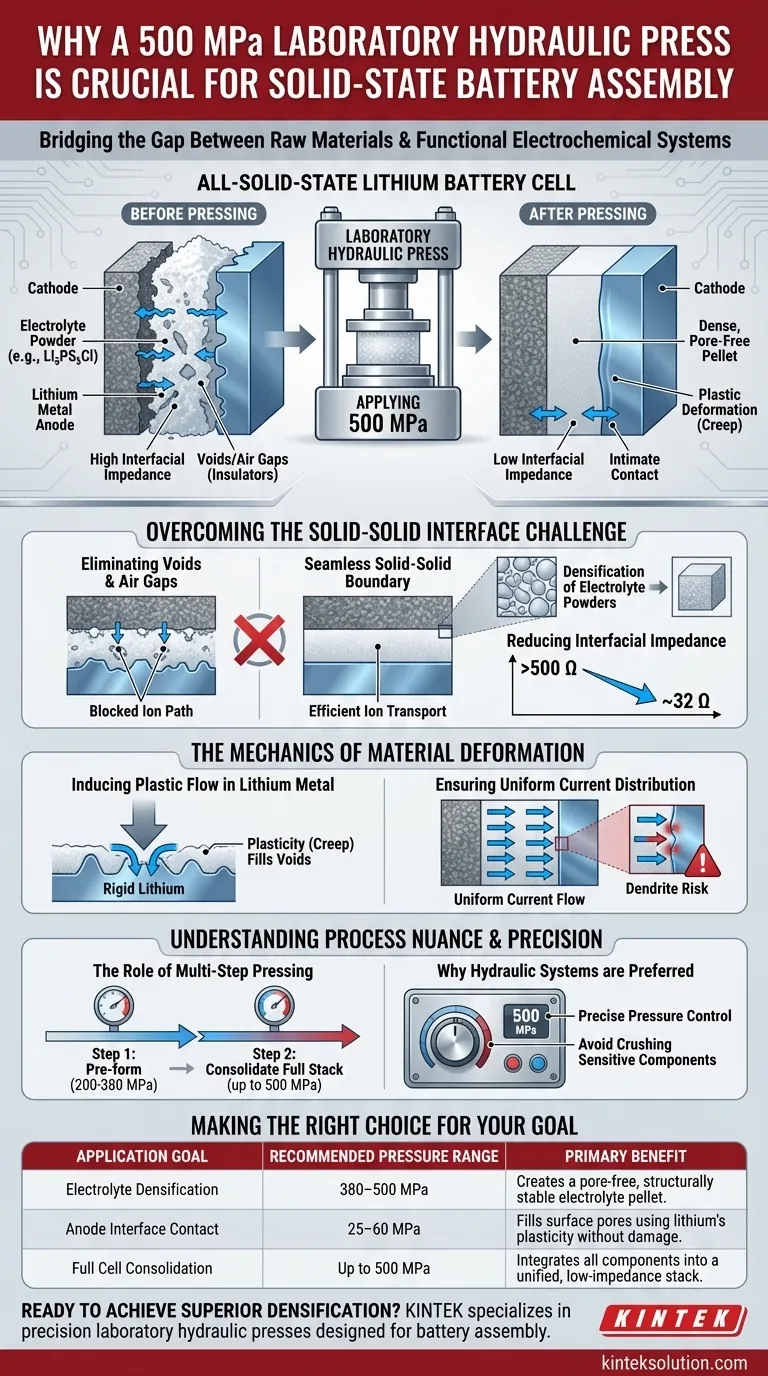
A laboratory hydraulic press applying 500 MPa is primarily used to overcome the inherent physical limitations of solid-state materials. By subjecting the cell assembly to this specific pressure, manufacturers transform loose electrolyte powder into a dense, cohesive pellet and force rigid components into intimate physical contact. This mechanical consolidation is the prerequisite for electrochemical functionality.
Core Takeaway The application of high pressure (up to 500 MPa) is critical for minimizing voids at solid-solid interfaces, which act as insulators in battery cells. This process densifies the electrolyte and induces plastic deformation in the anode, drastically reducing interfacial impedance to enable efficient lithium-ion transport.
Overcoming the Solid-Solid Interface Challenge
Eliminating Voids and Air Gaps
Unlike liquid electrolytes, which naturally wet surfaces, solid-state components are rigid and prone to microscopic gaps. Voids at the interface act as electrical insulators, blocking the path of ions. Applying 500 MPa forces the cathode, electrolyte, and anode layers together, physically eliminating these voids to create a seamless solid-solid boundary.
Densification of Electrolyte Powders
Solid electrolytes, such as Li6PS5Cl, often begin as loose powders. High pressure is required to compact this powder into a dense, pore-free pellet. This densification ensures the electrolyte layer has high structural integrity and a continuous pathway for ion movement.
Reducing Interfacial Impedance
The primary barrier to solid-state battery performance is high interfacial impedance (resistance). By maximizing physical contact area through cold pressing, resistance creates a direct correlation to performance. References indicate that proper pressure application can reduce impedance significantly (e.g., from >500 Ω to ~32 Ω), enabling stable cycling.
The Mechanics of Material Deformation
Inducing Plastic Flow in Lithium Metal
Lithium metal anodes are rigid solids, but they possess plastic properties under stress. High pressure forces the lithium metal to undergo plastic deformation (creep). This allows the metal to flow like a viscous fluid, filling the microscopic irregularities on the harder electrolyte surface.
Ensuring Uniform Current Distribution
If the contact between the anode and electrolyte is spotty, current concentrates in specific points. This uneven distribution can lead to dendrite formation and battery failure. The plastic deformation achieved via the hydraulic press ensures uniform contact, leading to uniform current distribution across the entire cell.
Understanding Process Nuance and Precision
The Role of Multi-Step Pressing
The application of 500 MPa is often the final step in a sequenced process. A lower pressure (e.g., 200 MPa or 380 MPa) may be used first to pre-form the electrolyte separator. The higher pressure is subsequently applied to consolidate the full stack (cathode, anode, and electrolyte) into a single integrated unit.
Why Hydraulic Systems are Preferred
Laboratory hydraulic presses provide the necessary force with high precision and control. They allow researchers to dial in exact pressures—whether 25 MPa for initial contact or 500 MPa for final densification. This precision is vital to avoid crushing sensitive components while ensuring the pressure is sufficient to achieve the required density.
Making the Right Choice for Your Goal
The specific pressure you apply should be dictated by the material properties and the specific interface you are targeting.
- If your primary focus is Electrolyte Densification: Use high pressure (380–500 MPa) to compact powders into a pore-free pellet to ensure structural stability.
- If your primary focus is Anode Interface Contact: Leverage the plastic nature of lithium with controlled pressure (starting lower, around 25–60 MPa) to fill surface pores without damaging the separator.
- If your primary focus is Full Cell Consolidation: Apply peak pressure (up to 500 MPa) as a final step to integrate the cathode, anode, and electrolyte into a unified, low-impedance stack.
Ultimatley, the hydraulic press is not just a tool for compression; it is the instrument that bridges the gap between raw materials and a conductive, functional electrochemical system.
Summary Table:
| Application Goal | Recommended Pressure Range | Primary Benefit |
|---|---|---|
| Electrolyte Densification | 380–500 MPa | Creates a pore-free, structurally stable electrolyte pellet. |
| Anode Interface Contact | 25–60 MPa | Fills surface pores using lithium's plasticity without damage. |
| Full Cell Consolidation | Up to 500 MPa | Integrates all components into a unified, low-impedance stack. |
Ready to achieve superior densification and low-impedance interfaces for your solid-state battery research? KINTEK specializes in precision laboratory hydraulic presses, including automatic and heated models, designed specifically for the demanding protocols of battery assembly. Our machines provide the exact pressure control you need to bridge the gap between materials and a functional electrochemical system. Contact our experts today to find the perfect press for your laboratory's needs!
Visual Guide
Related Products
- Automatic Lab Cold Isostatic Pressing CIP Machine
- Electric Split Lab Cold Isostatic Pressing CIP Machine
- Electric Lab Cold Isostatic Press CIP Machine
- Manual Cold Isostatic Pressing CIP Machine Pellet Press
- Warm Isostatic Press for Solid State Battery Research Warm Isostatic Press
People Also Ask
- What are the key features of automated laboratory Cold Isostatic Press (CIP) systems? Achieve Precise, High-Pressure Powder Consolidation
- Why is an Isostatic Press (CIP) Necessary After Uniaxial Pressing? Achieve Transparency in Nd:Y2O3 Ceramics
- What is the primary function of a Cold Isostatic Press (CIP) in NASICON preparation? Achieve 96% Theoretical Density
- How does a Cold Isostatic Press (CIP) facilitate the preparation of CaO-doped silicon carbide (SiC) green bodies?
- How does a Cold Isostatic Press (CIP) increase Bi-2223/Ag current density? Boost Superconductivity with Uniform Pressure






