
The primary purpose of applying 2.8 MPa of pressure to a dried mixed solid electrolyte membrane is to radically increase its density and optimize the internal structure for ion transport.
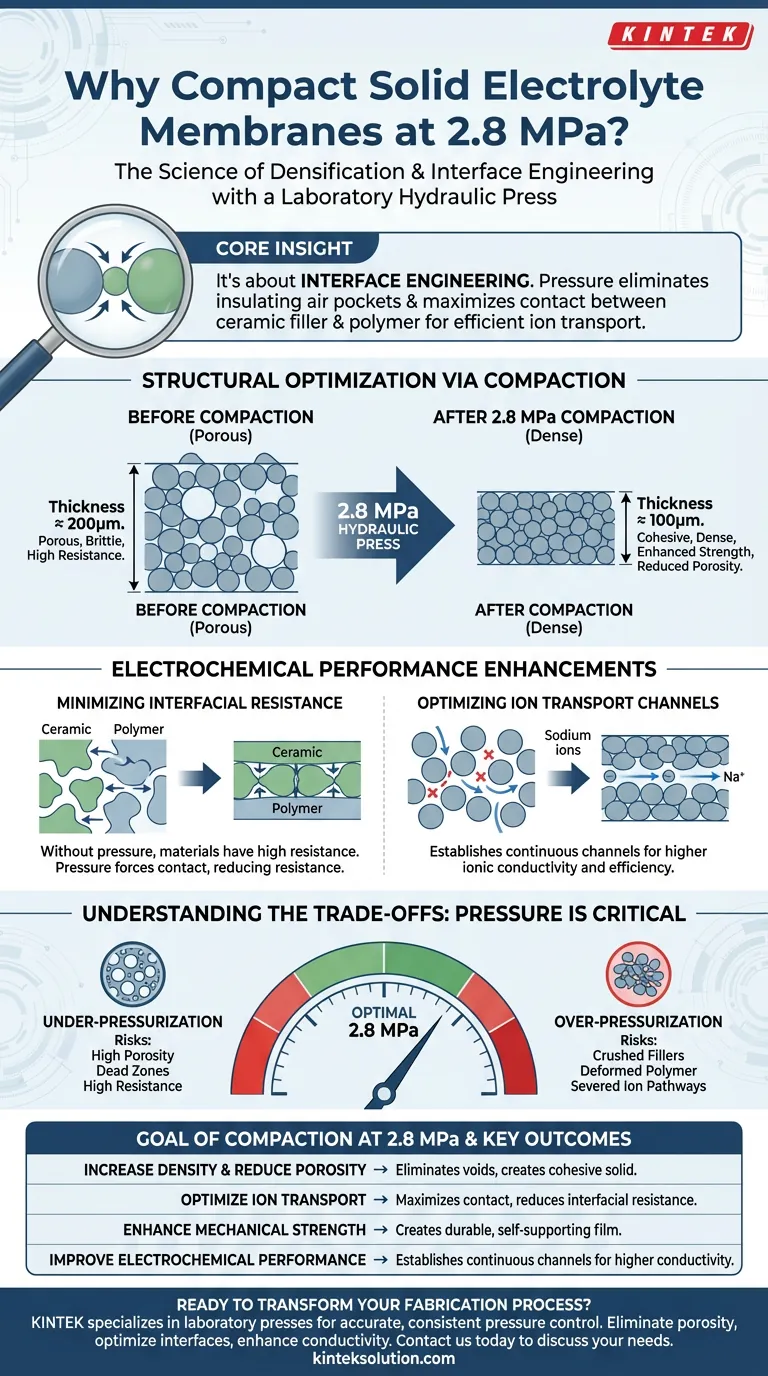
By using a laboratory hydraulic press, you mechanically reduce the membrane's thickness—typically halving it from roughly 200µm to 100µm—which eliminates internal voids. This compaction forces the polymer matrix into intimate contact with the ceramic filler, minimizing the physical gaps that otherwise impede performance.
Core Insight Compacting a mixed electrolyte is not just about making it thinner; it is about interface engineering. The pressure eliminates insulating air pockets and maximizes the contact area between the ceramic filler and the polymer, which is the prerequisite for efficient sodium-ion transport and low internal resistance.
Structural Optimization via Compaction
Increasing Density and Reducing Porosity
The most immediate physical change induced by the hydraulic press is densification. A dried membrane often contains microscopic pores or voids left behind as solvents evaporate.
Applying 2.8 MPa of pressure mechanically collapses these voids. This transforms a porous, potentially brittle structure into a cohesive, dense solid.
Thickness Reduction
The specific pressure of 2.8 MPa is calibrated to achieve a significant reduction in membrane thickness, often compressing the material from 200µm down to 100µm.
This reduction shortens the physical distance ions must travel between electrodes. A thinner membrane with equivalent insulation properties leads to higher volumetric energy density for the battery cell.
Enhancing Mechanical Strength
A loose, porous membrane is fragile and difficult to handle during cell assembly.
Compaction creates a self-supporting film with improved mechanical integrity. This ensures the electrolyte can withstand the physical stresses of battery operation without cracking or delaminating.
Electrochemical Performance Enhancements
Minimizing Interfacial Resistance
In a "mixed" solid electrolyte, performance depends on the interaction between two phases: the ceramic filler and the polymer matrix.
Without pressure, these materials may just sit next to each other. The hydraulic press forces them together, reducing the interfacial resistance that typically occurs at grain boundaries.
Optimizing Ion Transport Channels
For a battery to function, ions (such as sodium ions) must move freely from the anode to the cathode.
By eliminating pores and improving component contact, the pressing process establishes continuous, unobstructed ion transport channels. This directly translates to higher ionic conductivity and better overall cell efficiency.
Understanding the Trade-offs
While compaction is necessary, precision in pressure application is critical to avoid diminishing returns or damaging the sample.
The Risks of Over-Pressurization
Applying pressure significantly higher than the target (e.g., exceeding the 2.8 MPa protocol for this specific composite) can be detrimental. Excessive force may crush the ceramic filler particles or plastically deform the polymer matrix beyond recovery, potentially severing the very ion pathways you are trying to create.
The Risks of Under-Pressurization
Conversely, insufficient pressure fails to remove enough porosity. This leaves "dead zones" within the electrolyte where ions cannot travel, resulting in high internal resistance and poor battery rate performance.
Making the Right Choice for Your Goal
When establishing your membrane fabrication protocol, align your pressing parameters with your specific performance targets.
- If your primary focus is maximizing ionic conductivity: Ensure the pressure is sufficient to fully eliminate internal porosity and maximize the ceramic-polymer interface contact.
- If your primary focus is mechanical durability: Prioritize a pressure hold time that ensures the membrane retains its compacted shape without relaxation or cracking after ejection.
Ultimately, the hydraulic press transforms a loose mixture of chemicals into a functional electrochemical component by mechanically enforcing the connectivity required for ion flow.
Summary Table:
| Goal of Compaction at 2.8 MPa | Key Outcome |
|---|---|
| Increase Density & Reduce Porosity | Eliminates internal voids, creating a cohesive, dense solid. |
| Optimize Ion Transport | Maximizes contact between ceramic filler and polymer, reducing interfacial resistance. |
| Enhance Mechanical Strength | Creates a self-supporting, durable film for easier handling and cell assembly. |
| Improve Electrochemical Performance | Establishes continuous ion channels for higher conductivity and cell efficiency. |
Ready to Transform Your Material Fabrication Process?
Achieving precise compaction is critical for developing high-performance solid electrolytes. KINTEK specializes in laboratory press machines, including automatic, isostatic, and heated lab presses, designed to deliver the accurate and consistent pressure control your research demands.
Our equipment helps you eliminate porosity, optimize interfaces, and enhance the ionic conductivity of your materials—directly contributing to more efficient and durable batteries.
Let's discuss how our lab presses can optimize your membrane fabrication protocol. Contact our experts today to find the perfect solution for your laboratory's needs.
Visual Guide
Related Products
- Laboratory Hydraulic Press 2T Lab Pellet Press for KBR FTIR
- Laboratory Hydraulic Press Lab Pellet Press Machine for Glove Box
- Automatic Laboratory Hydraulic Press for XRF and KBR Pellet Pressing
- Lab Round Bidirectional Press Mold
- 24T 30T 60T Heated Hydraulic Lab Press Machine with Hot Plates for Laboratory
People Also Ask
- What is the role of a laboratory pressure machine and KBr in FTIR? Master Sample Preparation for Flame Retardants
- What is the role of a laboratory hydraulic press in high-loading NCM811 cathode prep for solid-state batteries?
- What role does a laboratory hydraulic press play in reaction pellets? Optimizing Lunar Soil and Metal Fuel Density
- Why is a laboratory hydraulic press necessary for sample preparation? Precise Pelleting for Spiro Heterocyclic Analysis
- What is the typical pressure capacity of a laboratory hydraulic press and what materials can it process?



















