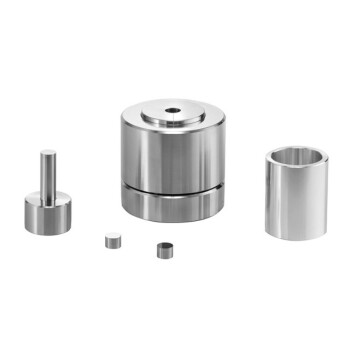
A laboratory press machine is the critical enabler of accurate electrochemical testing for composite electrolytes. It transforms loose powder mixtures into dense, circular pellets of a fixed thickness—typically around 0.21 cm—ensuring the physical integrity required for reliable data. Without this high-pressure molding, the presence of voids and poor particle contact would render resistance measurements meaningless.
Core Takeaway The validity of your electrochemical data relies entirely on the physical density of your sample. A laboratory press eliminates microscopic voids and standardizes sample geometry, ensuring that the bulk resistance and ionic conductivity measured via Electrochemical Impedance Spectroscopy (EIS) reflect the material's true properties, not the quality of its preparation.
The Physics of Sample Preparation
Eliminating Voids and Air Gaps
Composite electrolytes begin as mixtures of conductive materials and binders. In this state, air pockets act as insulators between particles.
The primary function of the press is to apply high pressure to collapse these voids. By extruding the air, you ensure that the volume you are measuring is the material itself, rather than a composite of material and air.
Creating Continuous Ion Transport Paths
For ions to move through an electrolyte, they require a continuous pathway. Loose or lightly packed powders suffer from high grain boundary resistance, where ions struggle to jump from one particle to another.
Standardized molding forces tight contact between particles. This physical proximity creates the necessary percolation network for ions to travel, allowing for the observation of intrinsic micro-transport mechanisms.
The Impact on Electrochemical Measurements
Accuracy in Impedance Spectroscopy (EIS)
Electrochemical Impedance Spectroscopy (EIS) is highly sensitive to the physical state of the sample.
If a sample is not sufficiently dense, the "bulk resistance" reading will be artificially high due to poor contact. A laboratory press ensures that the resistance data captured is accurate and not skewed by structural defects within the pellet.
Reproducibility of Results
Scientific validity hinges on reproducibility. If two samples of the same material are pressed at different pressures, they will yield different conductivity results.
By applying a precise, metric-ton-level force, the press ensures that every sample has the same compaction density. This consistency allows you to compare data across different batches with confidence.
The Role of Sample Geometry
Controlling Thickness for Calculation
To calculate ionic conductivity, you must know the exact dimensions of your sample.
The laboratory press molds materials into pellets with a fixed thickness (e.g., 0.21 cm). Because conductivity is calculated based on resistance relative to area and thickness, any variation in these dimensions would introduce calculation errors.
Defining the Geometric Area
Reliable kinetic parameters, such as current density, depend on a clearly defined geometric area.
The die used in a laboratory press establishes a specific diameter for the pellet. This ensures that the area used in your calculations matches the actual active area of the sample, preventing distortions in your final performance metrics.
Understanding the Trade-offs
The Risk of Density Gradients
While pressure is necessary, how it is applied matters.
If pressure is not applied uniformly, the pellet may develop density gradients—areas that are more compressed than others. This can lead to uneven current distribution during testing. A high-precision press is required to ensure the force is distributed evenly across the entire surface of the pellet.
Mechanical Integrity vs. Over-compression
The goal is a "self-supporting" pellet that can handle handling and cell assembly.
Insufficient pressure leads to pellets that crumble, breaking the conductive path. However, extreme over-compression beyond the material's limit can damage the microstructure of certain composite components. The key is finding the precise pressure (often up to 300 MPa) that maximizes density without degrading the material components.
Making the Right Choice for Your Goal
- If your primary focus is Ionic Conductivity: Prioritize high pressure to maximize pellet density, eliminating grain boundary resistance to find the material's true limit.
- If your primary focus is Data Reproducibility: Prioritize the precision of the press to ensure every sample has the exact same thickness and compaction density, ruling out preparation variables.
Ultimately, the laboratory press turns a variable powder mixture into a standardized test specimen, serving as the foundation for all subsequent electrochemical analysis.
Summary Table:
| Feature | Impact on Electrochemical Testing | Benefit for Research |
|---|---|---|
| Void Elimination | Removes insulating air pockets between particles | Reflects true material bulk resistance |
| Particle Contact | Creates continuous ion transport pathways | Reduces artificial grain boundary resistance |
| Geometric Control | Standardizes pellet thickness and diameter | Ensures precise ionic conductivity calculations |
| Compaction Force | Guarantees consistent sample density | Enhances data reproducibility across batches |
| Structural Integrity | Produces self-supporting, durable pellets | Prevents sample crumbling during cell assembly |
Elevate Your Battery Research with KINTEK Precision
At KINTEK, we understand that the integrity of your electrochemical data begins with superior sample preparation. As specialists in comprehensive laboratory pressing solutions, we provide the tools necessary to transform variable powder mixtures into standardized, high-density specimens.
Our Value to You:
- Versatile Solutions: Choose from manual, automatic, heated, multifunctional, and glovebox-compatible models tailored for sensitive electrolyte materials.
- Advanced Technology: Access cold and warm isostatic presses designed to eliminate density gradients and maximize ion transport paths.
- Precision Engineering: Ensure repeatable pellet thickness and diameter for flawless ionic conductivity and EIS calculations.
Don't let preparation variables compromise your results. Contact KINTEK today to find the perfect press for your lab and ensure your materials reach their true electrochemical potential.
References
- Nurul Ain Najihah Yusri, N. A. Mustaffa. NASICON-PEO (Polyethylene Oxide) Polymer-in-Ceramic Composite Electrolytes: Thermal, Structural and Electrical Properties. DOI: 10.48048/tis.2025.9672
This article is also based on technical information from Kintek Solution Knowledge Base .
Related Products
- Lab Round Bidirectional Press Mold
- Laboratory Hydraulic Press Lab Pellet Press Machine for Glove Box
- Cylindrical Lab Electric Heating Press Mold for Laboratory Use
- Automatic Laboratory Hydraulic Press for XRF and KBR Pellet Pressing
- Laboratory Hydraulic Split Electric Lab Pellet Press
People Also Ask
- What is the purpose of incorporating cartridge heaters into a lab press mold for MLCC block compression? Optimize Results
- Why is precise cooling management of the lab press mold necessary? Protect Core Integrity in Thermoforming
- What is the function of a pressing tool in thermoplastic panels? Master Precision Shaping & Fusion Bonding
- Why is a high-performance laboratory molding press critical for in-situ electrolyte formation? Unlock Battery Success
- How do the design and geometric precision of pressing molds and mandrels affect the quality of PTFE composite samples?