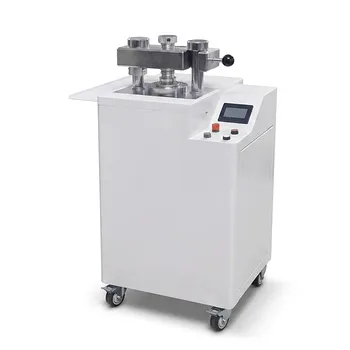
A laboratory press is fundamentally required to establish uniform mechanical pressure across all internal interfaces and to create a hermetic seal. It ensures reproducible interfacial contact between the lithium metal anode, electrolyte, and current collectors, which is necessary to eliminate impedance variations and obtain reliable electrochemical data. Without this precise pressure order, test results such as lithium stripping/plating profiles and critical current density (CCD) measurements become inconsistent and scientifically invalid.
Core Takeaway: The laboratory press transforms coin cell assembly from a manual task into a controlled engineering process. By delivering consistent sealing force, it stabilizes interfacial resistance and prevents the structural and chemical failures that lead to premature battery degradation.
Eliminating Interfacial Impedance Through Physical Contact
Achieving Atomic-Level Contact
A lab press provides the precise, uniform pressure required to ensure that lithium metal foil achieves atomic-level contact with the electrolyte or separator. This high-density contact is essential for reducing interfacial resistance, which is a primary hurdle in lithium metal battery research.
Optimizing Polymer and Solid-State Interfaces
For polymer or quasi-solid-state electrolytes, mechanical pressure is the primary driver for eliminating physical gaps inside the cell. Tight interface contact ensures that ions can move freely between the electrolyte membrane and the stainless steel current collectors without encountering high-resistance voids.
Simulating Operational Stack Pressure
In commercial applications, battery cells are often under physical compression; a laboratory press allows researchers to simulate this stack pressure. This ensures that the laboratory-scale coin cell behaves similarly to a real-world battery environment during cycling.
Enhancing Electrochemical Stability and Safety
Suppressing Lithium Dendrite Growth
Uniform pressure prevents localized current concentration, which is a major cause of lithium dendrite formation. By ensuring the lithium is pressed flat against the separator, the press helps maintain a homogenous electric field, significantly improving the battery's cycling stability.
Facilitating Stable SEI Layer Formation
The initial mechanical pressurization facilitates the formation of a thin, dense, and inorganic-rich Solid Electrolyte Interphase (SEI). A well-distributed pressure ensures that the initial chemical reactions occur uniformly across the anode surface, creating a protective layer that lowers long-term impedance.
Ensuring Data Reproducibility
Consistency is the cornerstone of scientific testing. Using a calibrated press eliminates the human variability associated with manual assembly, ensuring that every cell in a test batch has identical internal mechanical conditions.
Ensuring Environmental and Structural Integrity
Hermetic Sealing and Leak Prevention
A laboratory press provides the radial force necessary to crimp the battery case securely around the gasket. This prevents the evaporation of volatile electrolytes and blocks the ingress of moisture or oxygen, both of which would lead to rapid cell failure.
Protecting Internal Microstructures
While pressure is necessary, it must be controlled to prevent damaging the microporous structure of the separator. A professional press allows for fine-tuning the force so that the separator remains intact while the electrical contacts remain tight.
Understanding the Trade-offs
Excessive vs. Insufficient Pressure
Applying too much pressure can lead to internal short circuits if the separator is crushed or the lithium foil is deformed. Conversely, insufficient pressure results in high interfacial resistance and poor electrolyte wetting, leading to misleadingly low performance data.
Calibration and Mechanical Wear
A press that shifted out of calibration can produce skewed results across different research trials. Regular maintenance is required to ensure that the pressure indicated on the gauge matches the actual force applied to the coin cell components.
How to Apply This to Your Project
Recommendations for Assembly
- If your primary focus is solid-state battery testing: Prioritize a press with high-precision pressure gauges to ensure you are eliminating all micro-gaps at the interface.
- If your primary focus is long-term cycling stability: Use a constant-pressure sealing strategy to prevent electrolyte leakage and ensure the SEI layer remains stable over hundreds of cycles.
- If your primary focus is high-rate performance: Focus on maximizing interface contact uniformity to minimize the internal resistance that causes heat and voltage drops at high currents.
Precise mechanical pressure is the bridge between theoretical material performance and reproducible experimental reality.
Summary Table:
| Key Function | Impact on Battery Performance | Risk of Improper Pressure |
|---|---|---|
| Interfacial Contact | Reduces impedance; ensures atomic-level contact | High internal resistance; poor ion transport |
| Dendrite Suppression | Promotes homogeneous electric field; flat surfaces | Localized current concentration; short circuits |
| SEI Formation | Facilitates a thin, dense, protective inorganic layer | Inconsistent chemical reactions; rapid degradation |
| Hermetic Sealing | Prevents electrolyte evaporation and moisture ingress | Cell failure; structural integrity loss |
| Reproducibility | Eliminates human variability for valid datasets | Scientifically invalid/inconsistent test results |
Elevate Your Battery Research with KINTEK Precision Presses
Reliable lithium metal battery data begins with exact pressure control. KINTEK specializes in comprehensive laboratory pressing solutions tailored for advanced research. Our range includes manual, automatic, heated, multifunctional, and glovebox-compatible models, as well as cold and warm isostatic presses designed to eliminate impedance variations and ensure hermetic assembly.
Don't let inconsistent manual assembly compromise your findings. Partner with KINTEK to achieve the mechanical precision required for stable SEI formation and dendrite suppression.
Contact KINTEK Today to Optimize Your Lab Workflow
References
- Otaegui, Laida. Solvent - free processed polymer electrolyte for Li -metal batteries. DOI: 10.5281/zenodo.17749064
This article is also based on technical information from Kintek Solution Knowledge Base .
Related Products
- Assemble Lab Cylindrical Press Mold for Laboratory Use
- Assemble Square Lab Press Mold for Laboratory Use
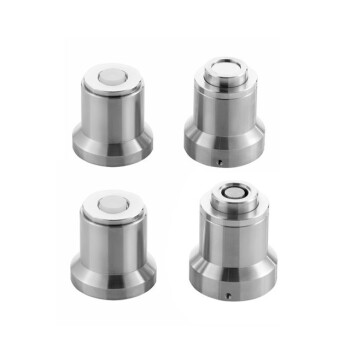
- Lab Button Battery Tablet Press Sealing Mold
- Button Battery Sealing Press Machine for Lab
- Lab Cylindrical Press Mold for Laboratory Use
People Also Ask
- What is the purpose of incorporating cartridge heaters into a lab press mold for MLCC block compression? Optimize Results
- What is the function of a pressing tool in thermoplastic panels? Master Precision Shaping & Fusion Bonding
- Why is precise cooling management of the lab press mold necessary? Protect Core Integrity in Thermoforming
- Why is a high-performance laboratory molding press critical for in-situ electrolyte formation? Unlock Battery Success
- How does the geometry of laboratory molds influence mycelium-based composites? Optimize Density and Strength