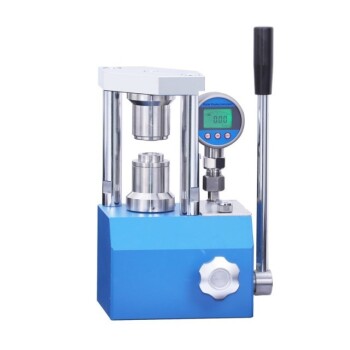
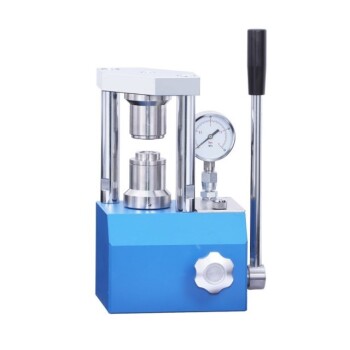
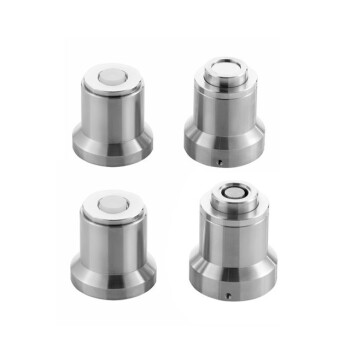
The application of precise mechanical force is the defining step in converting a stack of battery components into a functional electrochemical cell. A laboratory press or coin cell sealer is essential because it simultaneously establishes an airtight barrier against environmental contamination and enforces the physical intimacy required for ion transport between the gel polymer electrolyte and the electrodes.
The performance of a gel polymer battery is dictated by the quality of its interfaces. Without the controlled pressure from a press or sealer, microscopic gaps remain between the electrolyte and the electrodes, creating high resistance that severely limits the battery's capacity and lifespan.
The Dual Function of Mechanical Compression
Ensuring Environmental Isolation
The most immediate function of the sealer is to hermetically close the battery casing. This creates an airtight seal that isolates the sensitive internal chemistry from the external environment.
For lithium metal anodes and gel electrolytes, protection from moisture and oxygen is non-negotiable. Even trace amounts of environmental contamination can degrade the materials immediately, rendering the test cell useless before it is even cycled.
Establishing Interfacial Continuity
While sealing protects the outside, the critical work happens inside the cell. The press applies controlled pressure to the internal stack, forcing the gel electrolyte into tight contact with the lithium metal anode and the cathode (such as lithium iron phosphate).
This compression eliminates physical gaps at the interfaces. In a battery using gel or solid components, the electrolyte cannot "flow" into voids like a liquid; it must be mechanically pressed to ensure it touches every part of the electrode surface.
Optimizing Electrochemical Performance
Reducing Interfacial Resistance
The primary bottleneck in non-liquid electrolyte batteries is high interfacial impedance. If the layers are not pressed tightly together, ions struggle to jump from the electrode to the electrolyte.
By enforcing a tight, seamless interface, the press significantly reduces this resistance. This facilitates efficient lithium-ion transport, which is the fundamental mechanism of the battery's operation.
Enhancing Stability and Rate
The benefits of reduced resistance translate directly to measurable performance data. Tight contact ensures that the battery can maintain its performance over many charges and discharges, optimizing electrochemical cycling stability.
Furthermore, better contact improves rate performance—the ability of the battery to charge or discharge quickly. When the physical connection is poor, the battery cannot deliver power efficiently; precise pressurization solves this issue.
Understanding the Trade-offs
The Necessity of Uniformity
It is not enough to simply apply force; the pressure must be uniform and controlled.
If pressure is applied unevenly, it can lead to localized "hotspots" of current density or physical warping of the components. A laboratory press is designed to deliver force (e.g., 50 kg cm⁻²) evenly across the entire surface area, preventing mechanical failure.
Balancing Force and Integrity
There is a delicate balance between good contact and component damage.
Insufficient pressure leaves gaps and high resistance. However, excessive pressure could potentially damage the separator or the delicate gel structure, causing short circuits. The goal is to reach the "sweet spot" where contact is maximized without compromising structural integrity.
Making the Right Choice for Your Assembly
When setting up your assembly process, consider your specific testing goals:
- If your primary focus is Cycle Life: Prioritize the sealing precision of the equipment to ensure zero environmental ingress over long testing periods.
- If your primary focus is Rate Capability: Prioritize the pressure control capabilities to ensure maximum interfacial contact and minimum internal resistance.
Correctly utilizing a laboratory press transforms a collection of raw materials into a cohesive, high-performance energy storage device.
Summary Table:
| Feature | Impact on Gel Polymer Batteries | Benefit to Researcher |
|---|---|---|
| Hermetic Sealing | Prevents moisture and oxygen ingress | Protects sensitive lithium anodes from degradation |
| Interfacial Contact | Eliminates microscopic gaps between layers | Minimizes impedance for faster ion transport |
| Uniform Pressure | Distributes force evenly across the stack | Prevents current hotspots and mechanical failure |
| Controlled Force | Reaches the 'sweet spot' of compression | Optimizes rate performance without damaging components |
Elevate Your Battery Research with KINTEK Precision
Achieving peak electrochemical performance requires more than just quality materials; it requires the precise application of force. KINTEK specializes in comprehensive laboratory pressing solutions designed to help researchers master the interface of next-generation energy storage.
Whether you are working with sensitive gel polymer electrolytes or solid-state chemistries, our range of manual, automatic, heated, and glovebox-compatible presses, alongside our specialized isostatic presses, ensures your cells are assembled with world-class consistency.
Ready to reduce your interfacial resistance and improve cycle life?
Contact KINTEK today to find the perfect pressing solution for your lab.
References
- Xueli Yao, Yifeng Guo. Preparation and Performance of PVDF-HFP/PAN-Based Gel Polymer Electrolytes. DOI: 10.3390/gels11050317
This article is also based on technical information from Kintek Solution Knowledge Base .
Related Products
- Button Battery Sealing Press Machine for Lab
- Button Battery Sealing Machine for Button Batteries
- Manual Button Battery Sealing Machine for Battery Sealing
- Lab Button Battery Tablet Press Sealing Mold
- Lab Button Battery Disassembly and Sealing Mold
People Also Ask
- Why use standardized CR2032 components & high-precision presses? Ensure reliability in lithium metal battery research.
- Why is a laboratory battery sealing press essential for desolvation energy testing? Ensure Reliable Kinetic Data
- Why is a laboratory hydraulic press or battery sealing machine essential? Ensure Coin Cell Data Integrity
- How do laboratory battery sealing machines ensure performance consistency? Master Your Lithium and LFP Battery Assembly
- What role does a laboratory sealing press play in thermal analysis of solid dispersion films? Ensure Data Integrity