
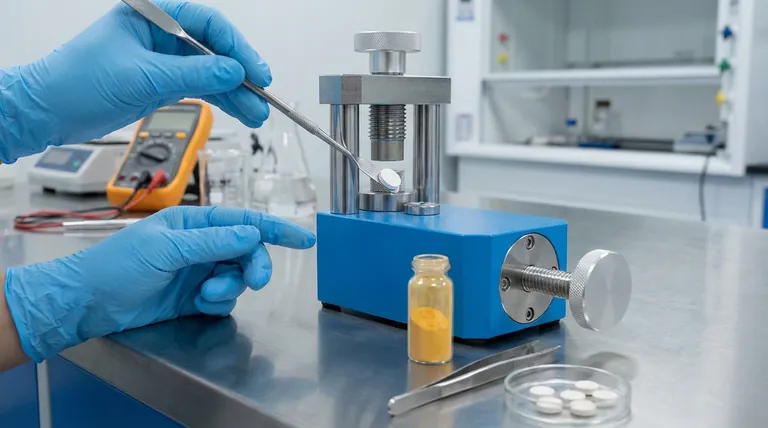
A laboratory press is fundamental to electrolyte characterization because it transforms loose, insulating powder into a conductive geometric solid. To characterize thioantimonate, you must apply significant pressure (often hundreds of megapascals) to eliminate air pockets and force the powder particles into intimate physical contact, creating a continuous pathway for ion transport.
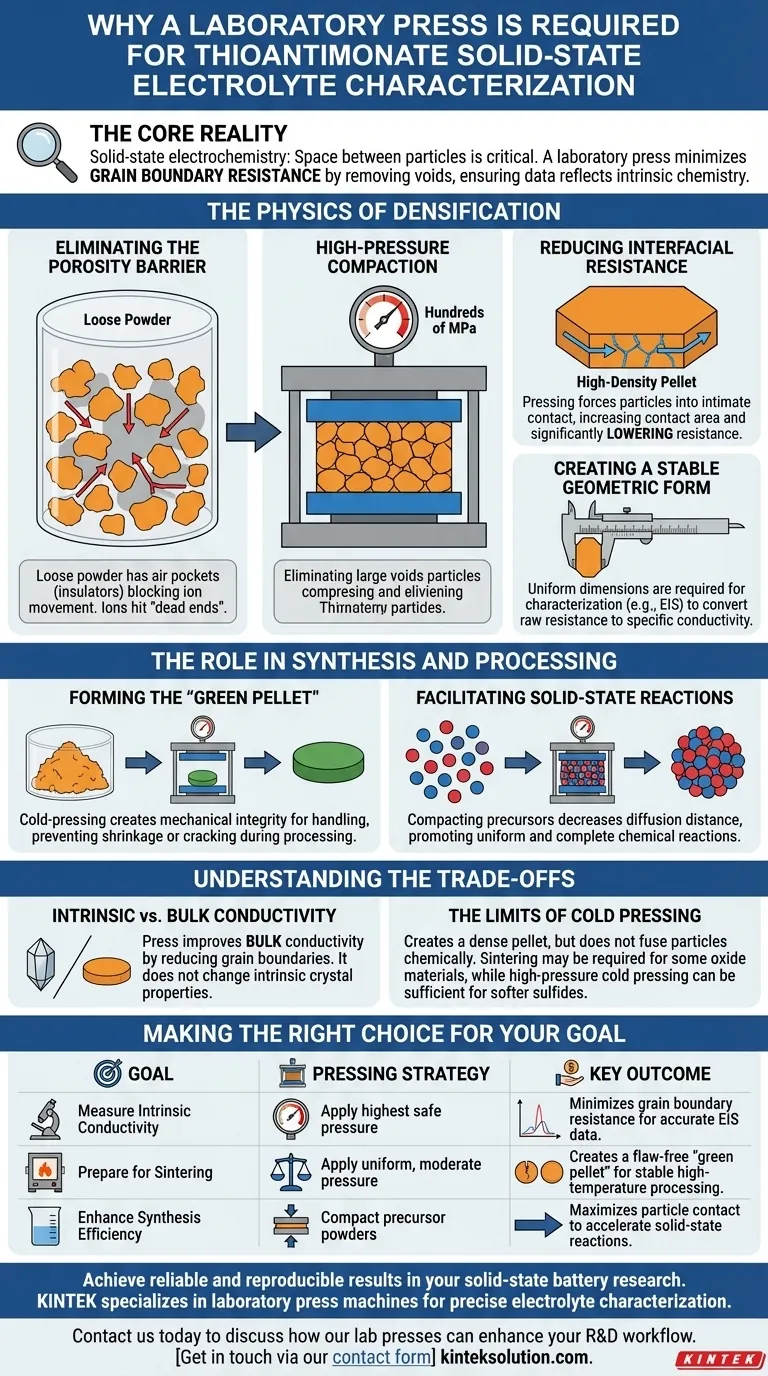
The Core Reality In solid-state electrochemistry, the space between particles is just as critical as the particles themselves. A laboratory press minimizes grain boundary resistance by removing voids, ensuring that your data reflects the material's intrinsic chemistry rather than the artifacts of loose packing.
The Physics of Densification
Eliminating the Porosity Barrier
Loose thioantimonate powder contains a significant volume of air. Air is an electrical insulator and blocks the movement of ions.
When you attempt to measure conductivity on a loose sample, the ions hit "dead ends" at these voids. High-pressure compaction mechanically collapses these voids, maximizing the volume of active material available for conduction.
Reducing Interfacial Resistance
Ionic conductivity relies on ions hopping from one crystal lattice to another. This transfer occurs at the grain boundaries—the interfaces where two particles touch.
If the contact area is small or loose, the resistance at these boundaries skyrockets. A laboratory press forces particles together, increasing the contact area and significantly lowering the resistance encountered as ions move through the pellet.
Creating a Stable Geometric Form
For characterization methods like Electrochemical Impedance Spectroscopy (EIS), the sample must have a defined geometry (thickness and area).
A press produces a pellet with uniform dimensions. This geometric stability is required to convert raw resistance data (Ohms) into specific conductivity (Siemens per centimeter).
The Role in Synthesis and Processing
Forming the "Green Pellet"
Before any potential heat treatment, the powder must be formed into a coherent shape, known as a green pellet.
References indicate that for materials like NASICON or LATP, this cold-pressing stage creates the mechanical integrity needed for handling. A uniform green pellet prevents issues like uneven shrinkage, cracking, or deformation during subsequent processing steps.
Facilitating Solid-State Reactions
If you are synthesizing the thioantimonate from precursors, the press plays a chemical role.
By compacting reactant powders, you decrease the diffusion distance between different chemical species. This proximity promotes a more uniform and complete chemical reaction during synthesis, leading to higher phase purity.
Understanding the Trade-offs
Intrinsic vs. Bulk Conductivity
It is vital to distinguish between the conductivity of the crystal grain (intrinsic) and the conductivity of the whole pellet (bulk).
While a press significantly improves bulk conductivity by reducing grain boundary resistance, it does not change the intrinsic properties of the crystal lattice itself. Cold pressing alone may not equal the density of a single crystal.
The Limits of Cold Pressing
Applying pressure creates a dense pellet, but it does not fuse the particles together chemically.
For some oxide-based electrolytes, a "green pellet" pressed at 10-400 MPa is merely a precursor that requires high-temperature sintering to achieve final density. However, for softer sulfide-based materials (often including thioantimonates), cold pressing at high pressures (e.g., 600 MPa) can sometimes achieve sufficient density for direct characterization without sintering.
Making the Right Choice for Your Goal
To maximize the utility of your laboratory press, align your pressure strategy with your specific experimental outcome:
- If your primary focus is measuring intrinsic conductivity: Use the highest safe pressure to minimize grain boundary resistance, ensuring the EIS spectrum reflects the material, not the pores.
- If your primary focus is high-temperature sintering: Focus on applying uniform, moderate pressure to create a flaw-free "green pellet" that will not crack during heating.
- If your primary focus is synthesis efficiency: Compact precursor powders to maximize particle contact, which accelerates diffusion and reaction kinetics.
Reliable solid-state battery research depends on the ability to create reproducible, high-density interfaces, making the laboratory press a non-negotiable tool for validation.
Summary Table:
| Goal | Pressing Strategy | Key Outcome |
|---|---|---|
| Measure Intrinsic Conductivity | Apply highest safe pressure | Minimizes grain boundary resistance for accurate EIS data |
| Prepare for Sintering | Apply uniform, moderate pressure | Creates a flaw-free 'green pellet' for stable high-temperature processing |
| Enhance Synthesis Efficiency | Compact precursor powders | Maximizes particle contact to accelerate solid-state reactions |
Achieve reliable and reproducible results in your solid-state battery research.
KINTEK specializes in laboratory press machines, including automatic, isostatic, and heated lab presses, designed to meet the precise demands of electrolyte characterization. Our equipment ensures you can create high-density, uniform pellets—eliminating porosity and interfacial resistance to measure the true properties of your thioantimonate materials.
Contact us today to discuss how our lab presses can enhance your R&D workflow and deliver the accurate data you need. Get in touch via our contact form
Visual Guide
Related Products
- Laboratory Hydraulic Press 2T Lab Pellet Press for KBR FTIR
- Laboratory Hydraulic Press Lab Pellet Press Button Battery Press
- Laboratory Hydraulic Press Lab Pellet Press Machine for Glove Box
- Laboratory Split Manual Heated Hydraulic Press Machine with Hot Plates
- Laboratory Hydraulic Pellet Press for XRF KBR FTIR Lab Press
People Also Ask
- What is the role of a laboratory pressure machine and KBr in FTIR? Master Sample Preparation for Flame Retardants
- What is the role of a laboratory hydraulic press in high-loading NCM811 cathode prep for solid-state batteries?
- Why is a laboratory hydraulic press necessary for sample preparation? Precise Pelleting for Spiro Heterocyclic Analysis
- What role does a laboratory hydraulic press play in reaction pellets? Optimizing Lunar Soil and Metal Fuel Density
- Why is a laboratory hydraulic press used to compact monazite samples before the roasting treatment? Optimize Reactions



















