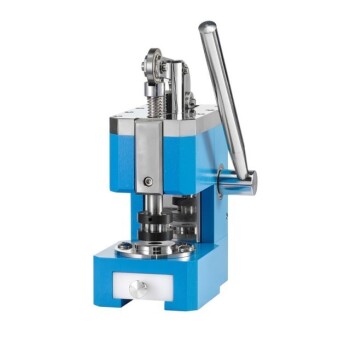
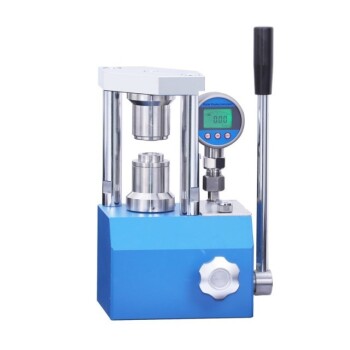
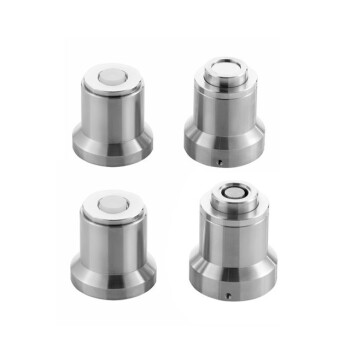
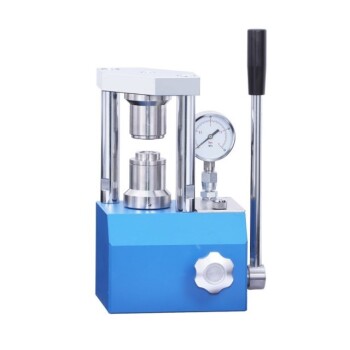
A precision disc cutter is essential for processing test samples because it ensures they have identical geometric dimensions and defined surface areas. By creating uniform specimens—such as standard 8 mm diameter discs—you eliminate variables related to irregular shapes, ensuring that test results reflect true material properties rather than sample preparation inconsistencies.
The standardization of sample geometry is critical for eliminating variations in swelling kinetics caused by irregular shapes, thereby guaranteeing the accuracy and repeatability of both gel fraction calculations and swelling ratio measurements.
The Critical Importance of Standardization
Eliminating Geometric Variables
In electrolyte and polymer testing, irregular shapes introduce uncontrolled variables.
If samples are cut manually, they will possess varying perimeters and surface anomalies. A precision disc cutter ensures every sample has the exact same geometric footprint.
Consistency in Swelling Kinetics
Swelling is a dynamic process where solvent diffuses into the material matrix.
Because this process is surface-dependent, uniform dimensions are required to standardize diffusion paths. If the shape varies, the rate of swelling (kinetics) will vary, leading to noisy or unusable data.
Enhancing Data Reliability
Accuracy in Gel Fraction Calculations
Gel fraction testing determines the portion of a polymer that is cross-linked and insoluble.
To calculate this accurately, the starting mass and surface area must be consistent. Precision cutting reduces errors derived from jagged edges or loose material fibers that can alter mass readings.
High Repeatability Across Batches
To validly compare different material formulas, the physical baseline of the test samples must be constant.
Precision disc cutters enable high repeatability, ensuring that a sample tested today is geometrically identical to one tested next week. This allows researchers to isolate chemical differences without worrying about physical inconsistencies.
Common Pitfalls to Avoid
Neglecting Edge Quality
While a cutter aims for precision, a dull blade can compress or tear the sample edges rather than shearing them cleanly.
Compromised edges can alter the surface area available for solvent interaction, reintroducing the very variables the tool is meant to eliminate.
Assuming One Size Fits All
Precision cutters typically produce a fixed diameter (e.g., 8 mm).
It is a mistake to assume a single diameter is suitable for all viscosity or thickness levels. You must ensure the chosen dimension is appropriate for the specific diffusion properties of the material being tested.
Making the Right Choice for Your Goal
To maximize the value of your testing protocol:
- If your primary focus is Kinetic Analysis: Use a precision cutter to ensure that observed swelling rates are dictated solely by material properties, not by variations in sample shape.
- If your primary focus is Comparative Data: Implement strict geometric standardization to minimize data scatter and ensure valid comparisons between different sample batches.
By removing geometric inconsistency, you transform your testing process from a rough estimation into a rigorous scientific measurement.
Summary Table:
| Feature | Impact on Testing | Benefit for Research |
|---|---|---|
| Uniform Geometry | Eliminates shape-related variables | Higher data repeatability |
| Defined Surface Area | Standardizes solvent diffusion paths | Accurate swelling kinetics |
| Clean Shearing | Prevents mass errors from jagged edges | Precise gel fraction calculation |
| Standardized Diameter | Maintains baseline across batches | Reliable material comparison |
Precision Sample Preparation with KINTEK
Are geometric inconsistencies compromising your research data? KINTEK specializes in comprehensive laboratory pressing and cutting solutions designed for the rigorous demands of battery research and polymer science.
Whether you require manual, automatic, or multifunctional precision tools, our equipment ensures every specimen meets exact standards for thickness and diameter. From heated and glovebox-compatible models to advanced isostatic presses, we provide the tools needed to eliminate variables and focus on your results.
Transform your testing from estimation into rigorous science. Contact KINTEK today to find the perfect precision solution for your lab.
References
- Samyak Nilesh Chordia, Christopher M. Evans. Crosslinking Density and Salt Addition Impacts on the Large Amplitude Oscillatory Shear Response of Acrylate Network Electrolytes. DOI: 10.1002/pol.20250310
This article is also based on technical information from Kintek Solution Knowledge Base .
Related Products
- Lab Manual Microtome Slicer for Tissue Sectioning
- Button Battery Sealing Machine for Button Batteries
- Laboratory Hydraulic Split Electric Lab Pellet Press
- Manual Laboratory Hydraulic Press Lab Pellet Press
- Lab Button Battery Disassembly and Sealing Mold
People Also Ask
- Why is it necessary to use a high-precision disc cutter for coin cells? Ensure Data Accuracy and Prevent Shorts
- How does a precision disc puncher ensure experimental accuracy? Standardize Your Battery Research Samples
- How do chemical etchants assist in Micro EDM microstructure analysis? Reveal Heat-Affected Zones and Recast Layers
- Why is a blade grinder necessary for PLA composites? Master Pretreatment for Perfect Hot-Press Molding
- How does the use of a precision disc puncher contribute to the consistency of battery testing results? Ensure Accuracy