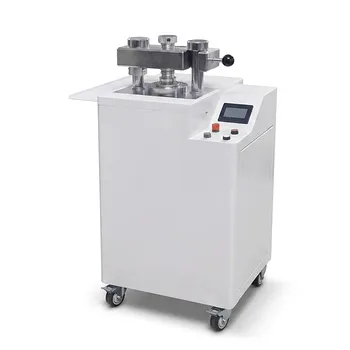
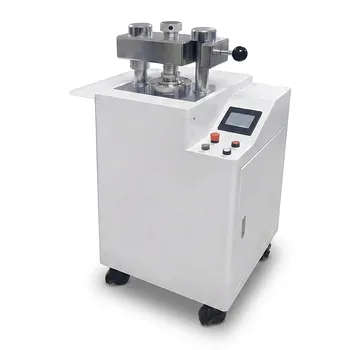
The precision manual laboratory pellet press transforms loose SiC/YAG powder into a cohesive "green body." By applying controlled axial pressure—typically around 100 MPa—the equipment compacts raw powders into a specific geometric shape with enough structural integrity to survive handling. This stage is critical because it establishes the particle-to-particle contact and initial density required for successful high-pressure treatment and sintering.
The primary role of the laboratory press is to provide "green strength" and geometric definition to composite powders. This creates a stable workpiece that can withstand the stresses of subsequent thermal and mechanical processing without collapsing or cracking.
Particle Rearrangement and Initial Densification
Establishing Particle Contact
Loose SiC and YAG powders exist as independent particles with significant air gaps between them. The uniaxial pressure from the manual press forces these particles to rearrange and pack tightly together. This initial contact is the foundation for all subsequent bonding that occurs during the sintering process.
Eliminating Internal Voids
Applying pressure through carbon steel dies helps expel the air trapped within the powder bed. Removing this air is vital because internal pockets can lead to structural defects or uneven heating during microwave or thermal sintering. A dense, uniform internal structure ensures more stable energy absorption and coupling.
Inducing Plastic Deformation
Depending on the pressure applied, the particles may undergo slight plastic deformation or fragmentation at their contact points. This increases the total contact area and the mechanical interlocking between the SiC and YAG phases. This increased contact area serves as the primary driving force for the diffusion that occurs later at high temperatures.
Geometric and Structural Definition
Creating the "Green Body"
The term "green body" refers to the compacted ceramic object before it has been fired. The laboratory press uses precision molds to ensure this body takes a specific form, such as a rectangle or cylinder. This regular shape is necessary for the workpiece to fit into subsequent high-pressure containers or sintering furnaces.
Providing Necessary Green Strength
Without this initial pressing stage, the powder mixture would remain a loose pile that is impossible to handle or transport. The press provides the "primary strength" needed for the material to maintain its shape. This allows researchers to move the sample from the forming stage to the densification stage without it crumbling.
Facilitating Consistent Density
A manual pellet press allows for the application of a specific, repeatable force to each sample. Maintaining a consistent green density across different samples is essential for experimental repeatability. If the initial density varies, the final shrinkage and properties of the SiC/YAG composite will also vary, leading to unreliable data.
Understanding the Trade-offs
Uniaxial vs. Isostatic Pressure
A manual laboratory press typically applies uniaxial pressure, meaning the force comes from one direction. While excellent for creating basic shapes, this can lead to density gradients, where the material is denser near the plunger and less dense in the center. For applications requiring perfect uniformity, this "green body" often requires a subsequent round of Cold Isostatic Pressing (CIP).
Wall Friction and Die Wear
During the pressing process, friction between the powder and the carbon steel die walls can interfere with the pressure distribution. This friction can lead to "capping" or internal laminations where the pellet splits into layers. Using high-quality precision dies and appropriate lubricants or binders is often necessary to mitigate these mechanical stresses.
How to Apply This to Your Project
Optimizing the Forming Stage
To achieve the best results with SiC/YAG composites, the forming stage must be tailored to the final manufacturing goal.
- If your primary focus is geometric precision: Use high-tolerance carbon steel or ceramic dies and ensure the powder is granulated with a binder to improve flow and mold filling.
- If your primary focus is maximum final density: Apply a higher initial pressure (up to 400-500 MPa) to maximize particle rearrangement before moving to the sintering phase.
- If your primary focus is preventing cracks during sintering: Focus on slow, steady pressure application to allow air to escape gradually, reducing the risk of trapped gas pockets.
By mastering the initial pressing stage, you ensure that the SiC/YAG composite possesses the structural foundation necessary for advanced high-temperature performance.
Summary Table:
| Aspect | Role in SiC/YAG Formation | Critical Impact on Quality |
|---|---|---|
| Pressure Application | Compacts loose powder into geometry | Creates a cohesive, stable "Green Body" |
| Void Removal | Expels internal air and gas pockets | Prevents structural cracking during sintering |
| Particle Contact | Forces mechanical interlocking | Accelerates diffusion at high temperatures |
| Shape Control | Uses precision carbon steel dies | Ensures compatibility with sintering furnaces |
| Consistency | Applies repeatable axial force | Guarantees density uniformity across samples |
Maximize Your Material Research Precision with KINTEK
Achieving the perfect green body density is the foundation of advanced material science. KINTEK specializes in comprehensive laboratory pressing solutions tailored for high-performance applications like SiC/YAG composites and battery research.
Whether you require manual oversight or high-throughput automation, our versatile range includes:
- Manual & Automatic Pellet Presses for ease and precision.
- Heated & Multifunctional Models for complex experimental requirements.
- Glovebox-Compatible Solutions for sensitive environments.
- Cold and Warm Isostatic Presses (CIP/WIP) for ultimate density uniformity.
At KINTEK, we empower researchers with the tools needed to eliminate defects and ensure experimental repeatability. Contact us today to find the ideal pressing solution for your lab!
References
- Xingzhong Guo, Hui Yang. Sintering and microstructure of silicon carbide ceramic with Y3Al5O12 added by sol-gel method. DOI: 10.1631/jzus.2005.b0213
This article is also based on technical information from Kintek Solution Knowledge Base .
Related Products
- Manual Laboratory Hydraulic Pellet Press Lab Hydraulic Press
- Automatic Laboratory Hydraulic Press Lab Pellet Press Machine
- Manual Laboratory Hydraulic Press Lab Pellet Press
- Automatic XRF Pellet Press for Laboratory Spectrometry Sample Preparation
- Automatic Fluorescence Sample Preparation Press 40 Ton Lab Pellet Press for XRF Analysis
People Also Ask
- What is the function of a lab hydraulic press in pyrolysis experiments? Standardize Raw Materials for Precision
- What role does a lab hydraulic press play in researching squishy granular matter? Expert Insights into Material Physics
- What is the primary purpose of manual lab hydraulic pellet presses? Achieve High-Precision Sample Preparation for Spectroscopy
- What is the primary function of a laboratory hydraulic press in evaluating the ionic conductivity of Li6PS5X (LMSX)?
- How does high-precision pressure holding control in a lab hydraulic press affect squishy granular matter experiments?