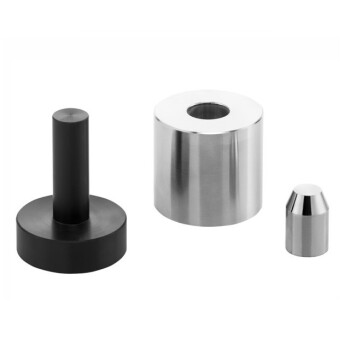
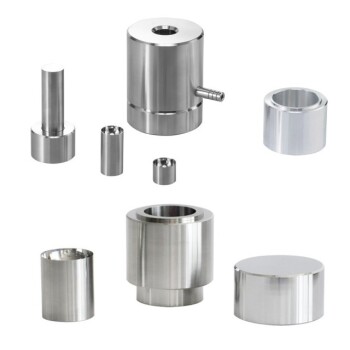
A precision pellet forming die is the definitive hardware component responsible for dictating the final physical geometry of biomass fuel. It functions as the critical mold that transforms loose raw material into standardized units, such as 10 mm diameter pellets, while ensuring the product retains its shape under significant stress.
The die serves a dual purpose: it enforces strict dimensional standards required for fuel consistency, and its physical properties—specifically hardness and smoothness—directly dictate the speed and efficiency of the production line.
The Mechanics of Quality Control
Defining Geometric Consistency
The primary function of the die is to determine the final geometric dimensions of the fuel pellet.
In biomass processing, standardization is key; the die ensures that every unit produced adheres to specific measurements, such as a precise 10 mm diameter.
This uniformity is essential for the end-user, ensuring the fuel feeds correctly into burners and combusts at a predictable rate.
Withstanding Extreme Environments
Biomass densification is a violent process involving intense heat and crushing forces.
A precision die must possess high dimensional stability to maintain its shape in this high-temperature and high-pressure environment.
If the die deforms even slightly under load, the resulting pellets will fail to meet specifications, leading to structural integrity issues.
Production Efficiency and Material Properties
The Role of Inner Wall Smoothness
The texture of the die’s inner surface is a critical variable in manufacturing efficiency.
A high degree of inner wall smoothness significantly reduces friction as the compressed material is pushed through the die.
This directly improves demolding efficiency, allowing pellets to be ejected cleanly without jamming or requiring excessive energy.
Material Hardness and Surface Quality
The hardness of the die material determines its lifespan and the finish of the final product.
A sufficiently hard die resists wear from abrasive biomass fibers, ensuring that the pellet surface remains smooth and compacted.
High surface quality on the pellet itself prevents crumbling during transport and reduces dust generation.
Understanding the Trade-offs
The Cost of Precision
Achieving high dimensional stability and superior inner wall smoothness requires specialized manufacturing and high-grade alloys.
Consequently, precision dies represent a higher upfront investment compared to standard molds.
The Risks of Lower Quality
Opting for a die with lower material hardness or poor surface finish often leads to "false economy."
Rough inner walls increase friction, which generates excess heat and creates resistance during demolding.
This not only slows down production but can cause the pellets to crack or expand unpredictably after ejection.
Optimizing Your Biomass Operation
To maximize the value of your equipment, select a die based on your specific operational targets:
- If your primary focus is Production Speed: Prioritize a die with exceptional inner wall smoothness to minimize friction and maximize demolding efficiency.
- If your primary focus is Product Durability: Ensure the die material possesses high hardness ratings to maintain strict dimensional stability over long production runs.
The right die transforms biomass pressing from a variable process into a reliable, standardized manufacturing operation.
Summary Table:
| Feature | Impact on Production | Benefit |
|---|---|---|
| Dimensional Stability | Resists high heat and pressure | Ensures uniform pellet size and density |
| Inner Wall Smoothness | Reduces friction during extrusion | Faster demolding and lower energy consumption |
| Material Hardness | Resists abrasive wear | Extends die lifespan and improves surface finish |
| Geometric Precision | Standardizes unit size | Guarantees consistent combustion and feeding |
Elevate Your Lab Research with KINTEK Precision Solutions
Don't let subpar equipment compromise your material research. KINTEK specializes in comprehensive laboratory pressing solutions, providing the precision needed for advanced material science and renewable energy studies.
Whether you are conducting battery research or developing biomass standards, our range of manual, automatic, heated, and multifunctional presses, along with our specialized cold and warm isostatic presses, ensure consistent, high-quality results.
Ready to optimize your pressing workflow? Contact us today to discover how KINTEK's superior hardware can drive your innovation forward.
References
- Ras Izzati Ismail, Alina Rahayu Mohamed. Biomass Fuel Characteristics of Malaysian Khaya senegalensis Wood-Derived Energy Pellets: Effects of Densification at Varied Processing Temperatures. DOI: 10.3390/jmmp8020062
This article is also based on technical information from Kintek Solution Knowledge Base .
Related Products
- Lab Ring Press Mold for Sample Preparation
- Lab XRF Boric Acid Powder Pellet Pressing Mold for Laboratory Use
- XRF KBR Steel Ring Lab Powder Pellet Pressing Mold for FTIR
- XRF KBR Plastic Ring Lab Powder Pellet Pressing Mold for FTIR
- Lab Infrared Press Mold for No Demolding
People Also Ask
- What is the purpose of incorporating cartridge heaters into a lab press mold for MLCC block compression? Optimize Results
- What is the role of a laboratory press in COF electrolyte prep? Achieving High-Performance Pellet Densification
- Why is precise cooling management of the lab press mold necessary? Protect Core Integrity in Thermoforming
- What is the function of a pressing tool in thermoplastic panels? Master Precision Shaping & Fusion Bonding
- What impact does a sample preparation press have on testing results when researching MXene as an electrolyte additive?