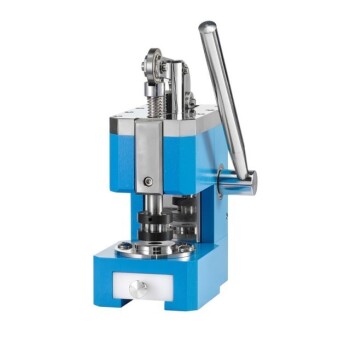
Precision and edge integrity are the non-negotiable reasons for using a specialized punching and cutting machine. This equipment, when paired with standardized dumbbell-shaped dies, ensures that tensile test specimens are cut with exact geometric uniformity and edges free from microscopic defects. Without this level of precision, the validity of your mechanical property data is compromised from the start.
The Core Takeaway Manual or improper cutting methods introduce edge nicks that act as stress concentrators, leading to premature material failure and biased data. A specialized punching machine eliminates these variables, ensuring your results reflect the material's true properties and comply with strict international standards like ASTM D638.
The Physics of Edge Integrity
Eliminating Stress Concentrations
The primary function of a specialized cutting machine is to prevent "stress risers." When a specimen is cut manually, it inevitably suffers from microscopic nicks, burrs, or irregularities along the edge.
During a tensile test, stress does not distribute distinctively across a flawed sample. Instead, it concentrates at these small nicks. This causes the material to fail at a lower load than it naturally would, resulting in artificial "weak points" that skew your data.
Ensuring Neat, Undamaged Edges
Specialized machines use high pressure to drive a sharp die through the material—often hot-pressed composite films or molded plates—in a single, rapid motion.
This mechanical action ensures the edges remain neat and smooth. Unlike sawing or manual slicing, which drags against the material, a punch cut preserves the structural integrity of the sample's perimeter.
Standardization and Compliance
Adhering to International Standards
Reliable testing requires strict adherence to standards such as ASTM D638. These protocols dictate the exact dimensions of the "dumbbell" or "dog-bone" shape used for testing.
A specialized machine guarantees that every specimen produced is an identical clone of the standard. This uniformity allows for valid comparisons between different batches of materials and ensures your data is accepted by the broader scientific and engineering community.
Avoiding Data Bias
The goal of tensile testing is to measure the properties of the material, not the quality of the cut. If specimens vary in width or edge quality due to manual preparation, the resulting data curve will exhibit high variance.
By standardizing the preparation method, you remove the human variable. This ensures that any change in performance data is attributed to the material itself, not the sample preparation process.
Understanding the Trade-offs: Mechanical vs. Alternate Methods
The Pitfalls of Manual Cutting
Manual cutting is the least reliable method. It is nearly impossible to achieve complex geometric transitions, such as the shoulders of a tensile bar, with a knife or shears. This leads to inconsistent cross-sectional areas and unreliable stress calculations.
The Hidden Risks of Laser Cutting
While laser cutting offers geometric precision, it introduces a different problem: thermal stress. The heat from the laser can degrade the polymer matrix at the cut edge or alter its crystalline structure.
A mechanical punching machine avoids this entirely. It is a "cold" process that cuts without altering the thermal history of the material, ensuring the test results reflect the material as it was molded, not as it was burned.
Making the Right Choice for Your Goal
To ensure your material testing program is effective, select your preparation method based on your specific requirements:
- If your primary focus is Data Validity: Use a specialized punching machine to ensure edge quality prevents premature failure and skewed results.
- If your primary focus is Standard Compliance: Rely on standardized dies and mechanical presses to meet the strict geometric tolerances of ASTM D638.
- If your primary focus is Material Purity: Choose mechanical punching over laser cutting to avoid introducing thermal degradation or heat-affected zones to your specimen.
Ultimately, the reliability of your mechanical data is only as good as the quality of your test specimen.
Summary Table:
| Feature | Specialized Punching Machine | Manual Cutting | Laser Cutting |
|---|---|---|---|
| Edge Quality | Smooth, burr-free edges | Nicks & stress concentrators | Potential thermal damage |
| Precision | High (Standardized Dies) | Low (Human Error) | High Geometric Accuracy |
| Thermal Impact | None (Cold Process) | None | High (Heat-Affected Zones) |
| Compliance | Meets ASTM D638 / ISO 527 | Generally Non-compliant | Varies by material |
| Data Reliability | High - Reflects true properties | Low - Premature failures | Variable - Material changes |
Elevate Your Material Testing Precision with KINTEK
Don't let poor sample preparation compromise your research integrity. KINTEK specializes in comprehensive laboratory pressing and preparation solutions, offering manual and automatic models designed to deliver the exact geometric uniformity required for ASTM standards. Whether you are working on advanced battery research or polymer composites, our high-precision equipment ensures your tensile specimens are free from stress-inducing defects.
Ready to achieve more reliable, repeatable data? Contact KINTEK today to find the perfect cutting solution for your lab!
References
- Evangelia Delli, K. Chrissafis. Defining the Effect of a Polymeric Compatibilizer on the Properties of Random Polypropylene/Glass Fibre Composites. DOI: 10.3390/jcs8020044
This article is also based on technical information from Kintek Solution Knowledge Base .
Related Products
- Lab Manual Microtome Slicer for Tissue Sectioning
- Automatic Heated Hydraulic Press Machine with Heated Plates for Laboratory
- Laboratory Split Manual Heated Hydraulic Press Machine with Hot Plates
- Manual Cold Isostatic Pressing CIP Machine Pellet Press
- Automatic High Temperature Heated Hydraulic Press Machine with Heated Plates for Lab
People Also Ask
- Why is a precision disc cutter used to process samples? Ensure Accuracy in Gel Content and Swelling Ratio Testing
- Why is it necessary to use a high-precision disc cutter for coin cells? Ensure Data Accuracy and Prevent Shorts
- How does a precision disc puncher ensure experimental accuracy? Standardize Your Battery Research Samples
- How do chemical etchants assist in Micro EDM microstructure analysis? Reveal Heat-Affected Zones and Recast Layers
- Why is a blade grinder necessary for PLA composites? Master Pretreatment for Perfect Hot-Press Molding