
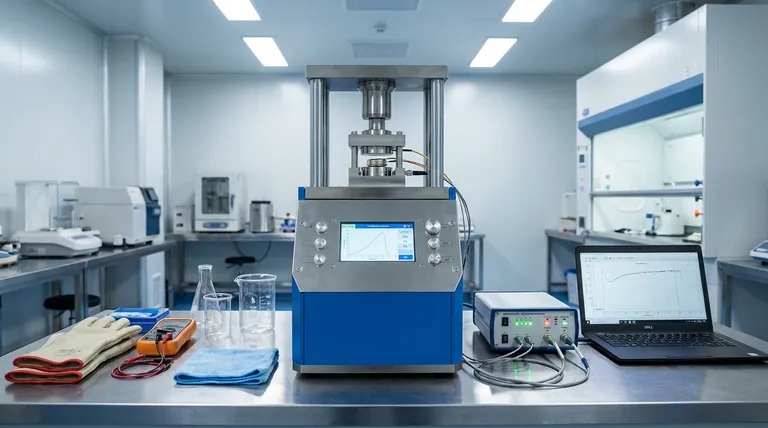
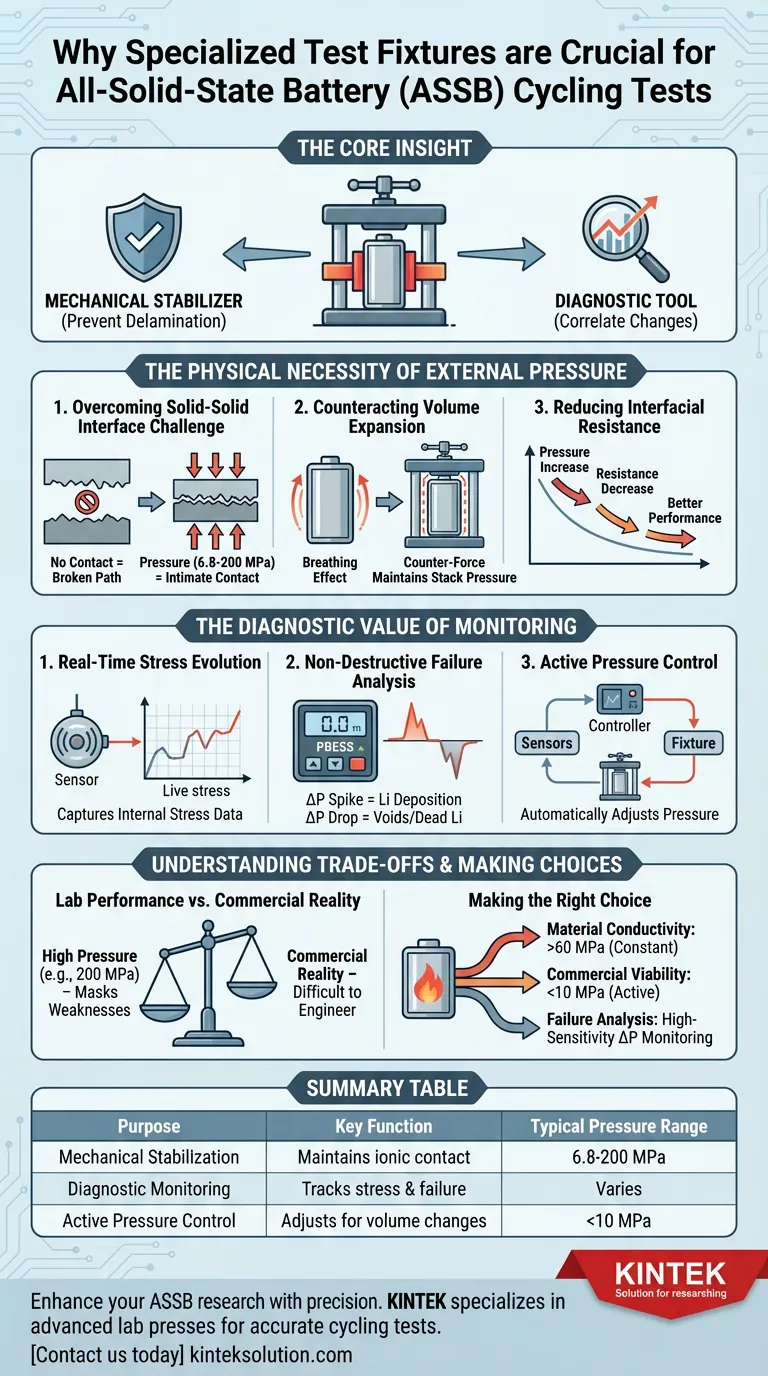
A specialized test fixture is indispensable for all-solid-state battery (ASSB) research because it bridges the gap between electrochemical potential and mechanical reality. Unlike liquid electrolytes that flow to fill voids, solid-state interfaces are rigid and prone to separation. The fixture applies the external pressure required to maintain ionic conductivity while monitoring the internal stresses generated by electrode expansion.
The Core Insight: The test fixture serves a dual purpose: it acts as a mechanical stabilizer to prevent immediate failure due to delamination, and as a diagnostic tool to correlate volumetric changes with electrochemical performance.
The Physical Necessity of External Pressure
Overcoming the Solid-Solid Interface Challenge
All-solid-state batteries rely entirely on rigid contact between the electrode and the solid electrolyte. Without a liquid medium to wet the surface, any physical gap breaks the ionic pathway. A specialized fixture applies constant external pressure (ranging from 6.8 MPa to 200 MPa depending on the chemistry) to force these materials into intimate contact.
Counteracting Volume Expansion
Active materials, particularly Silicon (Si) anodes or Lithium metal, experience significant volume changes during charge and discharge cycles. This "breathing" effect can push components apart. The test fixture provides a counter-force to maintain stack pressure, preventing the electrode and electrolyte from physically decoupling.
Reducing Interfacial Resistance
Simply put, better contact equals better performance. By applying uniform pressure, the fixture minimizes interfacial resistance. This ensures that the data you collect regarding ionic conductivity and cycle life accurately reflects the material's properties, rather than being skewed by poor physical connections.
The Diagnostic Value of Monitoring
Real-Time Stress Evolution
A fixture equipped with force sensors does more than just clamp the cell; it listens to it. It captures real-time data on internal stress evolution. This allows researchers to observe how the battery fights against the enclosure during lithium plating and stripping.
Non-Destructive Failure Analysis
Digital presses track pressure changes ($\Delta P$) continuously. A spike in pressure can indicate volumetric expansion due to lithium deposition, while a drop might signal the formation of voids or "dead lithium." This allows for the evaluation of mechanical stability without destroying the cell.
Active Pressure Control
Advanced fixtures utilize active control systems to automatically adjust pressure to a preset value. This compensates for the natural breathing of the cell. By stabilizing the mechanical environment, you stabilize the charging overpotential and significantly improve capacity retention.
Understanding the Trade-offs
Lab Performance vs. Commercial Reality
While high pressure (e.g., 200 MPa) can force a cell to cycle over 400 times by suppressing delamination, this may mask intrinsic material weaknesses. Relying too heavily on massive external pressure in the lab can create a false sense of security regarding how the chemistry will perform in a commercial pack, where such pressures are difficult to engineer.
Complexity of Equipment
Implementing active pressure monitoring adds a layer of complexity to testing. It requires precise sensors and feedback loops. Improper calibration of the "active" control can lead to inconsistent data if the system over-corrects or lags behind the rapid volume changes of the cell.
Making the Right Choice for Your Goal
To select the correct testing parameters, you must define the scope of your investigation.
- If your primary focus is Fundamental Material Conductivity: Apply high, constant pressure (e.g., >60 MPa) to eliminate contact resistance and isolate the intrinsic electrochemical properties of the material.
- If your primary focus is Commercial Viability: Use lower, active pressure settings (e.g., <10 MPa) with strict monitoring to simulate real-world pack constraints and identify failure modes likely to occur in production.
- If your primary focus is Failure Mechanism Analysis: Prioritize a fixture with high-sensitivity $\Delta P$ monitoring to correlate specific voltage anomalies with internal mechanical events like void formation.
Data reliability in solid-state batteries is not just about measuring electricity; it is about controlling the mechanical environment to ensure the chemistry has a chance to work.
Summary Table:
| Purpose | Key Function | Typical Pressure Range |
|---|---|---|
| Mechanical Stabilization | Maintains ionic contact between solid components | 6.8 MPa to 200 MPa |
| Diagnostic Monitoring | Tracks stress evolution and failure modes in real-time | Varies based on cell chemistry |
| Active Pressure Control | Automatically adjusts pressure to compensate for volume changes | <10 MPa (for commercial viability studies) |
Enhance your all-solid-state battery research with precision and reliability. KINTEK specializes in advanced lab press machines, including automatic lab presses, isostatic presses, and heated lab presses, designed to meet the rigorous demands of laboratory testing. Our equipment provides the precise pressure control and monitoring essential for accurate cycling tests, helping you achieve reliable data and optimize battery performance. Contact us today to learn how our solutions can support your research goals!
Visual Guide
Related Products
People Also Ask
- Why must composite cathodes be sealed in vacuum lamination bags for WIP? Ensure Battery Stability and Density
- How do sacrificial volume materials (SVM) maintain microchannels in isostatic pressing? Ensure Structural Integrity
- What is the function of elastic molds in warm isostatic pressing? Achieve Uniform Density in Composite Particles
- How does Warm Isostatic Pressing differ from traditional pressing methods? Unlock Uniform Density for Complex Parts
- What is the function of hydraulic pressure in warm isostatic pressing? Achieve Uniform Material Density
