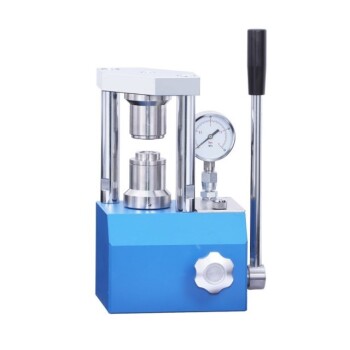
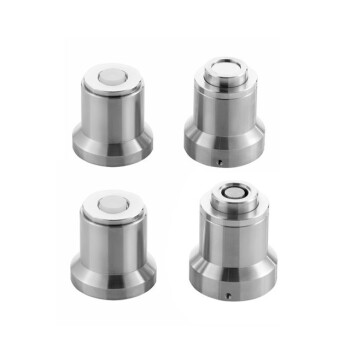
An automatic lab press machine is essential because it delivers the high-precision, repeatable pressure required to force solid materials into atomic-level contact. Unlike liquid electrolytes that naturally wet electrode surfaces, solid-state components require immense physical force to eliminate micropores and reduce interfacial impedance. This machine ensures the densification necessary for efficient charge transfer, directly influencing the battery's rate performance and cycling stability.
The Core Challenge: The fundamental hurdle in solid-state batteries is establishing a conductive interface between two rigid solids. The automatic lab press solves this by mechanically fusing these layers, replacing the natural "wetting" action of liquids with "densification" through precise force.
Overcoming Physical Barriers in Assembly
Eliminating Micropores
In their raw state, solid electrolyte powders and electrode materials are full of microscopic voids. These voids act as insulators, blocking the flow of ions.
An automatic lab press applies significant uniaxial pressure—often between 250 MPa and 375 MPa—to crush these loose powders. This process densifies the material into a solid ceramic pellet, effectively removing the pore space that hinders performance.
Reducing Interfacial Impedance
The greatest enemy of solid-state battery performance is high interfacial impedance (resistance) between the electrode and the electrolyte.
By applying controlled force, the press physically extrudes the materials against one another. This lowers the contact resistance significantly, ensuring that ions can move freely across the boundary between the cathode/anode and the electrolyte.
Achieving Atomic-Level Contact
For a solid-state battery to function, the materials cannot simply touch; they must achieve atomic-level close contact.
The lab press forces the active material particles and the solid electrolyte layer to merge at the microscopic level. This creates a tight solid-solid interface that mimics the connectivity found in traditional liquid batteries.
Improving Long-Term Battery Stability
Preventing Contact Loss
During charge and discharge cycles, battery materials naturally expand and contract. In a solid-state system, this movement can cause layers to separate, leading to failure.
By compacting the assembly with high pressure initially, the press ensures a robust mechanical bond. This resilience prevents the layers from delaminating during operation, thereby extending the battery's cycle life.
Optimizing Charge Transfer Paths
Efficient batteries require clear, uninterrupted pathways for charge carriers.
The compaction process optimizes these paths by ensuring that additives (like modified carbon nanotubes) and active particles (like NCM811) remain in tight physical contact. This structure allows for higher energy density and better rate performance.
The Role of Precision and Automation
Repeatability of Pressure Loads
In scientific research and quality control, consistency is paramount. Manual pressing introduces human error and variability.
An automatic machine provides highly precise pressure control, ensuring that every sample is subjected to the exact same conditions. This repeatability is critical for isolating variables and verifying experimental data.
Temperature Integration for Polymers
For batteries utilizing polymer or thermoplastic composite electrolytes, pressure alone is often insufficient.
Heated lab presses allow the material to reach its glass transition temperature or melting state. This facilitates flow and interfacial fusion at lower pressures, enhancing bonding strength without damaging the material structure.
Understanding the Trade-offs
High Pressure vs. Material Integrity
While high pressure is necessary for densification, excessive force can cause cracking or deformation in brittle ceramic electrolytes.
It is critical to balance the pressure applied with the mechanical limits of the specific material (e.g., Li7La3Zr2O12). Precise pressure control is required to achieve density without inducing structural failure.
Equipment Cost and Complexity
Automatic systems are significantly more expensive and complex than manual hydraulic presses.
For basic pelletizing tasks where repeatability is less critical, a manual press may suffice. However, for advanced battery assembly where interfacial impedance is the primary variable, the investment in automation is usually justified by the data quality.
Making the Right Choice for Your Goal
To select the correct equipment settings and approach, consider your specific material requirements:
- If your primary focus is Ceramic/Sulfide Electrolytes: Prioritize a press capable of high pressure (up to 375 MPa) to ensure full densification and grain boundary reduction.
- If your primary focus is Polymer Composites: Prioritize a heated lab press to reach the glass transition temperature, ensuring proper flow and fusion.
- If your primary focus is Research Consistency: Prioritize a fully automatic machine to eliminate operator error and ensure identical fabrication conditions across all samples.
Success in solid-state assembly ultimately relies on using precision force to turn separate powders into a unified, conductive system.
Summary Table:
| Feature | Impact on Solid-State Battery Assembly | Key Benefit |
|---|---|---|
| High-Pressure Densification | Eliminates micropores and voids in powders | Higher energy density and ion conductivity |
| Interfacial Impedance Reduction | Forces atomic-level contact between layers | Lower resistance and faster charge transfer |
| Automated Repeatability | Ensures consistent pressure across all samples | Reliable data and high-quality research control |
| Temperature Integration | Facilitates fusion for polymer/composite electrolytes | Enhanced bonding strength at lower pressures |
| Mechanical Bonding | Prevents delamination during cycling | Improved long-term battery cycle life |
Elevate Your Battery Research with KINTEK Precision
At KINTEK, we understand that the future of energy storage depends on the integrity of your solid-solid interfaces. As specialists in comprehensive laboratory pressing solutions, we provide the precision tools necessary to overcome interfacial impedance and achieve full material densification.
Our specialized equipment includes:
- Manual & Automatic Models: Tailored for research flexibility or high-throughput repeatability.
- Heated & Multifunctional Presses: Perfect for polymer fusion and advanced composite development.
- Glovebox-Compatible & Isostatic Presses: Critical for air-sensitive materials and uniform multi-directional compaction.
Whether you are working on sulfide electrolytes or NCM811 cathodes, our solutions are designed to deliver the exact force your research demands.
Contact KINTEK today to find your perfect pressing solution
References
- Xiaoping Yi, Hong Li. Achieving Balanced Performance and Safety for Manufacturing All‐Solid‐State Lithium Metal Batteries by Polymer Base Adjustment (Adv. Energy Mater. 10/2025). DOI: 10.1002/aenm.202570049
This article is also based on technical information from Kintek Solution Knowledge Base .
Related Products
- Warm Isostatic Press for Solid State Battery Research Warm Isostatic Press
- Button Battery Sealing Press Machine for Lab
- Laboratory Hydraulic Press Lab Pellet Press Button Battery Press
- Lab Button Battery Tablet Press Sealing Mold
- Lab Infrared Press Mold for Laboratory Applications
People Also Ask
- Why must composite cathodes be sealed in vacuum lamination bags for WIP? Ensure Battery Stability and Density
- What is the function of elastic molds in warm isostatic pressing? Achieve Uniform Density in Composite Particles
- How do sacrificial volume materials (SVM) maintain microchannels in isostatic pressing? Ensure Structural Integrity
- How does Warm Isostatic Pressing differ from traditional pressing methods? Unlock Uniform Density for Complex Parts
- What is the function of hydraulic pressure in warm isostatic pressing? Achieve Uniform Material Density