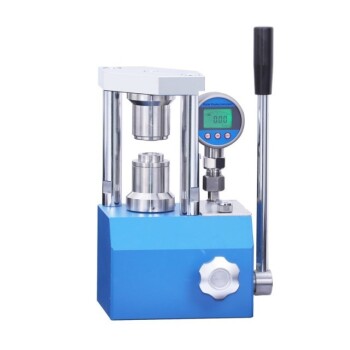
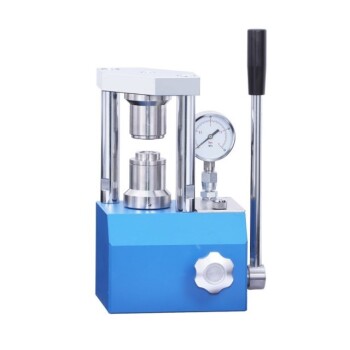
Experimental equipment capable of providing continuous stack pressure is essential because conversion-type cathodes like Iron Fluoride (FeFx) undergo drastic volume expansion and contraction during charge-discharge cycles. Without a mechanism to apply dynamic, continuous pressure, these physical changes cause the active material to detach from the solid electrolyte, leading to rapid performance degradation.
Core Takeaway Unlike liquid batteries where electrolytes flow to fill gaps, All-Solid-State Batteries (ASSBs) rely on rigid physical contact for ion transport. Continuous stack pressure acts as a dynamic stabilizer, compensating for the "breathing" of the cathode materials to prevent void formation and maintain the critical interface between the electrode and the electrolyte.
The Physical Challenge of Iron Fluoride (FeFx)
The "Breathing" Effect
Conversion-type materials like Iron Fluoride function differently than standard intercalation cathodes. During cycling, they break and reform chemical bonds, which results in significant physical volume changes.
As the battery charges and discharges, the cathode material effectively "breathes," expanding and contracting by a substantial margin.
The Solid-Solid Interface Issue
In a traditional battery with liquid electrolyte, the liquid simply flows to maintain contact with the electrode, regardless of how much it swells or shrinks.
In an ASSB, both the electrode and the electrolyte (such as sulfide-based LPSCl) are solids. They cannot flow. If the cathode particle shrinks and there is no external force pushing the components together, a physical gap (void) forms instantly.
Consequences of Contact Loss
Once a void forms between the FeFx particle and the electrolyte, lithium ions can no longer travel between them.
This leads to a spike in interfacial impedance. Effectively, that portion of the battery becomes electrically isolated and stops contributing to the capacity, shortening the battery's cycle life.
Why "Continuous" Pressure is Critical
Static vs. Dynamic Pressure
Simply bolting a cell shut (static pressure) is often insufficient for conversion materials. As the material contracts, the internal pressure drops, potentially below the threshold needed to maintain contact.
Experimental equipment using spring-loaded mechanisms or hydraulic systems provides continuous pressure. These systems actively adapt to the changing thickness of the cell, maintaining constant force even as the geometry changes.
Preserving the Electrolyte Interface
The primary goal of this equipment is to maintain interfacial stability.
By applying constant compression (often via an aluminum pressure frame), you force the solid sulfide electrolyte and the FeFx particles to remain touching. This mechanical constraint ensures that ionic conductivity is maintained throughout the entire expansion/contraction cycle.
Understanding the Trade-offs
The Risk of Over-Compression
While pressure is necessary, applying too much force can be detrimental. Excessive pressure can crush the porous structure of the electrode or cause the solid electrolyte layer to crack.
If the electrolyte layer cracks, it can create a pathway for lithium dendrites (metal spikes) to grow, leading to short circuits.
Mechanical Complexity
Implementing continuous pressure adds complexity to the testing setup. Standard coin cells may not suffice.
Researchers requires specialized frames or presses that can fit inside environmental chambers, which complicates the form factor and assembly process compared to traditional liquid cells.
Making the Right Choice for Your Goal
When designing your ASSB experiments with conversion cathodes, consider the following:
- If your primary focus is Cycle Life: Prioritize spring-loaded fixtures that can accommodate large volume swings without losing contact pressure, as this is the primary failure mode for FeFx.
- If your primary focus is Interfacial Impedance: Ensure your equipment can deliver uniform pressure distribution (e.g., via a hydraulic press) to maximize the initial active area utilization between the cathode and the LPSCl electrolyte.
Successful testing of Iron Fluoride ASSBs is less about the chemistry itself and more about the mechanical engineering required to keep that chemistry connected.
Summary Table:
| Feature | Static Pressure (Bolted) | Continuous Pressure (Spring/Hydraulic) |
|---|---|---|
| Mechanism | Fixed volume, dropping pressure | Adaptive force, constant compression |
| Volume Expansion | Risk of cell deformation | Absorbs expansion without damage |
| Volume Contraction | Formation of voids/gaps | Maintains contact (closes gaps) |
| Interface Quality | High impedance after cycling | Stable interfacial impedance |
| Best Application | Intercalation materials (low strain) | Conversion materials (FeFx, S, etc.) |
Maximize Your ASSB Research Precision with KINTEK
Don't let interfacial impedance and volume expansion compromise your battery performance data. KINTEK specializes in comprehensive laboratory pressing solutions designed for the rigors of next-generation energy research. From manual and automatic presses to specialized heated and glovebox-compatible models, our equipment provides the precise, continuous force necessary to stabilize conversion-type cathodes like Iron Fluoride.
Whether you are conducting cold or warm isostatic pressing or need dynamic stack pressure frames, our solutions ensure your solid-solid interfaces remain intact through every cycle. Contact KINTEK today to find the perfect pressing solution for your battery research lab!
References
- Julian F. Baumgärtner, Maksym V. Kovalenko. Navigating the Catholyte Landscape in All-Solid-State Batteries. DOI: 10.1021/acsenergylett.5c03429
This article is also based on technical information from Kintek Solution Knowledge Base .
Related Products
- Warm Isostatic Press for Solid State Battery Research Warm Isostatic Press
- Laboratory Hydraulic Press Lab Pellet Press Button Battery Press
- Button Battery Sealing Press Machine for Lab
- Lab Infrared Press Mold for Laboratory Applications
- Button Battery Sealing Machine for Button Batteries
People Also Ask
- Why must composite cathodes be sealed in vacuum lamination bags for WIP? Ensure Battery Stability and Density
- How do sacrificial volume materials (SVM) maintain microchannels in isostatic pressing? Ensure Structural Integrity
- What is the function of elastic molds in warm isostatic pressing? Achieve Uniform Density in Composite Particles
- What is the process involved in warm isostatic pressing? Mastering Uniform Density with WIP Technology
- What is the role of the flexible material in warm isostatic pressing? Key to Uniform Density & Precision