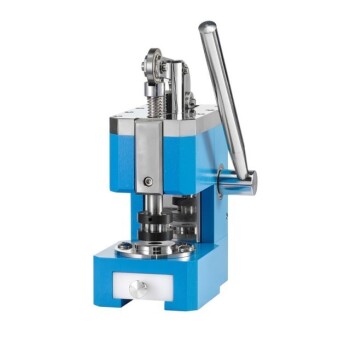
Grinding equipment plays a pivotal role in the preparation of catalyst precursors by mechanically pulverizing dried solid mixtures to eliminate physical irregularities. This step is necessary to break down the lumps and aggregates that naturally form during the drying process, converting the material into a fine, uniform powder.
Transforming solid mixtures into fine powder is not merely about size reduction; it significantly increases specific surface area to enable uniform heat transfer. This uniformity is the key to consistent carbonization and robust bonding between metal components and the biochar structure.
The Physical Mechanics of Preparation
Breaking Down Aggregates
During the drying phase of catalyst precursor preparation, solid materials often clump together.
Grinding equipment is employed to systematically pulverize these lumps and aggregates. This mechanical action restores the material to a free-flowing state required for subsequent processing steps.
Maximizing Specific Surface Area
The primary physical goal of grinding is the reduction of solids into a fine powder.
By significantly decreasing the particle size, the equipment drastically increases the material's specific surface area. This maximized surface area is the critical variable that influences how the material reacts to thermal treatment.
Thermal and Chemical Implications
Facilitating Rapid Heat Transfer
A fine powder behaves differently under heat compared to coarse lumps.
The increased surface area allows for faster and more uniform heat transfer throughout the material during pyrolysis. This ensures that thermal energy penetrates the catalyst precursor efficiently, without cold spots or gradients that occur in larger aggregates.
Ensuring Consistent Carbonization
Uniform heating leads to uniform chemical transformations.
Proper grinding ensures that the degree of lignin carbonization remains consistent across the entire batch. This consistency is vital for predicting the final properties of the catalyst.
Strengthening Structural Bonding
The physical form of the precursor directly impacts the final structural integrity of the catalyst.
Fine powder processing promotes strong bonding between the metal components and the biochar framework. This interaction creates a stable composite structure that might otherwise be compromised by uneven heating or poor mixing.
Understanding the Risks of Inadequate Preparation
The Impact of Thermal Gradients
If the material is not ground to a sufficiently fine powder, heat transfer becomes inefficient.
Large aggregates creates thermal resistance, leading to uneven carbonization. Some parts of the material may over-process while inside cores remain under-processed, resulting in a heterogeneous final product.
Weakened Framework Interaction
Skipping or under-performing the grinding step jeopardizes the material's molecular structure.
Without the intimacy provided by fine particles, the metal-biochar bond may be weak or inconsistent. This lack of structural integration can lead to catalyst failure or reduced performance in practical applications.
Making the Right Choice for Your Process
To ensure high-quality catalyst synthesis, apply the following principles based on your specific objectives:
- If your primary focus is thermal consistency: Prioritize grinding to maximize specific surface area, ensuring heat distributes evenly during pyrolysis.
- If your primary focus is structural durability: Ensure the material is pulverized to a fine powder to facilitate strong interaction and bonding between metal components and the biochar framework.
Detailed mechanical preparation is the invisible foundation of high-performance chemical synthesis.
Summary Table:
| Process Phase | Benefit of Fine Grinding | Impact on Final Catalyst |
|---|---|---|
| Aggregate Breakdown | Eliminates physical lumps and irregularities | Restores free-flowing state for uniform processing |
| Surface Area | Drastically increases specific surface area | Enables faster, more efficient thermal reactions |
| Heat Transfer | Ensures uniform temperature distribution | Prevents cold spots and uneven carbonization gradients |
| Structural Bonding | Maximizes contact between metals and biochar | Creates high-performance, stable composite frameworks |
Maximize Your Synthesis Precision with KINTEK
High-performance catalyst research begins with meticulous material preparation. KINTEK specializes in comprehensive laboratory solutions, offering professional-grade equipment designed to transform your precursors into the perfect fine powder required for superior carbonization.
Whether your work involves battery research, biochar frameworks, or complex chemical synthesis, our diverse range of manual, automatic, heated, and multifunctional presses, along with isostatic pressing solutions, ensures your materials achieve the structural integrity and surface area necessary for success.
Ready to elevate your laboratory efficiency? Contact us today to find the perfect pressing and preparation solution for your research!
References
- Wenpeng Wang, Hong Yang. Enhanced Removal of Dissolved Effluent Organic Matter in Wastewater Using Lignin-Based Biochar Supported Fe–Cu Bimetallic Oxide Catalyst. DOI: 10.3390/jmse12010183
This article is also based on technical information from Kintek Solution Knowledge Base .
Related Products
- Automatic High Temperature Heated Hydraulic Press Machine with Heated Plates for Lab
- Lab Manual Microtome Slicer for Tissue Sectioning
- Lab Ball Press Mold
- Split Automatic Heated Hydraulic Press Machine with Heated Plates
- Lab Cylindrical Press Mold with Scale
People Also Ask
- Function of a Laboratory Hydraulic Press with Heated Platens in SSE? Enhance Battery Density & Conductivity
- What are the requirements for electrode pressing with high-viscosity ionic liquids like EMIM TFSI? Optimize Performance
- How does a laboratory heated hydraulic press facilitate PBN sample prep for WAXS? Achieve Precise X-Ray Scattering
- What are the industrial applications of heated hydraulic presses? Master Heat & Force for Precision Manufacturing
- Why is a laboratory hydraulic press with heating plates required for PLA/TEC films? Achieve Precise Sample Integrity