High consistency in holding pressure is the fundamental requirement for ensuring that powder particles are fully rearranged and bonded into a high-density sample. This precision standardizes the initial molding process, which is critical because material properties like tensile strength are extremely sensitive to specimen preparation conditions. Without this consistency, it is impossible to obtain the stable, repeatable data necessary to optimize material algorithms or validate theoretical models.
Core Takeaway: Maintaining a precise, stable holding pressure eliminates internal density gradients and voids, ensuring that the physical characteristics of the specimen reflect the material’s chemistry rather than inconsistencies in the fabrication process.
Achieving Structural Homogeneity and Density
Particle Rearrangement and Interlocking
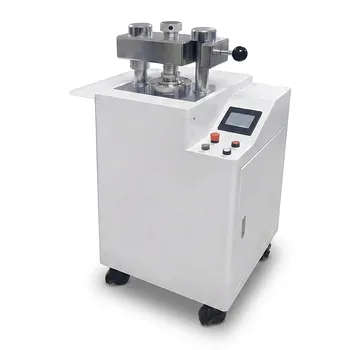
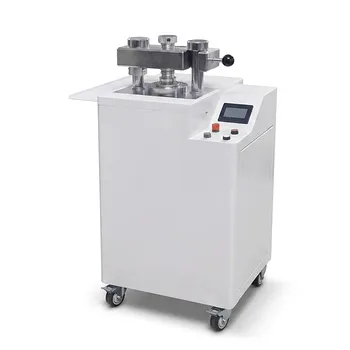
A laboratory pellet press uses high pressure—often hundreds of megapascals—to force powder particles to rearrange and interlock. Consistent holding pressure provides the necessary time for these particles to find their most stable configuration, maximizing the contact area between different alloy components.
Elimination of Internal Voids
Precision control during the holding phase is essential for eliminating internal pores and voids. By maintaining steady pressure, the press ensures that any air gaps are minimized, which prevents the formation of micro-cracks that could compromise the specimen's integrity during subsequent testing or sintering.
Minimizing Density Gradients
Inconsistent pressure during the holding cycle creates internal density gradients, where some parts of the pellet are more compacted than others. These gradients are a primary cause of sample deformation, cracking, or "powdering" during storage, transport, or high-temperature processing.
Standardizing Data for Material Optimization
Repeatability in Mechanical Testing
Measurements such as tensile strength and bulk density are highly sensitive to how a specimen was molded. High-performance pellet presses allow researchers to standardize this process, ensuring that any variation in test results is due to the alloy composition itself rather than flaws in the pressing stage.
Supporting Material Algorithms
Modern material science relies on optimizing algorithms to predict how new multi-component alloys will behave. These algorithms require high-quality, repeatable data points; inconsistent specimen preparation introduces "noise" that can lead to incorrect conclusions and failed material designs.
Aligning with Theoretical Predictions
Stable pressure-holding ensures that experimental measurements, such as surface charge distribution or conductivity, can be accurately compared with theoretical models. When the physical specimen matches the idealized "green body" assumed by thermodynamic models, researchers can trust their results.
Understanding the Trade-offs and Pitfalls
The Risk of Insufficient Holding Time
Even if the peak pressure is high, failing to hold that pressure consistently can result in "spring-back" where the particles expand slightly once the load is removed. This leads to interfacial contact resistance and reduced mechanical strength, especially in multi-component mixtures where different materials have varying levels of elasticity.
Over-Pressing and Particle Fracture
While high density is the goal, excessive pressure or uncontrolled spikes can cause unintentional plastic deformation or fracturing of harder powder particles. This can change the particle size distribution within the mold and negatively impact the final properties of the alloy.
Sensitivity to Environmental Factors
A press that cannot maintain consistent pressure may be susceptible to hydraulic drift or thermal expansion within the machine itself. These small fluctuations are often enough to create subtle differences between batches, ruining the statistical significance of a comparative study.
How to Optimize Your Pressing Process
Applying These Principles to Your Research
To ensure your alloy specimens provide the most accurate data possible, your preparation protocol should focus on the stability of the mechanical environment.
- If your primary focus is material discovery: Prioritize a press with programmable holding times to ensure every specimen in a large-scale screening is identical.
- If your primary focus is mechanical strength (tensile/yield): Use high-precision hydraulic control to eliminate the internal micro-cracks that act as stress concentrators during testing.
- If your primary focus is sintering and phase transformation: Ensure the initial "green body" density is uniform to prevent warping or uneven shrinkage during high-temperature cycles.
Standardizing the holding pressure is the single most effective way to transform a laboratory pellet from a simple "powder compact" into a reliable scientific specimen.
Summary Table:
| Key Factor | Impact on Specimen | Research Benefit |
|---|---|---|
| Particle Rearrangement | Maximized contact area | High-density sample bonding |
| Void Elimination | Minimal internal pores | Prevents micro-cracks & failures |
| Pressure Uniformity | Zero density gradients | Repeatable mechanical test data |
| Holding Stability | Prevents "spring-back" | Accurate theoretical model alignment |
Achieve Flawless Material Consistency with KINTEK
Maximize your research precision with KINTEK’s comprehensive laboratory pressing solutions. Designed for high-stakes applications like battery research and alloy development, our equipment ensures the stable holding pressure necessary to eliminate internal voids and density gradients.
Our Specialized Range Includes:
- Manual & Automatic Presses: For versatile and high-throughput laboratory needs.
- Heated & Multifunctional Models: To support complex phase transformations and thermal processing.
- Glovebox-Compatible & Isostatic Presses (Cold/Warm): Ideal for sensitive materials requiring uniform multi-directional compaction.
Ensure every specimen reflects your material’s true potential rather than processing flaws. Contact KINTEK today to optimize your lab workflow!
References
- Yuehui Xian, Dezhen Xue. Leveraging feature gradient for efficient acquisition function maximization in material composition design. DOI: 10.1039/d5dd00080g
This article is also based on technical information from Kintek Solution Knowledge Base .
Related Products
- Laboratory Hydraulic Split Electric Lab Pellet Press
- Automatic Laboratory Hydraulic Press Lab Pellet Press Machine
- Laboratory Hydraulic Pellet Press for XRF KBR FTIR Lab Press
- Manual Laboratory Hydraulic Pellet Press Lab Hydraulic Press
- Automatic Fluorescence Sample Preparation Press 40 Ton Lab Pellet Press for XRF Analysis
People Also Ask
- What are the emerging trends in the design and materials of lab pellet presses? Modernize Your Lab Efficiency
- What are common lab pellet press issues? Expert Troubleshooting Guide for Reliable Material Research
- How do lab pellet presses support customization and flexibility? Optimize Your Sample Prep for Any Material
- What are the common operational types of lab pellet presses? Choosing the Right Manual, Automatic, or Hydraulic System
- Why use a laboratory pellet press for solid-state battery evaluation? Ensure Accuracy in Interface Stability Testing