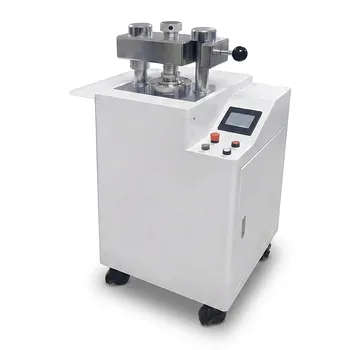
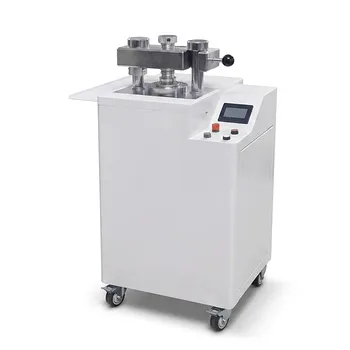
The primary advantages of lab pellet presses are their exceptional durability, extensive customization options, and the high degree of precision they bring to sample preparation.
These devices leverage heavy-duty hydraulic systems and high-tensile steel construction to ensure longevity, while offering flexible configurations—such as manual or automatic operation—to meet specific laboratory space and throughput requirements.
Core Takeaway While many tools can compress materials, lab pellet presses are engineered specifically to eliminate variables in sample preparation. Their value lies in transforming diverse raw materials into uniform, homogeneous samples, ensuring that the data derived from subsequent analysis is consistent and reliable.
Engineering and Durability
Built for Longevity
The most immediate advantage of a high-quality lab pellet press is its robust construction. Manufacturers utilize high-quality materials, such as high tensile steel tie rods, to withstand significant mechanical stress.
Resilient Hydraulic Systems
At the heart of these machines are heavy-duty hydraulic systems designed for repeated use. This industrial-grade engineering prevents the mechanical fatigue often seen in lighter equipment, ensuring the unit remains operational for years.
Low Maintenance Requirements
Because of their durable design, these presses generally require minimal maintenance. While hydraulic fluids must be monitored and parts lubricated, the core components are built to resist wear, making them a cost-effective choice over the equipment's lifespan.
Operational Flexibility and Customization
Tailored to Workspace Constraints
Labs rarely have unlimited space, and pellet presses address this through diverse form factors. Options range from compact benchtop models ideal for crowded environments to larger, floor-standing units for heavy-duty applications.
Manual vs. Automatic Operation
Users can select between manual and automatic configurations based on their workflow. Manual presses offer a cost-effective, portable solution that is easy to operate with minimal training. Automatic models reduce operator effort and are better suited for high-volume environments.
Versatility Across Materials
These presses are not limited to a single discipline. They are effective across a spectrum of materials, including metals, ceramics, and polymers. They are equally valuable in biological research for preparing tissues and cells, or in environmental science for compacting soil and sediment samples.
Precision and Sample Quality
Consistent Force Application
Achieving accurate analytical data—such as in Infrared Spectroscopy or X-ray Diffraction—requires samples with uniform density. Lab pellet presses provide adjustable pressure settings, allowing researchers to apply the exact force needed to avoid sample damage while ensuring compaction.
Enhanced Uniformity with Heated Options
For applications requiring temperature control, heated lab presses utilize flat heating elements to ensure uniform temperature distribution. This minimizes heat generation waste and creates workpieces with consistent thickness and repeatable characteristics.
Elimination of Human Error
By mechanizing the compression process, particularly in automatic models, the variability introduced by human operators is significantly reduced. This standardization is vital for high-throughput screening where data comparability is paramount.
Understanding the Trade-offs
Maintenance is Critical for Accuracy
While durable, these machines are not "set and forget." To maintain precision, hydraulic fluids degrade over time and must be replaced with the correct oil type. Furthermore, force gauges require regular calibration to ensure the pressure displayed matches the pressure applied.
The Cost vs. Labor Balance
Manual presses are significantly cheaper and portable but require physical effort and can vary slightly depending on the operator. Automatic presses guarantee consistency and ease of use but represent a larger capital investment and a larger physical footprint.
Making the Right Choice for Your Goal
To select the right press, you must weigh your volume of work against your budget and space.
- If your primary focus is budget and portability: Opt for a manual hydraulic press, which offers a compact footprint and accurate pressure application at a lower entry cost.
- If your primary focus is high throughput and consistency: Invest in an automatic model to reduce operator fatigue and ensure identical processing for large batches of samples.
- If your primary focus is temperature-sensitive materials: Choose a heated lab press to ensure uniform temperature distribution and consistent workpiece thickness.
Ultimately, the right lab pellet press transforms sample preparation from a variable into a constant, protecting the integrity of your research data.
Summary Table:
| Advantage Category | Key Benefits | Best For... |
|---|---|---|
| Engineering | High-tensile steel construction, heavy-duty hydraulic systems | Long-term durability and low maintenance |
| Flexibility | Manual and automatic options, compact benchtop designs | Diverse workspace and throughput needs |
| Precision | Adjustable pressure settings, uniform heat distribution | Consistent sample density and thickness |
| Versatility | Compatible with metals, ceramics, polymers, and biomass | Cross-disciplinary laboratory applications |
Elevate Your Research with KINTEK Lab Pressing Solutions
Don't let sample variability compromise your data. KINTEK specializes in comprehensive laboratory pressing solutions tailored to your specific research goals.
Whether you are conducting cutting-edge battery research or material analysis, we offer a full spectrum of equipment including:
- Manual & Automatic Hydraulic Presses for workflow efficiency.
- Heated & Multifunctional Models for precise temperature control.
- Glovebox-Compatible, Cold, and Warm Isostatic Presses for specialized environments.
Our heavy-duty engineering ensures your lab achieves maximum repeatability and longevity. Contact KINTEK today to find the perfect press for your lab and transform your sample preparation into a standardized, high-performance process.
Related Products
- Automatic Fluorescence Sample Preparation Press 40 Ton Lab Pellet Press for XRF Analysis
- Automatic Laboratory Hydraulic Press Lab Pellet Press Machine
- Laboratory Hydraulic Press 2T Lab Pellet Press for KBR FTIR
- Laboratory Hydraulic Pellet Press for XRF KBR FTIR Lab Press
- Laboratory Hydraulic Press Lab Pellet Press Machine for Glove Box
People Also Ask
- What is the general process for preparing a sample pellet for XRF? Master Consistency for Accurate Analysis
- What are the advantages of preparing a sample as a dense pellet for XRF? Unlock High-Precision Trace Element Analysis
- What are the common operational types of lab pellet presses? Choosing the Right Manual, Automatic, or Hydraulic System
- What are the emerging trends in the design and materials of lab pellet presses? Modernize Your Lab Efficiency
- What are common lab pellet press issues? Expert Troubleshooting Guide for Reliable Material Research