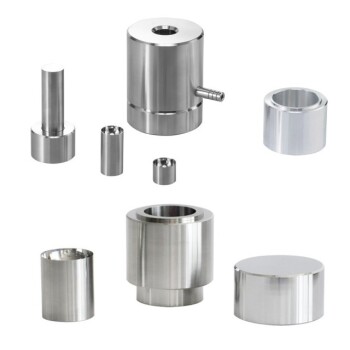
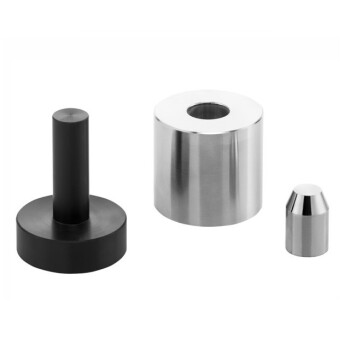
The primary function of high-precision cylindrical molds is to enforce rigid spatial constraints that standardize the dimensions of stabilized marine clay samples. Typically calibrated to specific sizes, such as 50mm in diameter and 100mm in height, these molds ensure that every sample achieves a consistent preset geometry and volume during the preparation phase.
Core Takeaway The physical precision of the mold is the foundation of data integrity in geotechnical research. By eliminating geometric variables, researchers ensure that subsequent unconfined compressive strength tests yield results that are both repeatable and comparable.
The Mechanics of Sample Standardization
Establishing Geometric Consistency
The fundamental purpose of the mold is to provide a fixed boundary for the soil mixture. When marine clay is mixed with multi-component stabilizers, it must be compacted into a definitive shape.
High-precision molds ensure that every sample produced matches exact specifications, such as a 50mm diameter and 100mm height. This uniformity allows researchers to treat sample volume as a constant rather than a variable.
Ensuring Data Repeatability
Scientific validity relies on the ability to reproduce results under identical conditions.
By using high-precision molds, researchers remove irregularities that could skew test data. If the physical dimensions of the soil samples vary, it becomes impossible to determine if differences in strength are due to the stabilizer performance or simply inconsistent sample sizes.
The Critical Role in Strength Testing
Facilitating Comparative Analysis
The ultimate goal of preparing these samples is to subject them to unconfined compressive strength (UCS) testing.
To accurately compare the effectiveness of different stabilizer mixtures, the mechanical stresses applied to the samples must be calculated against a standard cross-sectional area. The mold guarantees this area remains constant across all test subjects.
Minimizing Experimental Error
In geotechnical engineering, even minor deviations in sample preparation can lead to significant outliers in strength data.
Precision molding reduces the "noise" in the data caused by human error or equipment tolerances during the molding process. This ensures that the data reflects the true properties of the stabilized soil.
Understanding the Risks of Imprecision
The Cost of Geometric Deviation
It is crucial to understand that "close enough" is not acceptable in high-stakes material research.
If a mold allows for even slight variations in diameter or height, the calculated density of the sample will be incorrect. An incorrect density calculation propagates through the analysis, leading to invalid strength conclusions that cannot be compared with other studies.
Making the Right Choice for Your Research
To ensure your marine clay stabilization projects yield valid results, focus on the following standards:
- If your primary focus is data repeatability: Ensure your molds are machined to high-precision tolerances to guarantee identical sample volumes for every batch.
- If your primary focus is comparative analysis: Strictly adhere to standard dimensions (e.g., 50mm x 100mm) to ensure your results can be benchmarked against established industry data.
Precision in the molding phase is the single most controllable factor in ensuring the reliability of your final strength testing data.
Summary Table:
| Feature | Function in Marine Clay Preparation | Impact on Research Data |
|---|---|---|
| Geometric Constraints | Enforces 50mm x 100mm standard dimensions | Eliminates volume as a variable |
| Dimensional Precision | Guarantees exact cross-sectional area | Ensures accurate UCS stress calculations |
| Physical Boundary | Provides rigid compaction environment | Minimizes experimental noise and errors |
| Standardization | Facilitates identical sample reproduction | Allows for valid comparative analysis |
Optimize Your Geotechnical Research with KINTEK Precision
Don't let geometric inconsistencies compromise your data integrity. At KINTEK, we specialize in comprehensive laboratory pressing and molding solutions designed for the most demanding research environments. Whether you are conducting marine clay stabilization studies or battery material research, our range of manual, automatic, and heated pressing models—along with our cold and warm isostatic presses—provides the exactness your project requires.
Ensure your samples meet industry benchmarks with our high-tolerance molding equipment. Contact KINTEK today to find the perfect solution for your laboratory needs!
References
- Qirui Bo, Kaiyue Sun. Application of ANN in Construction: Comprehensive Study on Identifying Optimal Modifier and Dosage for Stabilizing Marine Clay of Qingdao Coastal Region of China. DOI: 10.3390/jmse12030465
This article is also based on technical information from Kintek Solution Knowledge Base .
Related Products
- Lab Cylindrical Press Mold for Laboratory Use
- Lab Cylindrical Press Mold with Scale
- Cylindrical Lab Electric Heating Press Mold for Laboratory Use
- Assemble Lab Cylindrical Press Mold for Laboratory Use
- Lab Polygon Press Mold
People Also Ask
- What is the purpose of incorporating cartridge heaters into a lab press mold for MLCC block compression? Optimize Results
- Why is precise cooling management of the lab press mold necessary? Protect Core Integrity in Thermoforming
- What is the function of a pressing tool in thermoplastic panels? Master Precision Shaping & Fusion Bonding
- Why is a high-performance laboratory molding press critical for in-situ electrolyte formation? Unlock Battery Success
- How does the geometry of laboratory molds influence mycelium-based composites? Optimize Density and Strength