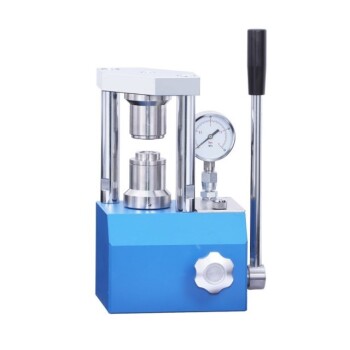
Precise pressure control is the defining factor in ensuring the viability of All-Solid-State Battery (ASSB) cathodes. High-precision equipment allows manufacturers to accurately set the electrode compaction ratio, which directly dictates the interfacial contact area between the active material and the solid electrolyte. Without this exact regulation, the battery will suffer from either excessive contact resistance due to insufficient pressure or structural failure caused by particle breakage under excessive force.
The core challenge in solid-state manufacturing is that the "electrolyte" does not flow; it must be physically forced into contact. Precision equipment ensures the optimal balance between maximizing interfacial contact for conductivity and preserving particle integrity to accommodate volume expansion.
The Critical Role of Interfacial Contact
Establishing the Conductive Network
Unlike liquid electrolyte batteries where the fluid wets the electrode, solid-state batteries rely entirely on solid-solid contact. High-precision calendering applies constant, high linear pressure to mechanically densify the electrode structure. This process establishes the fundamental conductive network required for both ion and electron transport.
Minimizing Interface Impedance
The primary objective of the roller press is to reduce internal voids within the dried cathode coating. By eliminating these voids, you increase the physical contact area between the active materials and the solid electrolyte particles. This directly lowers interface impedance, enhancing the electrochemical kinetic performance of the battery.
The Risks of Improper Pressure Regulation
Consequences of Insufficient Pressure
If the pressure control is not precise and falls below the required threshold, the electrode compaction ratio will be too low. This results in poor contact between particles, leading to excessively high contact resistance. Without intimate contact, the ion transport pathways are broken, severely degrading battery performance.
Consequences of Excessive Pressure
Conversely, applying pressure beyond the target tolerance is equally detrimental. Over-compression can lead to particle breakage, physically damaging the active material or the solid electrolyte. Furthermore, excessive density restricts the natural volume expansion of the active material during charge-discharge cycles, generating internal mechanical stress that shortens cycle life.
Understanding the Trade-offs
The "Goldilocks" Window of Densification
There is a narrow operating window for successful cathode manufacturing. You must achieve high compaction—often over 90% of theoretical density—to ensure efficiency. However, you must stop exactly at the point before mechanical stress compromises the material's structural integrity.
Mechanical Integrity vs. Electrochemical Performance
Aggressive densification improves energy density by packing more material into a smaller volume. However, this comes at the cost of reduced mechanical flexibility within the cathode layer. High-precision equipment is required to navigate this trade-off, maintaining stable pressure levels (often 250–350 MPa) without crossing into destructive force ranges.
Making the Right Choice for Your Manufacturing Process
To optimize your calendering process, consider your specific performance targets:
- If your primary focus is Maximizing Energy Density: Prioritize equipment capable of sustaining the upper limits of pressure (up to 350 MPa) to achieve >90% density and minimize void volume.
- If your primary focus is Cycle Life and Stability: Prioritize precision controls that limit maximum pressure to prevent particle breakage and allow accommodation for volume expansion during cycling.
Mastering pressure control is not just about making the electrode flatter; it is about engineering the microscopic interface that powers the battery.
Summary Table:
| Pressure Factor | Impact on Cathode Quality | Consequence of Poor Control |
|---|---|---|
| Interfacial Contact | Determines ion/electron transport efficiency | High resistance and poor conductivity |
| Compaction Ratio | Optimizes energy density (Target >90%) | Inefficient volume utilization |
| Particle Integrity | Maintains structural stability during cycling | Particle breakage and shortened cycle life |
| Void Reduction | Lowers interface impedance | Discontinuous conductive networks |
Elevate Your Solid-State Battery Research with KINTEK
Precision is the difference between a high-performance cell and structural failure. KINTEK specializes in comprehensive laboratory pressing solutions, offering manual, automatic, heated, and multifunctional models specifically designed for the rigorous demands of battery research.
Whether you need cold or warm isostatic presses to eliminate voids or high-precision roller presses for delicate calendering, our equipment ensures you hit the "Goldilocks" window of densification every time.
Maximize your energy density and cycle life—Contact KINTEK today for expert laboratory pressing solutions!
References
- Siwar Ben Hadj Ali, Alejandro A. Franco. A New Three‐Dimensional Microstructure‐Resolved Model to Assess Mechanical Stress in Solid‐State Battery Electrodes. DOI: 10.1002/batt.202500540
This article is also based on technical information from Kintek Solution Knowledge Base .
Related Products
- Warm Isostatic Press for Solid State Battery Research Warm Isostatic Press
- Automatic Laboratory Hydraulic Press for XRF and KBR Pellet Pressing
- Lab Infrared Press Mold for Laboratory Applications
- Laboratory Hydraulic Press Lab Pellet Press Button Battery Press
- Lab Button Battery Tablet Press Sealing Mold
People Also Ask
- Why must composite cathodes be sealed in vacuum lamination bags for WIP? Ensure Battery Stability and Density
- What is the function of elastic molds in warm isostatic pressing? Achieve Uniform Density in Composite Particles
- How do sacrificial volume materials (SVM) maintain microchannels in isostatic pressing? Ensure Structural Integrity
- What is the process involved in warm isostatic pressing? Mastering Uniform Density with WIP Technology
- What is the role of the flexible material in warm isostatic pressing? Key to Uniform Density & Precision