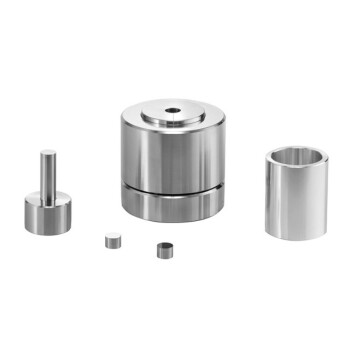
High-precision sample pressing is the prerequisite for reliable infrared (IR) spectroscopy of tripak solid samples. By compacting the powder into uniform pellets, this process forces sample particles to bond tightly with the surrounding matrix, effectively eliminating the internal voids that compromise optical clarity.
The pressing process minimizes infrared light scattering by creating a dense, void-free medium. This yields a high signal-to-noise ratio, which is indispensable for tracking subtle chemical changes, such as the systematic red shift in S=O bond vibrations.
The Physics of Optical Clarity
Eliminating Internal Voids
When tripak solids are in a loose powder form, air gaps between particles act as scattering centers for infrared light. High-precision pressing compacts the material significantly, removing these internal voids.
Bonding with the Matrix
To achieve the necessary transparency for transmission spectroscopy, the sample is often mixed with a matrix (such as Potassium Bromide/KBr). The pressure causes the tripak particles to bond tightly with this matrix, creating a continuous, solid medium rather than a loose mixture.
Ensuring Optical Uniformity
The laboratory press ensures the resulting pellet is not only dense but also geometrically and optically uniform. This uniformity is required for infrared light to pass through the sample without deviation, ensuring that the detector measures absorption rather than scattering artifacts.
Impact on Data Fidelity
Maximizing Signal-to-Noise Ratio
The direct result of minimizing light scattering is a spectrum with a high signal-to-noise ratio. Without the interference of scattering background noise, the distinct peaks of the chemical bonds become sharp and definable.
Detecting Electronic Injection
For tripak samples, high fidelity is crucial for observing specific electronic phenomena. Precise pressing allows researchers to detect the systematic red shift in the S=O symmetric stretching vibration frequency.
Tracking Frequency Shifts
Specifically, as electronic injection occurs, the frequency shifts from 1,178 cm⁻¹ to 1,073 cm⁻¹. A poorly pressed sample with high scattering noise would likely obscure this specific spectral shift, rendering the characterization of the molecule's electronic state impossible.
Common Pitfalls to Avoid
While high pressure is essential, it is important to understand the variables at play to avoid inconsistent results.
Insufficient Pressure
If the pressure applied is too low, the pellet will remain opaque or "cloudy." This results in significant light scattering (baseline drift), which can mask the delicate vibrational signals of the S=O bonds and lead to misinterpretation of the electronic injection data.
Inconsistent Density
Variability in the pressing process can lead to pellets of uneven density. This inconsistency makes it difficult to compare spectra between different samples quantitatively, as the path length and concentration of the tripak solid effectively vary across the pellet.
Making the Right Choice for Your Goal
To ensure your IR characterization of tripak solids yields valid scientific data, tailor your approach based on your specific analytical needs.
- If your primary focus is observing electronic states: Prioritize high-pressure pressing to maximize transparency; this is the only way to resolve the specific 1,178 cm⁻¹ to 1,073 cm⁻¹ red shift in the S=O stretching frequency.
- If your primary focus is sample preservation: Utilize the pressing process to create dense blocks that reduce surface area, helping to protect air-sensitive oxidation states from degradation during handling.
Mastering the sample preparation phase ensures that your spectral data reflects the true chemistry of the tripak molecule, not the artifacts of physical defects.
Summary Table:
| Parameter | Impact of High-Precision Pressing | Consequence of Poor Pressing |
|---|---|---|
| Optical Clarity | High; eliminates voids for transparent pellets | Low; opaque or cloudy pellets |
| Scattering | Minimized; light passes through directly | High; significant baseline drift |
| S=O Frequency | Sharp peaks (1178 cm⁻¹ to 1073 cm⁻¹) | Obscured or masked spectral shifts |
| Data Quality | High signal-to-noise ratio | High background noise and artifacts |
| Matrix Bonding | Tight bonding with KBr for uniform medium | Loose mixture causing uneven density |
Achieve Scientific Precision with KINTEK Pressing Solutions
Don't let poor sample preparation compromise your research fidelity. KINTEK specializes in comprehensive laboratory pressing solutions designed to eliminate scattering artifacts and ensure optical uniformity.
Whether you are conducting battery research or analyzing sensitive chemical shifts, our range of equipment meets every lab's needs:
- Manual & Automatic Presses for consistent pellet density.
- Heated & Multifunctional Models for advanced material synthesis.
- Glovebox-Compatible & Isostatic Presses (Cold/Warm) for air-sensitive samples.
Ready to elevate your spectroscopy results? Contact KINTEK today to find the perfect press for your laboratory application!
References
- Paweł Pakulski, Dawid Pinkowicz. A multifunctional pseudo-[6]oxocarbon molecule innate to six accessible oxidation states. DOI: 10.1016/j.chempr.2023.12.024
This article is also based on technical information from Kintek Solution Knowledge Base .
Related Products
- Lab Infrared Press Mold for No Demolding
- Manual Laboratory Hydraulic Pellet Press Lab Hydraulic Press
- Automatic Laboratory Hydraulic Press for XRF and KBR Pellet Pressing
- Lab Infrared Press Mold for Laboratory Applications
- XRF KBR Plastic Ring Lab Powder Pellet Pressing Mold for FTIR
People Also Ask
- What is the purpose of incorporating cartridge heaters into a lab press mold for MLCC block compression? Optimize Results
- What is the function of a pressing tool in thermoplastic panels? Master Precision Shaping & Fusion Bonding
- Why is precise cooling management of the lab press mold necessary? Protect Core Integrity in Thermoforming
- What role do precision positioning and pressure molds play in single-lap joints? Ensure 100% Data Integrity
- Why is a lab press used for KBr pellet preparation in polyurethane FTIR? Achieve High-Resolution Spectral Data