
Testing solid-state batteries (SSBs) requires equipment capable of applying and maintaining precise uniaxial pressure because ion transport in these systems relies entirely on the quality of physical contact between solid particles. Unlike liquid electrolytes that flow into voids, solid interfaces must be mechanically forced together to minimize impedance, and this pressure must be actively regulated to counteract the significant volume changes materials undergo during cycling.
Core Insight: In solid-state battery research, mechanical integrity is the prerequisite for electrochemical performance. Precise pressure control is the only way to distinguish between intrinsic material failure and extrinsic contact failure caused by delamination or void formation.
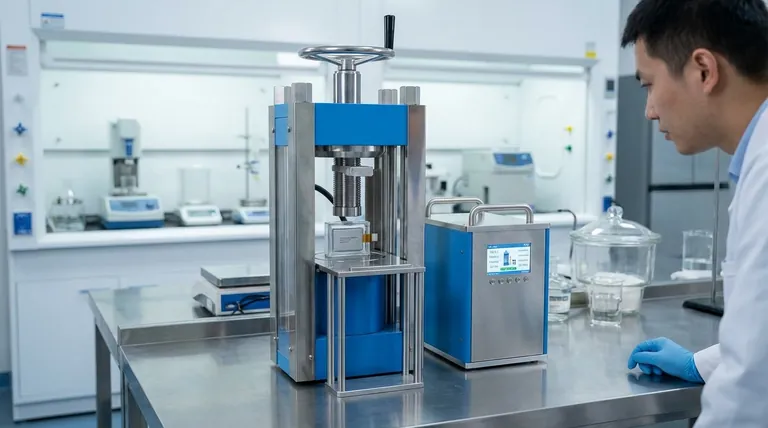
The Critical Role of the Solid-Solid Interface
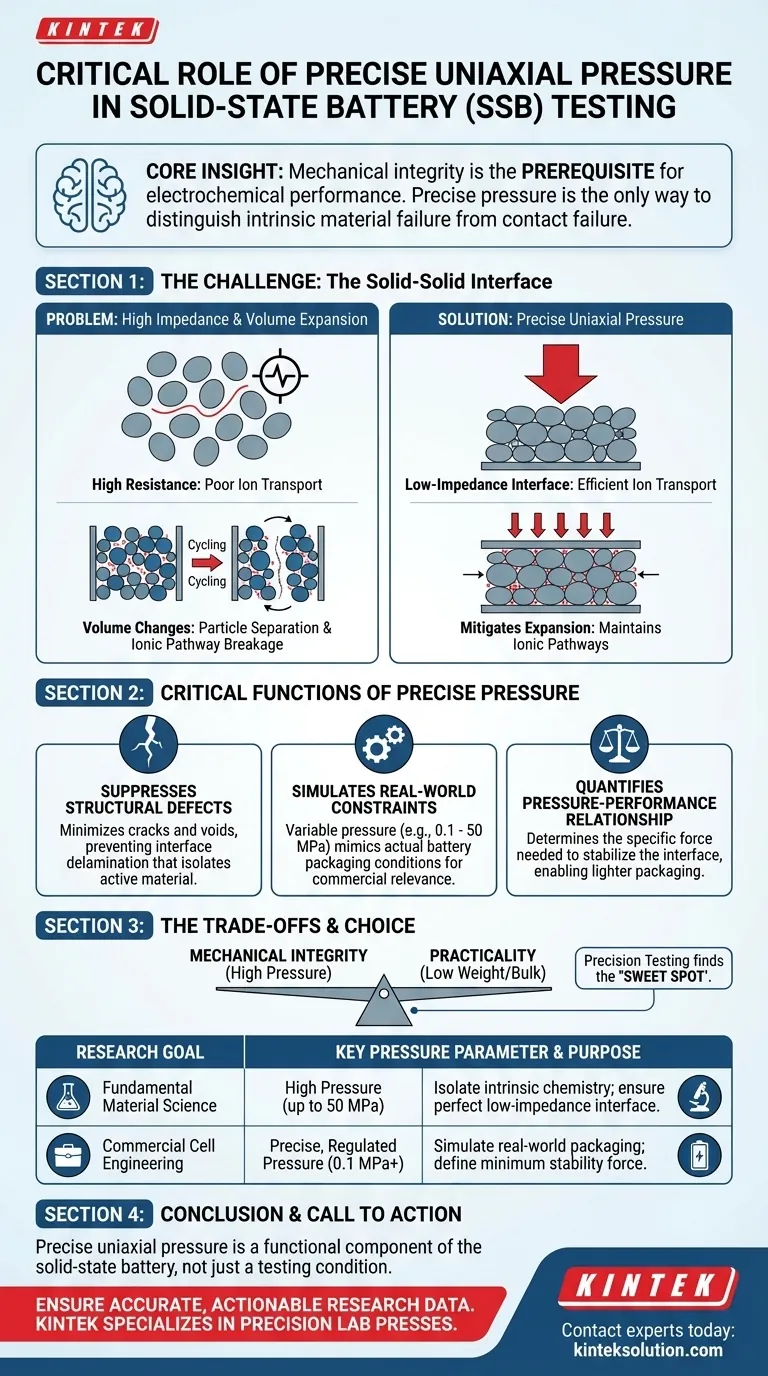
Overcoming High Impedance
In liquid batteries, the electrolyte naturally wets the electrode surface. In SSBs, the "wetting" must be achieved mechanically.
Applying high pressure creates a low-impedance solid-solid interface, which is fundamental for battery operation. Without this mechanical force, the resistance between layers is too high to allow for efficient ion transport.
Mitigating Volume Expansion
Active materials, such as Nb2O5 cathode materials, experience significant volume changes during cycling.
As the battery charges and discharges, particles expand and contract. Without constant, precise pressure, this "breathing" causes particles to separate, breaking the ionic pathway and leading to rapid performance degradation.
Suppressing Structural Defects
Precise pressure control is essential to minimize the formation of cracks and voids within the material layers.
If the pressure is insufficient or fluctuates, the stress of cycling leads to interface delamination. This physical separation permanently isolates parts of the active material, directly reducing the battery's capacity stability.
Why Precision is Essential for Data Validity
Simulating Real-World Constraints
Research data is only valuable if it translates to practical application.
Equipment capable of varying pressure across a specific range (e.g., 0.1 MPa to 50 MPa) allows researchers to simulate actual battery packaging conditions. This ensures that the failure mechanisms observed in the lab are relevant to commercial cell designs.
Quantifying the Pressure-Performance Relationship
It is not enough to simply apply "high" pressure; researchers must quantify exactly how much is needed.
Precise control allows you to determine the specific magnitude of pressure required to stabilize the interface. This data is critical for engineering the lightest possible packaging that still maintains necessary stack pressure.
Understanding the Trade-offs
The Risk of Variable Isolation
If your testing equipment cannot maintain precise pressure, you introduce an uncontrolled variable.
When a battery fails under inconsistent pressure, it is impossible to know if the chemistry was unstable or if the physical contact simply loosened. This ambiguity renders the experiment inconclusive regarding the material's true potential.
Mechanical Integrity vs. Practicality
While high pressure (up to 50 MPa) suppresses delamination, it imposes heavy constraints on battery pack design.
The trade-off is often between maximizing electrochemical performance and minimizing the weight/bulk of the external casing required to maintain that force. Precision testing identifies the "sweet spot" where these factors balance.
Making the Right Choice for Your Goal
To select the correct testing parameters and equipment, consider your specific research objective:
- If your primary focus is Fundamental Material Science: Prioritize high-pressure capability (up to 50 MPa) to ensure a perfect low-impedance interface, isolating the intrinsic chemistry from contact resistance issues.
- If your primary focus is Commercial Cell Engineering: Prioritize precise pressure regulation at lower ranges (0.1 MPa+) to simulate realistic packaging constraints and define the minimum force required to prevent delamination.
Precise uniaxial pressure is not just a testing condition; it is a functional component of the solid-state battery itself.
Summary Table:
| Testing Goal | Key Pressure Parameter | Purpose |
|---|---|---|
| Fundamental Material Science | High Pressure (up to 50 MPa) | Isolate intrinsic chemistry by ensuring a perfect low-impedance interface. |
| Commercial Cell Engineering | Precise, Regulated Pressure (0.1 MPa+) | Simulate real-world packaging to define the minimum force for stability. |
Ensure your solid-state battery research data is accurate and actionable. The mechanical integrity of your battery is a prerequisite for its electrochemical performance. KINTEK specializes in laboratory press machines, including automatic lab presses and isostatic presses, designed to deliver the precise, consistent uniaxial pressure required to study failure mechanisms and interface stability effectively. Don't let inconsistent pressure introduce uncontrolled variables into your experiments. Contact our experts today to find the perfect press for your research needs.
Visual Guide
Related Products
- Lab Round Bidirectional Press Mold
- Lab Polygon Press Mold
- Lab Cylindrical Press Mold with Scale
- Split Automatic Heated Hydraulic Press Machine with Heated Plates
- Lab Cylindrical Press Mold for Laboratory Use
People Also Ask
- What is the purpose of incorporating cartridge heaters into a lab press mold for MLCC block compression? Optimize Results
- Why is precise cooling management of the lab press mold necessary? Protect Core Integrity in Thermoforming
- What is the function of a pressing tool in thermoplastic panels? Master Precision Shaping & Fusion Bonding
- Why is a high-performance laboratory molding press critical for in-situ electrolyte formation? Unlock Battery Success
- How do the design and geometric precision of pressing molds and mandrels affect the quality of PTFE composite samples?



















