
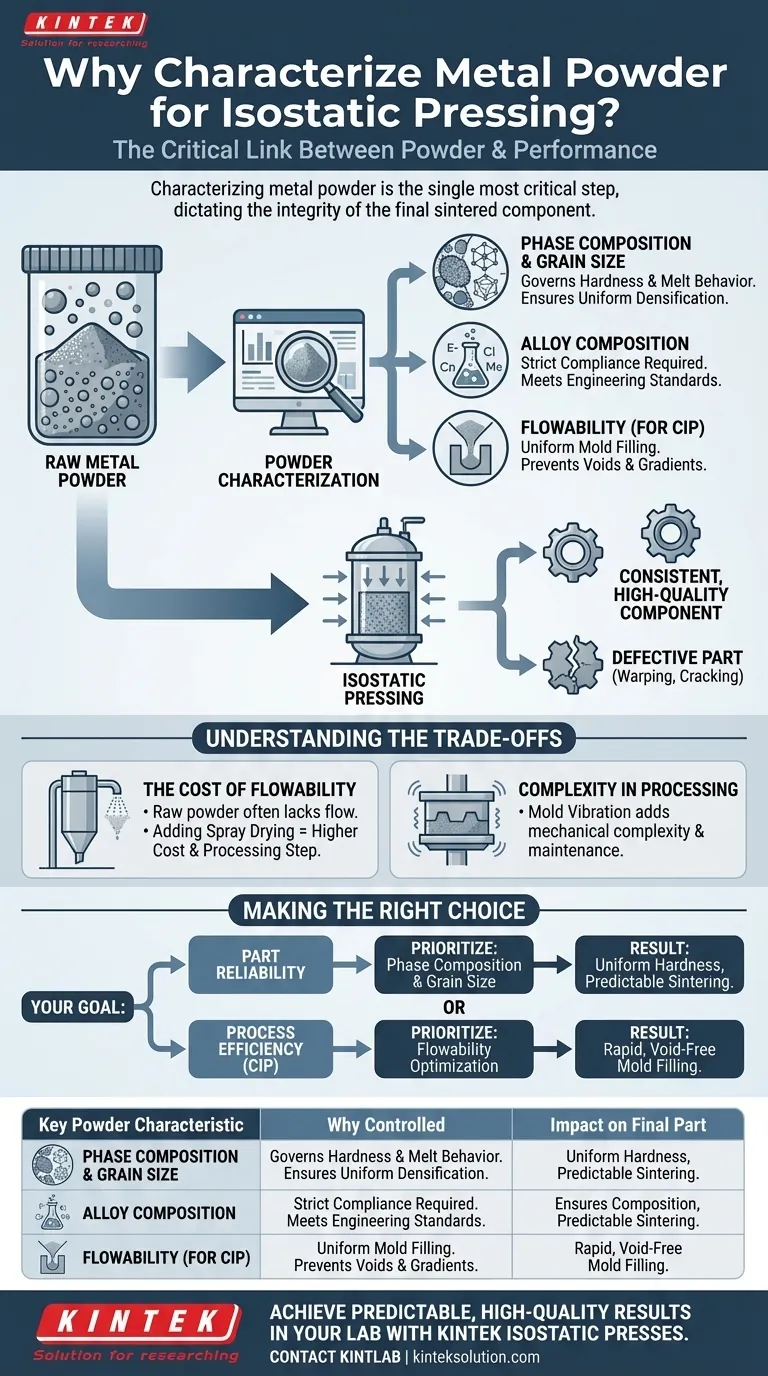
Characterizing metal powder is the single most critical step in isostatic pressing because the physical and chemical state of the raw material directly dictates the integrity of the final sintered component. To ensure optimal performance, you must strictly control specific characteristics—namely phase composition, grain size, and alloy composition—as these variables govern the powder's hardness, melt behavior, and ability to densify uniformly.
The success of isostatic pressing relies on the predictability of the raw material; inconsistencies in powder morphology or chemistry will inevitably lead to structural defects or sintering failures in the finished part.

The Critical Link Between Powder and Performance
The goal of isostatic pressing is to reduce porosity by compacting powder within a flexible membrane using uniform pressure. However, the efficacy of this pressure transfer depends entirely on the powder's initial state.
Influence on Sintering Behavior
The phase composition and grain size of the powder are not merely physical dimensions; they determine the material's thermal and mechanical potential. These factors influence the powder's hardness and melt properties. If these are uncontrolled, the sintering process becomes unpredictable, compromising the mechanical properties of the final part.
Efficiency of Pressing
Isostatic pressing works by encapsulating powder to allow for uniform pressure from all directions. If the powder characteristics vary, the compaction will be uneven. This leads to density gradients in the "green" (unsintered) part, which can cause warping or cracking during the final heating stage.
Key Characteristics to Control
To achieve a reliable manufacturing process, you must rigorously characterize three specific areas of your metal powder.
1. Phase Composition and Grain Size
These are the primary drivers of powder hardness. Hardness affects how the particles deform and lock together under pressure. Furthermore, these characteristics dictate the melt properties, which are essential for achieving the correct density during the sintering phase.
2. Alloy Composition Compliance
The powder must strictly adhere to the specified alloy composition. Any deviation in chemical makeup can alter the material's response to heat and pressure. Using powder that does not comply with the specific alloy requirements will result in a component that fails to meet engineering standards.
3. Flowability (Specific to CIP)
For Cold Isostatic Pressing (CIP), the powder must possess excellent flowability. The powder needs to fill the flexible mold uniformly without bridging or clumping. Poor flow leads to voids within the mold before pressure is even applied, guaranteeing a defective part.
Understanding the Trade-offs
While high-quality powder is essential, achieving the necessary characteristics often introduces complexity and cost to the production line.
The Cost of Flowability
Raw metal powders often do not naturally possess the flow characteristics required for consistent mold filling. To correct this, you may need to implement additional processes such as spray drying. While this ensures the powder flows like a liquid into the mold, it adds a distinct processing step and increases material costs.
Complexity in Processing
To further assist with flow and packing density, manufacturers often use mold vibration during the filling stage. While effective, this adds mechanical complexity to the setup. You must balance the need for perfect powder packing against the increased time and equipment maintenance required for these auxiliary processes.
Making the Right Choice for Your Goal
Characterization is about balancing the cost of preparation with the risk of part failure. Use the following guide to prioritize your approach.
- If your primary focus is Part Reliability: Prioritize strict control of phase composition and grain size to ensure uniform hardness and predictable sintering, even if it requires more expensive raw materials.
- If your primary focus is Process Efficiency in CIP: Focus heavily on flowability optimization (via spray drying) to ensure rapid, void-free mold filling and minimize rejection rates.
Consistently characterizing your powder prevents costly manufacturing defects by ensuring the raw material is chemically and physically aligned with your processing method.
Summary Table:
| Key Powder Characteristic | Why It Must Be Controlled | Impact on Final Part |
|---|---|---|
| Phase Composition & Grain Size | Dictates powder hardness and melt behavior during sintering. | Ensures uniform densification and prevents structural defects. |
| Alloy Composition | Must meet exact specifications for material properties. | Guarantees the component meets required engineering standards. |
| Flowability (for CIP) | Enables uniform, void-free filling of the flexible mold. | Prevents density gradients that cause warping or cracking. |
Achieve predictable, high-quality results in your lab with reliable isostatic pressing.
Characterizing your metal powder is the foundation of a successful press. KINTEK specializes in precision lab press machines, including isostatic presses, designed to meet the exacting demands of laboratory R&D and production. Our equipment ensures uniform pressure application, complementing your controlled powder characteristics for superior part integrity.
Whether you are developing new materials or optimizing a manufacturing process, our expertise and robust press solutions help you minimize defects and maximize reliability.
Contact KINTLAB today to discuss how our isostatic presses can enhance your powder characterization and pressing workflow.
Visual Guide
Related Products
- Lab Isostatic Pressing Molds for Isostatic Molding
- Warm Isostatic Press for Solid State Battery Research Warm Isostatic Press
- XRF KBR Steel Ring Lab Powder Pellet Pressing Mold for FTIR
- Lab Round Bidirectional Press Mold
- Lab Polygon Press Mold
People Also Ask
- What is the purpose of incorporating cartridge heaters into a lab press mold for MLCC block compression? Optimize Results
- What is the function of an isostatic lab press in energy storage research? Achieve Superior Material Standardization
- How do laboratory press machines resolve increased impedance in solid-state batteries? Achieve Low-Resistance Interfaces
- How does controlling the parameters of a laboratory isostatic press contribute to reducing deformation in LTCC channels?
- Why is a laboratory isostatic press used for hydroxyapatite bioceramics? Achieve Maximum Density and Strength



















