
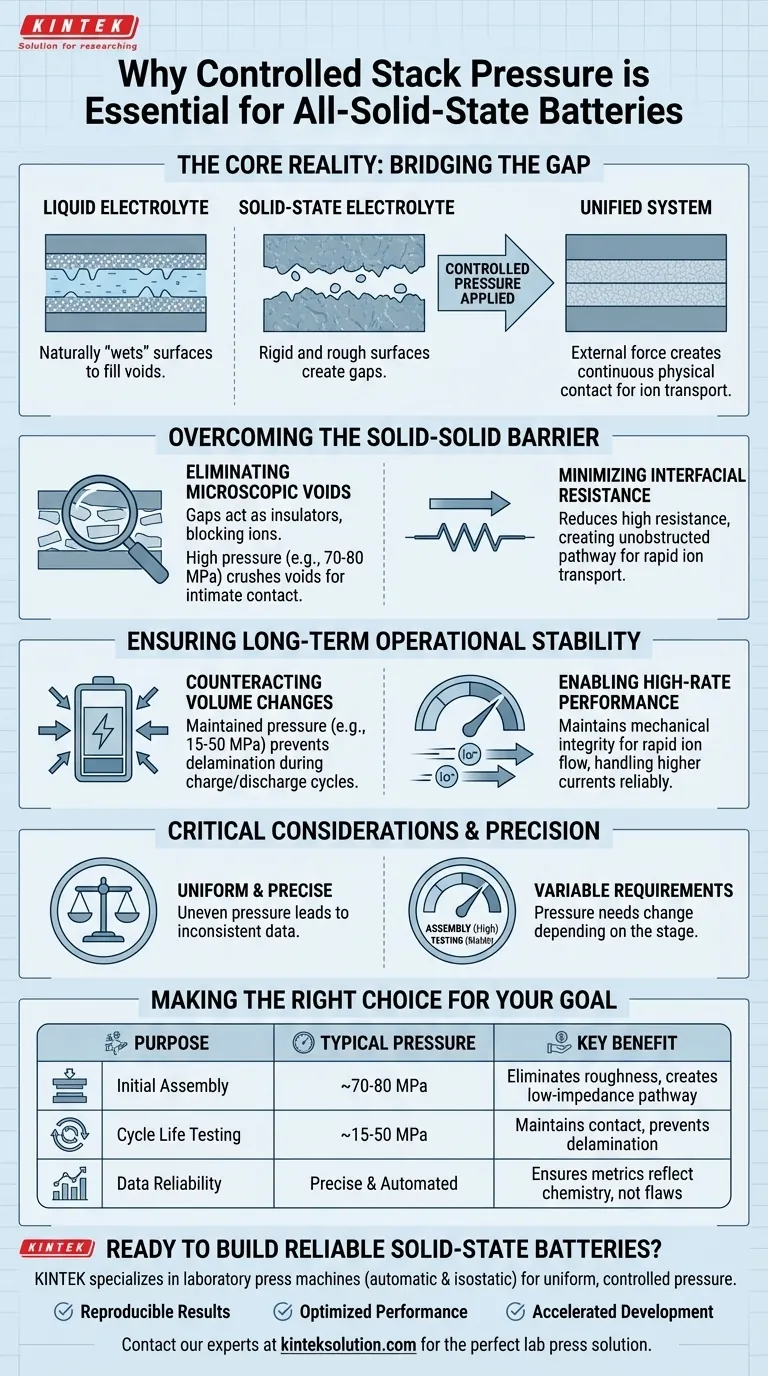
Applying controlled stack pressure is the fundamental mechanism required to bridge the microscopic gaps inherent in rigid solid materials. Without this external force, the rough surfaces of the cathode, electrolyte, and anode cannot form the continuous physical contact necessary for lithium ions to move effectively between layers.
The Core Reality: Unlike liquid electrolytes that naturally "wet" electrode surfaces to fill voids, solid-state components are rigid and rough. External pressure is the primary variable that converts disjointed layers into a unified electrochemical system, acting as the bridge for ionic transport.
Overcoming the Solid-Solid Interface Barrier
Eliminating Microscopic Voids
All solid materials, including cathodes and solid-state electrolytes, possess inherent surface roughness. When these layers are stacked, microscopic gaps or voids naturally occur at the interfaces.
These gaps act as insulators, blocking the movement of ions. Applying high pressure (often ranging from 70-80 MPa during assembly) forces the materials together, effectively crushing these voids.
This process ensures intimate, seamless physical contact, which is the first prerequisite for a functional solid-state battery.
Minimizing Interfacial Resistance
The physical gaps between layers create high interfacial resistance (impedance). If the resistance is too high, the battery cannot deliver power efficiently.
By applying precise pressure, you maximize the contact area between particles. This directly lowers the solid-solid interfacial resistance.
The result is an unobstructed pathway that allows for rapid lithium-ion transport, which is essential for activating the battery and achieving low internal resistance.
Ensuring Long-Term Operational Stability
Counteracting Volume Changes
Battery materials physically expand and contract during charge and discharge cycles. In a solid-state system, this movement can cause the layers to physically separate or delaminate.
Maintained stack pressure (such as 15 MPa or 50 MPa during testing) acts as a mechanical constraint. It forces the layers to remain in contact even as the internal volume shifts.
This constant compression prevents the breakdown of the ion transport network, ensuring the battery survives repeated cycling without rapid degradation.
Enabling High-Rate Performance
For a battery to charge or discharge quickly (high-rate performance), ions must move at high speeds.
Any break in physical contact acts as a bottleneck, slowing down ion flow.
Controlled pressure maintains the mechanical integrity required for rapid ion transport, allowing the battery to handle higher currents reliably.
Critical Considerations and Precision
The Necessity of Controlled Application
Pressure cannot be applied haphazardly; it must be uniform and precise. Uneven pressure can lead to localized poor contact and inconsistent performance data.
Variable Pressure Requirements
The magnitude of pressure changes depending on the stage of the battery's life.
Final assembly often requires higher pressures (e.g., 74 MPa) to form the initial interface. However, operational testing may require different, stable pressures to maintain that interface dynamically.
Failure to distinctively control these pressures leads to non-reproducible data and unreliable battery characterization.
Making the Right Choice for Your Goal
To optimize your solid-state battery strategy, you must align your pressure protocols with your specific objective.
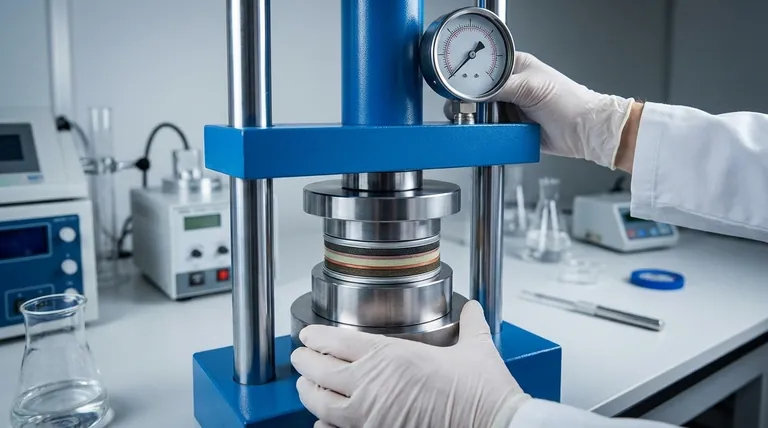
- If your primary focus is Initial Assembly: Apply high, uniform pressure (approx. 70-80 MPa) via a hydraulic press to eliminate surface roughness and create the initial low-impedance transport pathway.
- If your primary focus is Cycle Life Testing: Implement an in-situ compression setup to maintain a constant, moderate pressure (e.g., 15-50 MPa) that accommodates volumetric expansion and prevents layer delamination.
- If your primary focus is Data Reliability: Ensure the pressure applied is automated and precise to eliminate contact variables, ensuring that performance metrics reflect the material chemistry rather than assembly flaws.
Ultimately, stack pressure is not merely a manufacturing step; it is an active component of the battery's architecture that enables the very physics of solid-state ion conduction.
Summary Table:
| Purpose | Typical Pressure Range | Key Benefit |
|---|---|---|
| Initial Assembly | ~70-80 MPa | Eliminates surface roughness, creates low-impedance ion pathway |
| Cycle Life Testing | ~15-50 MPa | Maintains contact during volume changes, prevents delamination |
| Data Reliability | Precise & Automated | Ensures performance metrics reflect material chemistry, not assembly flaws |
Ready to build reliable solid-state batteries?
Precise pressure control is not just a step—it's fundamental to your battery's performance. KINTEK specializes in laboratory press machines, including automatic lab presses and isostatic presses, designed to deliver the uniform, controlled pressure essential for R&D and testing of solid-state batteries.
Let us help you achieve:
- Reproducible Results: Eliminate assembly variables with precise pressure control.
- Optimized Performance: Create and maintain the intimate contact required for efficient ion transport.
- Accelerated Development: Reliable equipment for consistent and reliable battery characterization.
Contact our experts today to find the perfect lab press solution for your solid-state battery research.
Visual Guide
Related Products
- Automatic Lab Cold Isostatic Pressing CIP Machine
- Automatic Laboratory Hydraulic Press for XRF and KBR Pellet Pressing
- Electric Lab Cold Isostatic Press CIP Machine
- Electric Split Lab Cold Isostatic Pressing CIP Machine
- Split Automatic Heated Hydraulic Press Machine with Heated Plates
People Also Ask
- What are the key features of automated laboratory Cold Isostatic Press (CIP) systems? Achieve Precise, High-Pressure Powder Consolidation
- Why is an Isostatic Press (CIP) Necessary After Uniaxial Pressing? Achieve Transparency in Nd:Y2O3 Ceramics
- How does a Cold Isostatic Press (CIP) increase Bi-2223/Ag current density? Boost Superconductivity with Uniform Pressure
- How does a Cold Isostatic Press (CIP) facilitate the preparation of CaO-doped silicon carbide (SiC) green bodies?
- What is the primary function of a Cold Isostatic Press (CIP) in NASICON preparation? Achieve 96% Theoretical Density







