
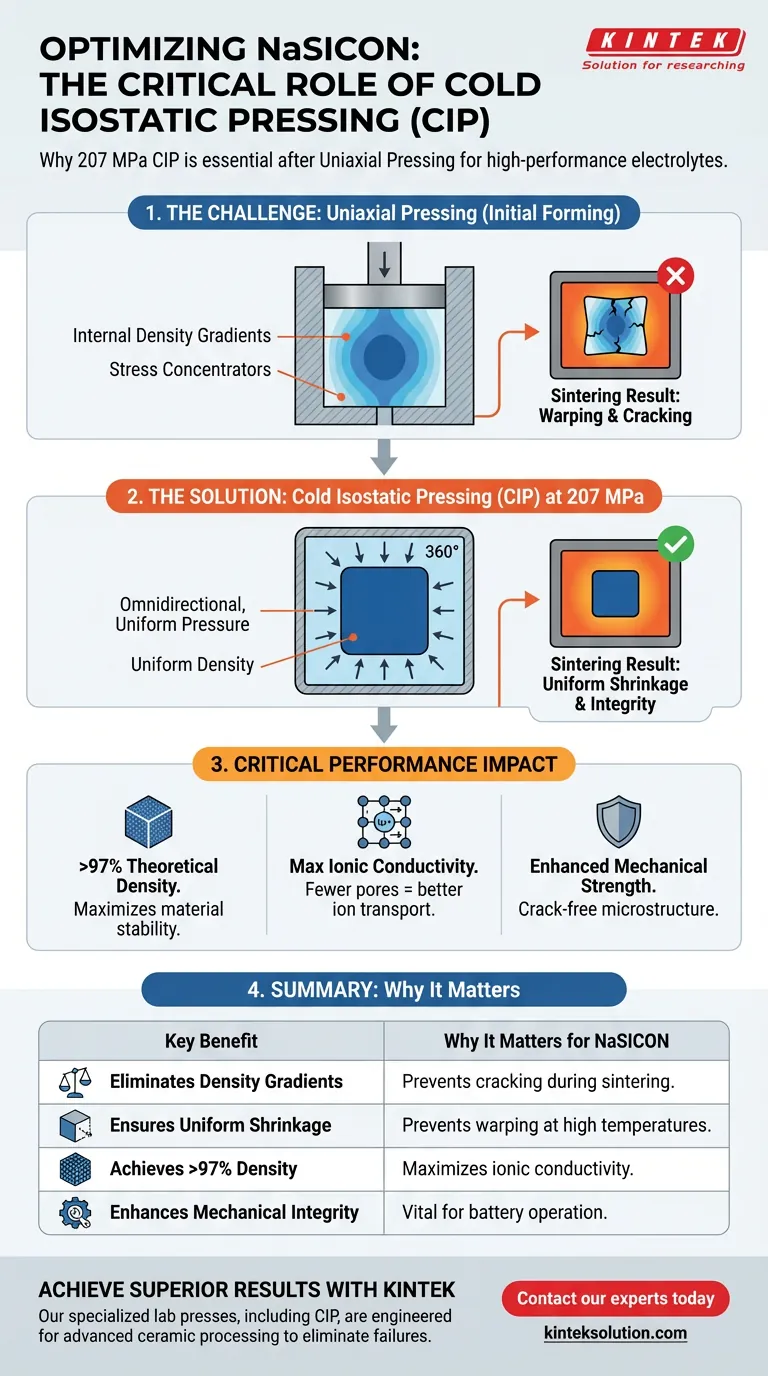
Processing a NaSICON green body with Cold Isostatic Pressing (CIP) is essential to eliminate the structural weaknesses and density gradients inherently caused by initial uniaxial pressing. While the uniaxial step creates the basic shape, applying uniform hydrostatic pressure—such as 207 MPa—is required to homogenize the material's internal structure. This secondary densification is the critical prerequisite for preventing failure during sintering and achieving the high performance expected of advanced electrolytes.
Uniaxial pressing introduces internal stress and uneven density, which can lead to cracking during high-temperature processing. CIP corrects these defects by applying omnidirectional pressure, ensuring the green body achieves the uniformity required for >97% theoretical density and superior ionic conductivity.
The Problem with Uniaxial Pressing
Internal Density Gradients
When a ceramic powder is pressed uniaxially (from one or two directions), friction occurs between the powder particles and the die walls. This friction prevents the pressure from transmitting evenly throughout the bulk of the material.
Resulting Non-Uniformity
Consequently, the "green body" (the unfired ceramic) develops regions of varying density. Some areas are tightly packed, while others remain porous and loose.
Structural Vulnerability
These density gradients act as stress concentrators. If left uncorrected, they become the failure points where cracks initiate once the material is subjected to thermal stress.
Why CIP is Critical for NaSICON
Applying Omnidirectional Force
Cold Isostatic Pressing subjects the green body to fluid pressure from every direction simultaneously. This eliminates the "shadowing" effects of uniaxial pressing and forces particles into a tightly packed arrangement.
Ensuring Uniform Shrinkage
For a high-performance ceramic like NaSICON, the sintering phase involves significant volume reduction. If the green body density is uniform, the material shrinks evenly.
Preventing Sintering Failure
If the density is uneven, the material will shrink at different rates in different areas. This differential shrinkage causes warping, deformation, or catastrophic cracking at high temperatures.
The Impact on Final Performance
Achieving High Density
To function effectively as a solid electrolyte, NaSICON must reach a final sintered density greater than 97% of its theoretical value. CIP creates the high-density green body necessary to reach this target.
Maximizing Ionic Conductivity
There is a direct correlation between density and performance. A denser material has fewer pores to block the path of ions. Therefore, the uniformity provided by CIP leads directly to superior ionic conductivity.
Enhancing Mechanical Strength
Beyond conductivity, a dense, crack-free microstructure ensures the mechanical integrity of the ceramic. This is vital for ensuring the electrolyte can withstand physical stresses during battery assembly and operation.
Understanding the Trade-offs
Process Complexity vs. Yield
Introducing a CIP step at 207 MPa adds time and equipment costs to the fabrication process. It transforms a single-step forming process into a multi-stage operation.
The Cost of Shortcuts
However, the trade-off of skipping CIP is a drastically higher rejection rate. Without this step, achieving a viable, high-density electrolyte is statistically improbable for advanced ceramics.
Making the Right Choice for Your Goal
To optimize your NaSICON fabrication process, consider your specific performance targets:
- If your primary focus is Ionic Conductivity: Prioritize CIP to minimize porosity, as high density is the primary driver of ion transport efficiency.
- If your primary focus is Mechanical Integrity: Use CIP to eliminate internal density gradients, which are the root cause of cracking and structural failure during sintering.
By standardizing the use of Cold Isostatic Pressing, you ensure the reliability and performance required for high-quality solid electrolytes.
Summary Table:
| Key Benefit | Why It Matters for NaSICON |
|---|---|
| Eliminates Density Gradients | Corrects uneven packing from uniaxial pressing to prevent cracking during sintering. |
| Ensures Uniform Shrinkage | Allows the ceramic to shrink evenly at high temperatures, preventing warping. |
| Achieves >97% Theoretical Density | Maximizes ionic conductivity by minimizing pores that block ion paths. |
| Enhances Mechanical Integrity | Creates a strong, crack-free microstructure vital for battery operation. |
Achieve superior density and performance for your solid electrolytes with KINTEK's expertise.
Our specialized lab press machines, including automatic lab presses and cold isostatic presses, are engineered to meet the precise demands of advanced ceramic processing, like your NaSICON electrolyte. We help laboratory researchers eliminate sintering failures and consistently produce high-performance materials.
Contact our experts today to discuss how our solutions can optimize your fabrication process and ensure reliable, high-yield results.
Visual Guide
References
- Amanda Peretti, Leo J. Small. Machinable, high‐conductivity NaSICON through mitigation of humidity effects during solid‐state synthesis. DOI: 10.1111/jace.70195
This article is also based on technical information from Kintek Solution Knowledge Base .
Related Products
- Electric Lab Cold Isostatic Press CIP Machine
- Electric Split Lab Cold Isostatic Pressing CIP Machine
- Automatic Lab Cold Isostatic Pressing CIP Machine
- Manual Cold Isostatic Pressing CIP Machine Pellet Press
- Lab Isostatic Pressing Molds for Isostatic Molding
People Also Ask
- What role do electric lab cold isostatic presses play in industrial contexts? Bridge R&D and Manufacturing with Precision
- What are the applications of electric lab cold isostatic presses in research settings? Advance Material R&D with High-Pressure CIPs
- How does electrical Cold Isostatic Pressing (CIP) contribute to cost savings? Unlock Efficiency and Reduce Expenses
- What are some research applications of electric lab CIPs? Unlock Uniform Powder Densification for Advanced Materials
- What are the characteristics of standard off-the-shelf electric lab CIP solutions? Achieve Immediate, Cost-Effective Processing
















