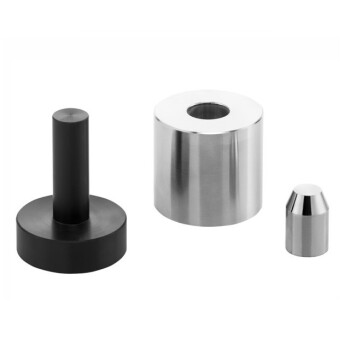
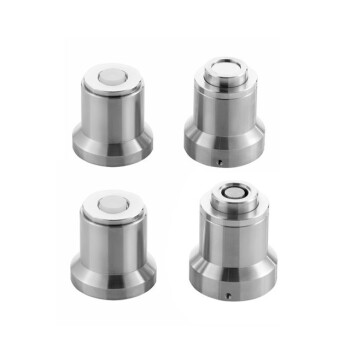
Standardized molding tools are essential for ensuring that every Geopolymer Landscape Concrete specimen possesses an identical geometric shape and volume. This physical uniformity is the baseline requirement for ensuring even stress distribution during compressive strength testing, which is critical for valid data.
Core Takeaway In materials science, physical consistency is the control that allows for chemical analysis. By standardizing the mold, you eliminate geometric variables, ensuring that any difference in strength is strictly due to the material composition—such as the ratio of aluminosilicate precursors or activators—rather than inconsistencies in the specimen's shape.
The Physics of Reliable Testing
Achieving Even Stress Distribution
To accurately measure compressive strength, the force applied to a specimen must be distributed evenly across its surface.
Standardized molds create perfectly flat, parallel surfaces that align correctly with testing equipment.
Without this geometric precision, stress concentrates in specific "hot spots," causing the specimen to fail prematurely and producing misleadingly low strength ratings.
Eliminating Calculation Errors
Mechanical property testing relies on mathematical formulas that assume a specific surface area.
For example, a standard paving block mold typically produces a compression area of exactly 200 cm² (20 cm x 10 cm).
If the mold varies, the actual area differs from the theoretical area used in calculations, rendering the resulting data mathematically incorrect.
Isolating Chemical Variables
Benchmarking Material Composition
The goal of geopolymer research is often to understand how specific ingredients affect performance.
Researchers need to assess the impact of variables like aluminosilicate precursors, activator types, or additives like sugarcane bagasse ash.
Standardization ensures that physical dimensions are a constant, not a variable.
Ensuring True Comparability
To claim that a new mix is stronger than a control group, the testing conditions must be identical.
Using standardized tools allows for a direct "apples-to-apples" comparison between control blocks and experimental composites.
This ensures that performance differences are attributed to the composite gel system, not the preparation method.
Common Pitfalls to Avoid
The Illusion of Consistency
A common error is assuming that "close enough" dimensions will yield accurate results.
Even minor geometric deviations can skew stress distribution significantly, introducing noise into your dataset that masks the true properties of the material.
Overlooking Mold Maintenance
Standardization is not a one-time event; molds can warp or degrade over time.
Using worn tools that no longer adhere to the standard dimensions (e.g., 20 cm x 10 cm x 8 cm) reintroduces the very variables you are trying to eliminate.
Making the Right Choice for Your Goal
To ensure your geopolymer research yields defensible, high-quality data, apply the following principles:
- If your primary focus is Academic Research: Prioritize mold precision to isolate the effects of chemical ratios and precursor types on mechanical properties.
- If your primary focus is Quality Control: Ensure strict adherence to dimensional standards to maintain comparability between production batches and control samples.
Standardization is not just about shaping the concrete; it is about shaping the credibility of your data.
Summary Table:
| Factor | Benefit of Standardization | Risk of Non-Standard Molds |
|---|---|---|
| Stress Distribution | Ensures uniform force across parallel surfaces | Creates "hot spots" causing premature failure |
| Data Accuracy | Precise area (e.g., 200 cm²) for exact calculations | Geometric deviations lead to mathematical errors |
| Material Benchmarking | Isolates chemical variables (precursors/activators) | Physical inconsistencies mask true material properties |
| Comparability | Enables valid "apples-to-apples" comparisons | Introduces noise that invalidates experimental results |
Precision is the Foundation of Materials Science
At KINTEK, we understand that the integrity of your research depends on the precision of your equipment. As specialists in comprehensive laboratory pressing solutions, we offer a wide range of manual, automatic, heated, and multifunctional models, including cold and warm isostatic presses designed for advanced battery research and composite material development.
Whether you are refining aluminosilicate precursors or testing new geopolymer binders, our high-performance tools ensure your specimens meet the most rigorous standards for repeatability and accuracy. Don’t let geometric variables compromise your data—contact us today to find the perfect molding and pressing solution for your lab!
References
- Jun Zhang, Jiandong Huang. Prediction of Compressive Strength of Geopolymer Concrete Landscape Design: Application of the Novel Hybrid RF–GWO–XGBoost Algorithm. DOI: 10.3390/buildings14030591
This article is also based on technical information from Kintek Solution Knowledge Base .
Related Products
- Lab Ball Press Mold
- Lab Isostatic Pressing Molds for Isostatic Molding
- Lab Infrared Press Mold for No Demolding
- Lab Round Bidirectional Press Mold
- Lab Cylindrical Press Mold with Scale
People Also Ask
- What is the purpose of incorporating cartridge heaters into a lab press mold for MLCC block compression? Optimize Results
- What are the requirements for pressing molds when using SSCG? Key Materials for Complex Single Crystal Production
- How do the design and geometric precision of pressing molds and mandrels affect the quality of PTFE composite samples?
- How does the geometry of laboratory molds influence mycelium-based composites? Optimize Density and Strength
- What role do precision positioning and pressure molds play in single-lap joints? Ensure 100% Data Integrity