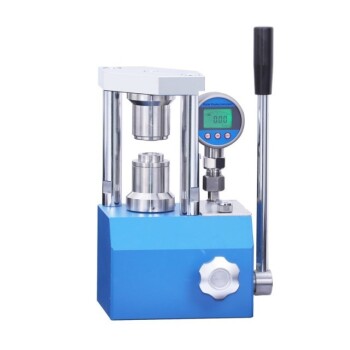
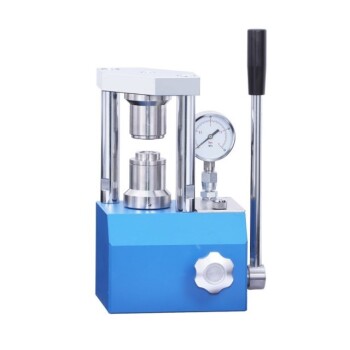
The application of constant stack pressure via high-precision equipment is essential to counteract the inherent lack of fluidity in solid-state materials. unlike liquid electrolytes, solid components cannot self-repair gaps caused by volume changes during operation. Precision pressing forces the electrolyte and electrodes into tight physical contact, managing lithium volume fluctuations and preventing the formation of performance-killing voids.
High-precision pressure acts as a mechanical substitute for chemical fluidity. It actively compensates for volume expansion and contraction during cycling to maintain a low-impedance interface, inhibiting dendrite penetration and preventing the physical delamination that leads to battery failure.
Managing Dynamic Volume Changes
Argyrodite solid-state batteries face a unique mechanical challenge: the internal components change size and shape significantly during operation.
The Lithium Stripping Challenge
During the discharge process (stripping), lithium moves from the anode to the cathode, effectively reducing the volume of the anode layer. Without external pressure, this loss of material creates physical gaps or "voids" at the interface. High-precision pressure collapses these potential voids immediately, maintaining the conductive pathway.
Cathode Expansion and Contraction
The challenge is not limited to the anode; cathode particles also undergo expansion and contraction during cycling. Because solid electrolytes lack fluidity, they cannot flow to fill the spaces created when the cathode contracts. Constant stack pressure ensures the electrolyte remains pressed against the cathode particles despite these dimensional shifts.
Ensuring Interfacial Integrity
The primary failure mode in solid-state batteries is often the loss of contact between layers, resulting in high resistance.
Eliminating Interfacial Voids
Micro-cracks and voids at the electrode-electrolyte interface sever the ionic connection. High-precision pressing equipment applies uniform force to inhibit the formation of these defects. This mechanical constraint is the only barrier against physical separation in a solid-state system.
Reducing Interfacial Impedance
For ions to move efficiently, the solid-solid interface must be seamless. Pressure forces the deformable electrolyte into the microscopic pores of the electrode material. This maximizes the active contact area, drastically reducing interfacial impedance and enabling efficient ion transport.
Safety and Dendrite Suppression
Beyond performance, stack pressure is a critical safety parameter in argyrodite batteries.
Blocking Vertical Penetration
Lithium dendrites (needle-like structures) tend to grow through the electrolyte, potentially causing short circuits. Sufficient mechanical pressure increases the density of the electrolyte layer. This acts as a physical barrier that makes it difficult for dendrites to penetrate vertically toward the cathode.
Guiding Lateral Growth
Precision pressure influences the direction of lithium deposition. By constraining vertical growth, the pressure guides lithium to expand laterally (sideways). This results in a safer, more uniform deposition layer rather than dangerous spikes that threaten the cell's integrity.
Understanding the Trade-offs
While pressure is vital, the application of force must be precise; "more" is not always "better."
The Risk of Over-Pressurization
Applying excessive pressure can be detrimental to the battery chemistry. Thermodynamic analysis suggests that exceeding certain thresholds (often around 100 MPa) can induce unwanted phase changes in the materials. This can degrade the electrolyte's properties and actually harm performance.
Mechanical Complexity
Maintaining constant pressure adds weight and complexity to the battery pack design. The fixtures or hydraulic systems used in the lab must eventually be translated into practical packaging solutions. This requires balancing the need for pressure with the need for energy density and compact design.
Making the Right Choice for Your Assembly Process
Selecting the correct pressure parameters requires aligning your assembly protocols with your specific performance targets.
- If your primary focus is cycle life: Prioritize systems that maintain constant pressure to continuously suppress void formation during repeated stripping/plating cycles.
- If your primary focus is high current density: Ensure pressure is sufficient to maximize surface contact area, reducing the charge transfer resistance that bottlenecks high-rate performance.
- If your primary focus is safety: Calibrate pressure to the upper limit of material tolerance to maximize the mechanical barrier against dendrite propagation.
Precision pressure is not merely an assembly step; it is an active, structural component essential for the battery's electrochemical survival.
Summary Table:
| Key Benefit | Mechanical Role | Impact on Battery Performance |
|---|---|---|
| Void Management | Collapses gaps during lithium stripping | Maintains low interfacial impedance |
| Interfacial Integrity | Forces solid-solid physical contact | Enables efficient ion transport across layers |
| Dendrite Suppression | Increases electrolyte density | Prevents vertical penetration and short circuits |
| Dynamic Compensation | Counteracts cathode volume changes | Ensures long-term cycle stability and safety |
| Precision Control | Avoids over-pressurization (>100 MPa) | Prevents unwanted material phase changes |
Elevate Your Solid-State Battery Research with KINTEK
Precise pressure control is the difference between a failing prototype and a high-performance solid-state cell. KINTEK specializes in comprehensive laboratory pressing solutions designed specifically for the rigorous demands of battery research.
Whether you require manual, automatic, heated, or multifunctional models, our equipment provides the high-precision constant stack pressure needed to manage argyrodite volume changes and inhibit dendrite growth. We also offer glovebox-compatible systems and isostatic presses (CIP/WIP) to ensure seamless integration into your specialized assembly environment.
Ready to optimize your interfacial integrity? Contact our laboratory specialists today to find the perfect pressing solution for your research goals.
References
- Berhanu Degagsa Dandena, Bing‐Joe Hwang. Review of interface issues in Li–argyrodite-based solid-state Li–metal batteries. DOI: 10.1039/d5eb00101c
This article is also based on technical information from Kintek Solution Knowledge Base .
Related Products
- Warm Isostatic Press for Solid State Battery Research Warm Isostatic Press
- Laboratory Hydraulic Press Lab Pellet Press Button Battery Press
- Lab Infrared Press Mold for Laboratory Applications
- Button Battery Sealing Press Machine for Lab
- Lab Button Battery Tablet Press Sealing Mold
People Also Ask
- Why must composite cathodes be sealed in vacuum lamination bags for WIP? Ensure Battery Stability and Density
- How do sacrificial volume materials (SVM) maintain microchannels in isostatic pressing? Ensure Structural Integrity
- What is the function of elastic molds in warm isostatic pressing? Achieve Uniform Density in Composite Particles
- What is the significance of temperature control in Warm Isostatic Pressing? Unlock Uniform Densification and Process Stability
- What is the function of hydraulic pressure in warm isostatic pressing? Achieve Uniform Material Density