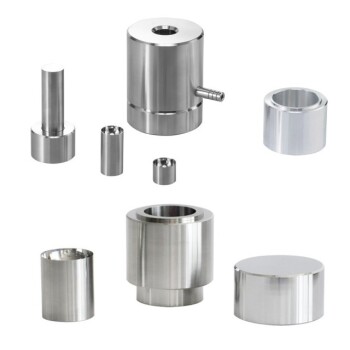
The intentional gap between the mold and the material acts as the primary driver for internal structural refinement. By designing the inner diameter of the high-purity graphite mold to be significantly larger than the initial Ruthenium green compact, engineers create the necessary physical space for radial flow. This specific allowance is what transforms simple axial pressure into a complex shaping process, ensuring the final target meets critical density and texture requirements.
By providing space for the material to expand from a column to a disk, the mold design facilitates restricted plastic deformation. This movement is mechanically necessary to forcibly close internal pores and align the material’s grain structure into a specific (002) orientation.
The Mechanics of Radial Flow
Creating Space for Deformation
In vacuum hot pressing, the relationship between the mold and the compact is not about a tight fit; it is about controlled expansion. The graphite mold must be designed with an inner diameter significantly larger than the Ruthenium green compact.
The Shape Transition
This extra space allows the material to undergo a drastic geometric change. Under axial pressure, the Ruthenium transitions from a tall, narrow "columnar" shape into a flatter, wider "disk" shape.
Facilitating Plastic Flow
This transition is not merely cosmetic; it represents significant plastic deformation. The mold design ensures that the material actually flows outward rather than just being compressed downward.
Achieving Structural Integrity
Forcing Pore Closure
The radial flow generated by the mold's geometry is the mechanism responsible for eliminating voids. As the material deforms and spreads into the empty space, internal pores are mechanically forced to close.
Near-Full Densification
Without this lateral movement, the material might remain porous even under high pressure. The designed gap ensures the deformation is sufficient to achieve near-full densification, a critical metric for target quality.
Optimizing Microstructure
Inducing Grain Texture
Beyond simple density, the flow pattern dictates the crystallographic alignment of the metal. The plastic deformation facilitated by the mold induces a strong (002) grain texture within the Ruthenium.
Enhancing Material Properties
This specific texture is often a requirement for high-performance applications. The mold geometry effectively programs this microstructure into the target during the pressing cycle.
Understanding the Trade-offs
The Importance of "Restricted" Deformation
While flow is necessary, the process is described as "restricted plastic deformation." The mold eventually limits the expansion.
Calculating the Expansion Limit
If the mold diameter is too small, the material creates a disk too early, preventing sufficient flow to close pores or align grains. Conversely, the geometry must still constrain the final shape to ensure the material forms a usable target.
Making the Right Choice for Your Goal
To optimize the quality of Ruthenium targets, consider how the mold dimensions influence the final material properties.
- If your primary focus is Maximum Density: Ensure the mold diameter creates a large enough gap to allow significant radial flow, which is required to mechanically squeeze out internal pores.
- If your primary focus is Microstructural Alignment: Prioritize a design that forces a complete transition from columnar to disk shape, as this heavy deformation is what induces the desired (002) grain texture.
Correct mold geometry turns static pressure into a dynamic forming process that dictates the ultimate performance of the Ruthenium target.
Summary Table:
| Design Factor | Impact on Ruthenium Target | Key Benefit |
|---|---|---|
| Intentional Gap | Facilitates radial flow from column to disk | Enables restricted plastic deformation |
| Internal Space | Mechanically forces closure of internal voids | Achieves near-full densification |
| Geometry Control | Directs crystallographic alignment | Induces strong (002) grain texture |
| Restricted Flow | Constrains final shape after deformation | Ensures structural integrity and dimensions |
Elevate Your Material Research with KINTEK's Precision Solutions
At KINTEK, we understand that the perfect target requires more than just pressure—it requires precision engineering. Whether you are developing high-performance Ruthenium targets or advancing battery research, our comprehensive laboratory pressing solutions are designed to meet your exact specifications.
Our expertise includes:
- Manual and Automatic Presses for versatile lab applications.
- Heated and Multifunctional models for complex material synthesis.
- Glovebox-compatible systems for sensitive environments.
- Advanced Cold and Warm Isostatic Presses for superior densification.
Ready to optimize your material properties and achieve unmatched microstructural alignment? Contact us today to find the perfect pressing solution for your lab!
References
- Shaohong Liu, Xudong Sun. Hot-Pressing Deformation Yields Fine-Grained, Highly Dense and (002) Textured Ru Targets. DOI: 10.3390/ma16206621
This article is also based on technical information from Kintek Solution Knowledge Base .
Related Products
- Lab Heat Press Special Mold
- Special Shape Lab Press Mold for Laboratory Applications
- Lab Anti-Cracking Press Mold
- Square Lab Press Mold for Laboratory Use
- XRF KBR Plastic Ring Lab Powder Pellet Pressing Mold for FTIR
People Also Ask
- How is a laboratory heat press used to evaluate bio-based aliphatic polyesters? Prepare Reliable Samples for Analysis
- How is a laboratory heat press utilized in MEA preparation? Achieve High-Efficiency Iron-Chromium Redox Flow Batteries
- Why is a laboratory heat press necessary for biodegradable films? Unlock Precision Bonding and Barrier Performance
- What is the purpose of incorporating cartridge heaters into a lab press mold for MLCC block compression? Optimize Results
- What is the significance of pressure and temperature control in a laboratory heated press for ZIF-8/NF coatings?