
The rate of pressurization and depressurization acts as the primary control mechanism for the structural integrity of a Cold Isostatic Pressed (CIP) component. Maintaining a strictly controlled velocity during these phases is essential to ensure uniform compaction and prevent catastrophic defects in the final product. Rapid or erratic pressure changes frequently lead to uneven density distribution and significant structural weaknesses within the material.
Core Insight: In Cold Isostatic Pressing, the speed of pressure application and release is just as critical as the maximum pressure achieved. A controlled rate is the only way to ensure the internal uniformity required for predictable shrinkage during subsequent sintering.
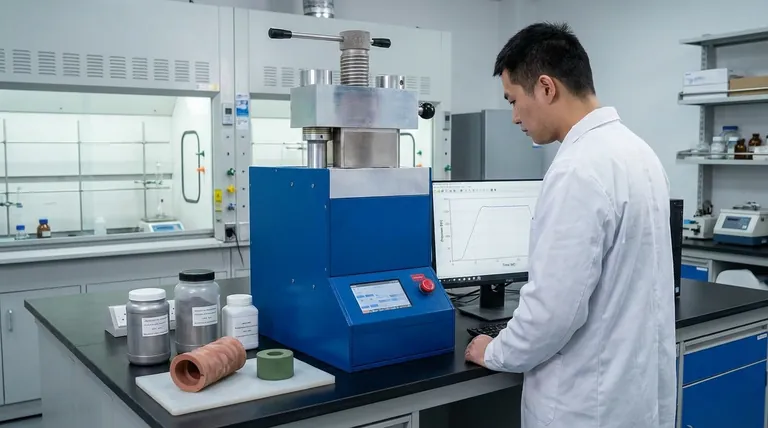
The Mechanics of Density Distribution
Achieving Uniform Compaction
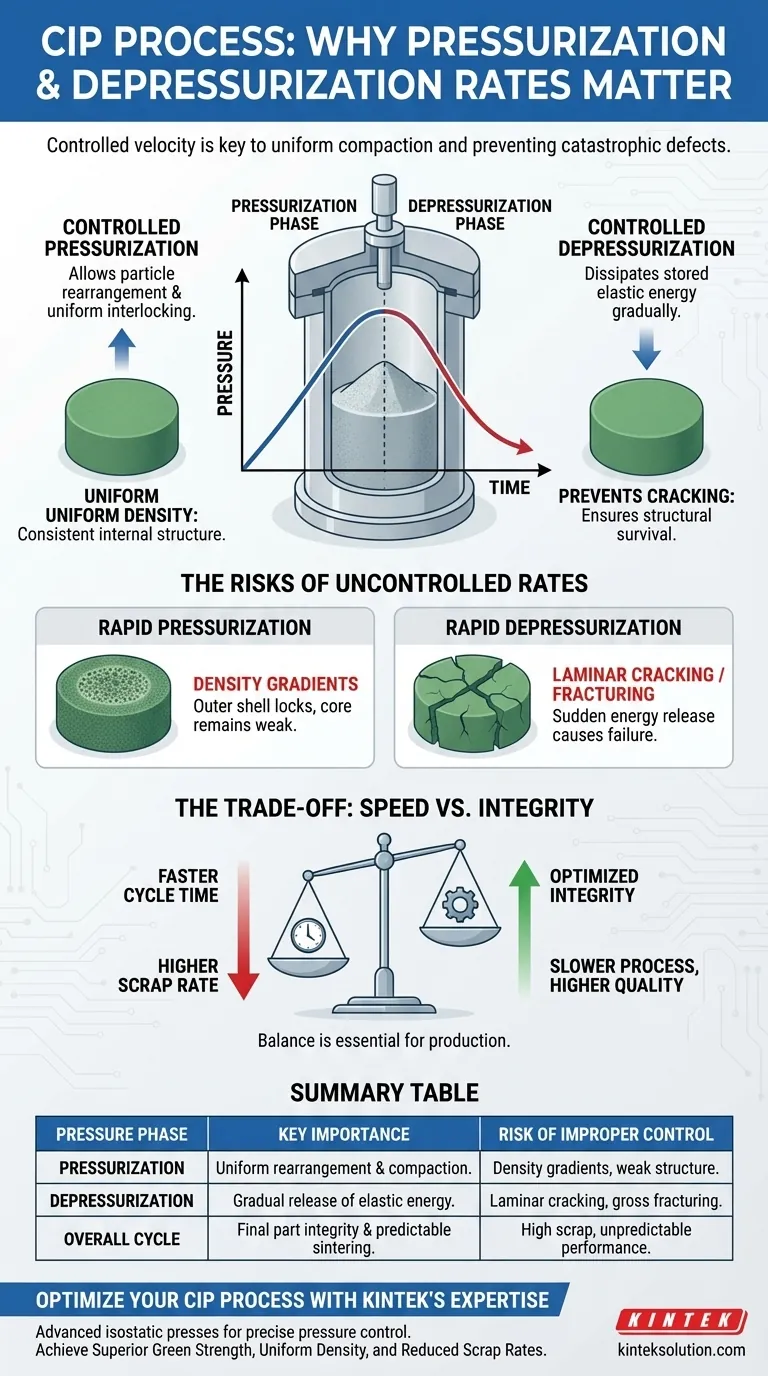
The primary goal of CIP is to transform loose powder into a solid "green body" with uniform density. By controlling the pressurization rate, you allow the powder particles sufficient time to rearrange and interlock tightly. This creates a consistent internal structure that is difficult to achieve with rapid, uncontrolled compression.
Preventing Density Gradients
If pressure is applied too quickly, the outer layers of the material may lock into place before the core is fully compacted. This creates a density gradient, where the surface is hard but the interior remains porous or weak. Reference data indicates that avoiding these gradients is key to minimizing mechanical scatter and improving green strength.
The Risks of Rapid Pressure Changes
Structural Weaknesses
The depressurization phase is the most critical moment for the structural survival of the part. Releasing pressure too rapidly does not allow the stored elastic energy in the compacted part to dissipate gradually. This sudden release often causes laminar cracking or gross fracturing, rendering the part useless.
Impact on Sintering
Defects introduced during the pressure cycle are rarely fixable; they are typically amplified during firing. A green body with uneven density will shrink unpredictably during sintering or Hot Isostatic Pressing. Controlled rates ensure that shrinkage remains uniform, allowing for the formation of complex, near-net shapes.
System Dependencies
The Role of Flexible Tooling
CIP relies on flexible molds made from elastomers like urethane or rubber to transmit pressure from fluids like oil or water. The rate of pressure change must be compatible with the elasticity of the mold material. If the rate is too aggressive, the mold may not deform uniformly, leading to geometric distortions in the powder compact.
Powder Quality Interaction
The ideal pressure rate often depends on the specific characteristics of the powder being consolidated. High-quality powder and optimized tooling design work in tandem with pressure controls to ensure integrity. Materials ranging from ceramics to graphite require specific protocols to maintain their properties under pressures up to 100,000 psi (roughly 690 MPa).
Understanding the Trade-offs
Cycle Time vs. Part Integrity
The most significant trade-off in CIP is the balance between production speed and part quality. Slowing down the pressurization and depressurization steps significantly increases the total cycle time, reducing throughput. However, attempting to speed up the process to save time directly increases the scrap rate due to cracking and non-uniformity.
Capital and Labor Investment
Implementing precise rate controls requires sophisticated, often expensive equipment capable of managing pressures up to 150,000 psi. It also necessitates skilled labor to program and monitor these cycles effectively. While the initial investment is high, it is offset by the reduction in scrap loss and the ability to machine green bodies prior to firing.
Making the Right Choice for Your Goal
To optimize your Cold Isostatic Pressing process, you must align your pressure rates with your specific material requirements and production targets.
- If your primary focus is complex geometries: Prioritize a slow, gradual depressurization rate to prevent cracking in intricate features and ensure uniform shrinkage.
- If your primary focus is high-volume production: Optimize the cycle by finding the maximum safe pressurization speed that does not compromise density uniformity, accepting that some material limitations may apply.
- If your primary focus is material performance: maintain conservative ramp rates to maximize green strength and corrosion resistance, particularly for critical aerospace or medical applications.
Mastering the rate of pressure change is the difference between a pile of loose powder and a high-performance component.
Summary Table:
| Pressure Phase | Key Importance | Risk of Improper Control |
|---|---|---|
| Pressurization | Ensures uniform particle rearrangement and compaction. | Creates density gradients and weak internal structures. |
| Depressurization | Allows gradual release of elastic energy, preventing cracking. | Causes laminar cracking or gross fracturing of the green body. |
| Overall Cycle | Determines final part integrity and predictable sintering shrinkage. | Leads to high scrap rates and unpredictable material performance. |
Optimize Your CIP Process with KINTEK's Expertise
Are you struggling with cracking, uneven density, or unpredictable shrinkage in your Cold Isostatic Pressed components? The precise control of pressurization and depressurization rates is often the solution.
KINTEK specializes in advanced lab press machines, including isostatic presses designed for exacting pressure control. Our equipment and expertise help laboratories and manufacturers serving aerospace, medical, and advanced ceramics industries achieve:
- Superior Green Strength: Minimize defects and maximize part integrity.
- Uniform Density: Ensure consistent material properties and predictable sintering.
- Reduced Scrap Rates: Save on material costs and improve production efficiency.
Let us help you master the critical variables of your CIP process. Contact KINTEK today to discuss your specific material and production goals.
Visual Guide
Related Products
- Automatic Lab Cold Isostatic Pressing CIP Machine
- Electric Lab Cold Isostatic Press CIP Machine
- Electric Split Lab Cold Isostatic Pressing CIP Machine
- Manual Cold Isostatic Pressing CIP Machine Pellet Press
- Lab Isostatic Pressing Molds for Isostatic Molding
People Also Ask
- What are the key features of automated laboratory Cold Isostatic Press (CIP) systems? Achieve Precise, High-Pressure Powder Consolidation
- Why is an Isostatic Press (CIP) Necessary After Uniaxial Pressing? Achieve Transparency in Nd:Y2O3 Ceramics
- What is the primary function of a Cold Isostatic Press (CIP) in NASICON preparation? Achieve 96% Theoretical Density
- How does a Cold Isostatic Press (CIP) increase Bi-2223/Ag current density? Boost Superconductivity with Uniform Pressure
- How does a Cold Isostatic Press (CIP) facilitate the preparation of CaO-doped silicon carbide (SiC) green bodies?








